
Accountability vs ownership debates start after the miss, which is already too late. A harsher test works better: who actually made the call, and which belief made it look sensible at the time? If a team cannot answer those two questions, it has a decision problem, not an ownership one.
“We need people to own it” is what leaders say after a miss. I hear it after late projects and bad launches, and after the sort of post-mortem where everyone suddenly rediscovers their principles. The usual accountability versus ownership debate starts there too, which is already too late.
I use a harsher test. Who actually made the call, and which belief made it look sensible at the time? If a team cannot answer those two questions, it does not have an ownership problem. It has a decision problem. No one was watching for the signal that would have told them to stop. Ownership then becomes a mood and accountability becomes a search party. The meeting produces the usual office theatre and nobody leaves with an artefact worth keeping.
Accountability versus ownership is the distinction between being answerable for a decision or result and merely feeling committed to the work attached to it.
Accountability versus ownership is the wrong argument
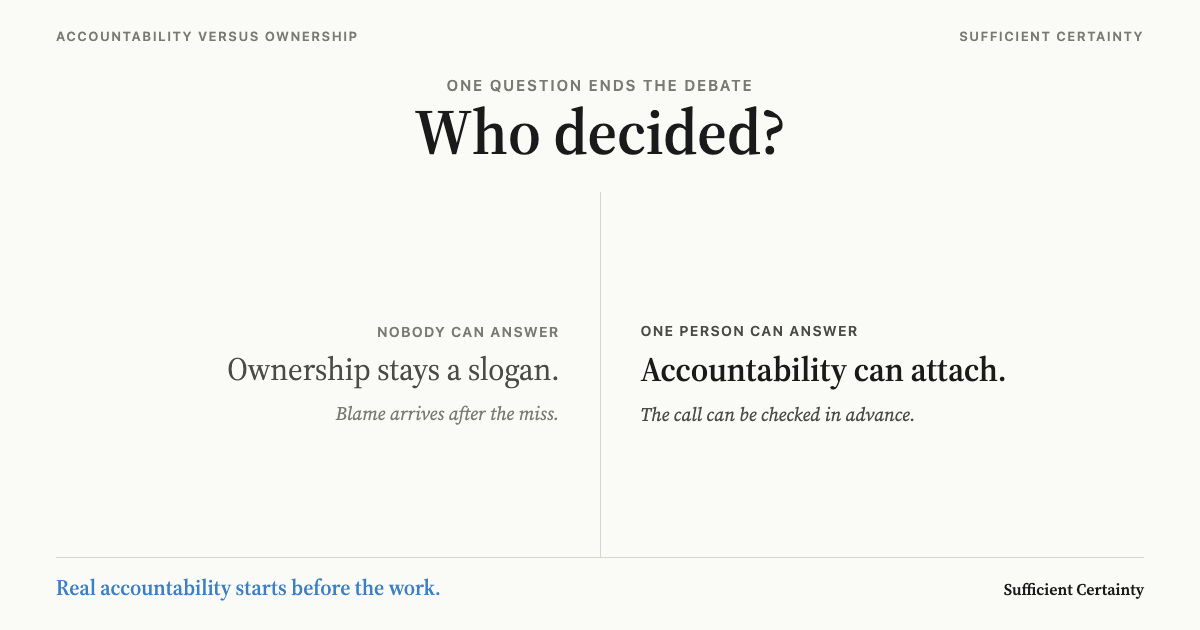
Most page-one articles say ownership is internal and accountability is external. That is thin. When something fails, can you point to the person who had authority to make the call and the assumptions that made the call look sensible? Can you then find a record of what was meant to happen next? If not, the language has failed the pub test. It sounds serious, but it does not help anybody decide better.
Ownership is an attractive word because it flatters people. It suggests pride and backbone. It also lets leaders sound demanding without demanding a method. If all I say is “own it”, I can look tough while leaving the machinery untouched. That is a good deal for the speaker. It is a rotten deal for the person who later gets asked why the plan failed. Without structure, ownership is just vibes with a deadline.
Take OceanGate. In its June 30, 2026 investigation report, the Transportation Safety Board of Canada found that the Titan submersible’s carbon-fibre hull properties were never properly validated and construction did not follow standard engineering practice. The acoustic warning system had not been shown to give enough warning either. Nobody at OceanGate lacked ownership. Ownership was practically part of the ticket price. What was missing was accountable structure around its assumptions, backed by proper testing. The company had commitment in abundance. What it did not have was a sound way to decide when its confidence had stopped being earned.
The same pattern turned up in Microsoft’s 2023 Exchange Online intrusion. The Cyber Safety Review Board report says 22 organisations and more than 500 individuals were affected, with about 60,000 emails taken from the U.S. State Department alone. The Board said the intrusion should never have occurred. A giant engineering organisation can talk about ownership all day. If nobody can say who accepted the control posture around critical keys and on what basis, the word is just costume jewellery. The telemetry gap made the breach invisible until it was too late.
Ownership is not a control system
Ownership does not replace decision structure, however energetic the team. It does not tell you who had the authority to proceed or which assumption, once tested by events, would force a rethink. For that, you need a method. In the Universal Decision-Making Method, I want the decision framed plainly before anybody starts congratulating themselves on their commitment. That is the core argument behind accountability in leadership.
This is where the story usually goes wrong. Leaders want a clean distinction. What they actually need is someone who can stop or reopen the call. Who is the Decider, and what exactly is being decided? Until those two questions are answered and recorded, ownership is a slogan. It sounds fine in a slide deck and does nothing when the work fails.
Silicon Valley Bank is a good example because it did not lack ambitious people. In the Federal Reserve’s April 28, 2023 review, the bank grew from $71 billion to more than $211 billion in assets between 2019 and 2021. The review says the full board did not receive adequate information from management and did not hold management accountable for effectively managing the firm’s risks. On March 9, 2023, the bank lost more than $40 billion in deposits. Plenty of executives owned growth. Very few could point to the interest-rate and deposit-stickiness assumptions that made that growth look sensible. Committees love ownership language because everybody can applaud it and nobody has to sign for the premise.
Most accountability frameworks map roles neatly enough. They do not make a single person the Decider whose reasoning is inspectable after things go wrong. Without that, the organisation is merely acting out accountability.
Name the decision behind your last miss and record who held the authority before ownership talk starts again. Start the Walk →
Accountability versus ownership starts before the work
Real accountability begins before action, not after disappointment. I want one person to frame the decision plainly and then decide it, rather than chair a committee about it. I want the live assumptions written down, and I want the monitoring designed before the work starts. Ownership without monitoring is only enthusiasm. That is also the argument underneath accountability vs responsibility: if nobody can see the reasoning, nobody can hold the Decider to account.
The February 2026 Chemical Safety Board report into the PEMEX Deer Park hydrogen sulphide release shows the difference in steel-toed boots. The report says about 27,000 pounds of hydrogen sulphide were released on October 10, 2024, and two contract workers were killed. Later procedures required both the equipment owner and the specific craftworker to sign blind-identification tags before opening equipment. Before those signatures, ownership existed as a general expectation. After them, accountability had an artefact. Somebody could point to who verified what, before the line was opened, not after the funerals and the forms.
This is why the accountability versus ownership distinction matters only if it changes how decisions are made. If it stays as a motivational contrast, nothing changes except the poster budget. A person can feel ownership for a plan that was based on lazy assumptions. Accountability asks a rougher question: who decided that those assumptions were good enough, and what were they watching once the work began?
How to run the next post-mortem without theatre
When something fails, always start upstream. Ask who made the call and what assumptions were doing the hidden work. If the answers are vague, do not prescribe more ownership. Prescribe better decision records. The point of a record is not to make life bureaucratic. It is to preserve the logic of the decision while the logic is still honest.
A decent record also separates a bad outcome from a bad decision. If the assumptions were visible and the reasoning was explicit, you can say the decision was sound even if reality bit you. If nothing was written down, the strongest personality in the room rewrites history and calls it accountability. Calling that governance flatters what is really just memory arranged by whoever talks last.
Roger Estall and I wrote Deciding because we had seen too many organisations confuse seriousness with paperwork. I still think the plain test is the best one. Can you point to the decision record and the assumptions inside it? If you can, ownership has somewhere useful to sit. If you cannot, the whole argument is just another blame ritual held after the horse has bolted and after somebody has already billed for the new stable manual.
How to assign accountability that outlasts the meeting
I once sat through a project review where accountability had been assigned so thoroughly that the RACI chart ran to four pages. Every deliverable had a name next to it. The governance pack was exemplary. Six months later the project was late, over budget, and the subject of a very long email chain in which everybody pointed at everybody else. Every name on the chart could prove they had done what was listed. Nobody could say what assumption the project was riding on or who was supposed to notice when it stopped being true.
That is how accountability becomes blame allocation after the fact. The names were assigned. The work behind the names was not. People knew they were accountable. They did not know what they were accountable for, which is a different problem dressed in the same language.
The distinction between accountability and ownership dissolves once you ask a simpler pair of questions. Who will know first when the assumption fails? And who will act? If nobody can answer either question at the point of commitment, the accountability is decorative. It will surface later, in the post-mortem, when nothing can change except the tone.
In that project, the critical assumption was straightforward: the vendor's platform would integrate with the legacy billing system inside the existing contract window. Nobody had tested that assumption before the board approved the spend. The project manager had flagged integration risk in the register, which earned her a green tick and changed nothing. The register captured the label. It did not name who was watching the integration timeline week by week, or what signal would force the sponsor back into the room to reopen the scope.
That is the gap I keep seeing. Accountability gets treated as a title when it should be treated as a monitoring obligation. You are not accountable for the outcome in some grand retrospective sense. You are accountable for watching the assumption that carries the decision and acting when the evidence turns. Monitoring is part of the decision, not an afterthought bolted on once the plan is approved.
When I work with teams on this, I ask them to do three things before the meeting ends. First, name the decision plainly. Not the project objective. The actual commitment: we are proceeding on the basis that this vendor will deliver integration by March, and if that assumption breaks, the business case breaks with it. Second, assign one person to watch that assumption, with a signal they can read without waiting for the next status report. Third, agree on what happens when the signal fires. Does the sponsor get called back? Does the scope change? If nobody has answered that question, the accountability is just a name on a chart waiting to be blamed.
That sequence is not bureaucracy. It is the method applied to the moment accountability is assigned. Frame the decision. Surface the assumption. Set the monitoring. It takes ten minutes if the room is honest about what the commitment depends on.
Most decision-rights frameworks get the authority part right and stop. They say who can make the call. They do not say who owns the signal that would reopen it. That second job is where accountability lives or dies. A name on a chart is a starting position. A name attached to a signal, a threshold, and a response is accountability that outlasts the meeting and still works when the facts turn against you.
You could praise ownership in the next post-mortem and still not know who decided.
Work through your decisionNo sign-up. Just pick your decision and start.
Grant Purdy is the co-author, with Roger Estall, of Deciding (2020), and the architect of the Universal Decision-Making Method.