
After an ESG assessment, put one planned ESG claim beside the assets and criteria that were actually assessed. In September 2024, the Federal Court ordered Vanguard Investments Australia to pay A$12.9 million for misleading ESG screening claims. ASIC's penalty announcement identified the Ethically Conscious Global Aggregate Bond Index Fund. The next decision needs evidence about the coverage behind the claim.
An ESG assessment examines environmental, social and governance information against stated criteria for a defined purpose and scope.
An ESG assessment supplies evidence for a stated use
The completed assessment may contain issuer research, an ESG rating or a set of exclusion screens. The next step is to decide what that evidence permits. An investment committee might use it when approving a fund against a mandate. A product owner might use it when approving a description of that fund.
Begin with the assessment's stated purpose. Find the methodology and the date of the underlying information. Identify which assets it covers. Then compare that coverage with the decision awaiting approval. Keep this comparison in the approval paper so the person deciding can inspect it.
Record missing coverage explicitly. A blank result should not silently become evidence that an issuer meets a criterion. Ask whether the gap reflects unavailable information or an asset outside the methodology. The answer determines what further evidence is useful.
Keep the assessed issuer separate from the security held when the methodology makes that distinction. Research on a parent company may leave a question about another issuing entity. Ask the assessment provider to explain the mapping. The table should show the answer before the findings are used to approve an exclusion claim.
This is an organisational governance task because someone must approve reliance on the findings. The report's author supplies analysis. The person approving the investment or statement decides whether the analysis supports that use.
Attach the intended use to the assessment before approving reliance on it.
What can the assessment say about investment fit?
ESG research can provide useful evidence about a company's exposure to particular issues. It can also explain how the company manages those issues. Read the provider's definition before interpreting a favourable result.
MSCI describes its ESG Ratings as measures of resilience to financially relevant, industry-specific sustainability risks and opportunities. Its ratings compare companies within an industry. That purpose differs from establishing that a fund excludes every issuer involved in a specified activity.
Use the findings to answer the question they were designed to address. Then check the separate requirement in the investment mandate. Research on financial exposure may help one decision while leaving an exclusion requirement unresolved. This distinction also explains why double materiality findings address a different reporting and management question.
The assessment can also identify where a focused question is needed. Use the detail behind the result to ask about a relevant exposure. Keep the response with the original research so the approver can trace the conclusion.
A favourable assessment needs a clear connection to the proposed investment. Checking that connection preserves the value of the research.
Which holdings still lack the evidence your ESG claim requires? Start the Walk →
The required evidence depends on the claim being made
Sufficient certainty means enough confidence to make the particular decision. It requires the approver to state what must be known before proceeding. An ESG score cannot set that requirement on the approver's behalf.
Separate a comparison from a claim of exclusion. Comparing researched companies may permit a stated coverage limit. Claiming that a product excludes a particular activity requires evidence about how the relevant screen covers its holdings. The same research can support the first statement while leaving the second unsupported.
Set the evidence requirement from the intended claim. Read its exact words beside the assessment's coverage. Words such as “all” require particular attention. Define the relevant assets and check whether any exceptions change the meaning of the statement.
ASIC's guidance on sustainability-related products asks issuers to explain their investment approach and its limitations clearly. It also asks whether the scope of screening criteria is clear. That is useful preparation for a claim review, rather than permission to rely on the label alone.
Specify how missing information will be treated before looking at the final result. Otherwise, an acceptable score may encourage the approver to overlook a missing condition. Record whether the gap prevents approval, requires a qualification or can be resolved through another source.
Give unresolved questions to someone who can examine the methodology. Ask what evidence would resolve the decision, rather than requesting another general ESG report. The amount of due diligence needed depends on what the approver needs to establish.
If essential coverage remains unknown, the proposed claim needs revision or further evidence. An investment decision may also need to wait when that gap concerns a mandatory condition.
Vanguard claims exceeded the screening coverage
The 2024 Federal Court judgment concerned claims about the Vanguard Ethically Conscious Global Aggregate Bond Index Fund. As at mid-February 2021, approximately 74% of its securities by market value were not researched or screened against applicable ESG criteria. This was a coverage measure, not an issuer count or a probability of investment loss.
The court distinguished the statements. Product Disclosure Statements and the website claimed screening of company securities, rather than all securities. The court accepted that narrower scope but still found those statements misleading. It characterised the media release, YouTube and FNN presentation claims as reckless. It did not apply that characterisation to the PDS and website claims.
No investor financial loss was demonstrated. The judgment records a trading halt and self-report after the Head of Risk became aware of the inaccuracies. It also records substantial compliance improvements. These are historical findings, not evidence of current noncompliance.
The case requires attention to the exact claim and the exact coverage. It does not establish that every ESG assessment is defective. Nor does missing screening itself establish that every unscreened asset would breach an exclusion.
For a reader reviewing a different product, the proposed check is a claim-to-evidence table. Put the intended wording in one column and the supporting coverage in another. Add a column for exceptions. This is a suggested application of the case, not a process the judgment says Vanguard used.
Have the research owner confirm the table against the underlying methodology. Have the person responsible for the statement check its wording against that table. These reviews answer different questions. A single approval of the score should not stand in for both.
A governance audit response can examine approval arrangements. Here, the immediate task is narrower: establish whether the assessment supports the decision awaiting approval.
Set the coverage needed before relying on the assessment
Take that table to the person who approves the investment or statement. Ask them to identify the coverage condition that must hold. Add the assessment date and a link to the evidence. Record any unresolved gap in words that the approver can understand.
The Universal Decision-Making Method provides a sequence for making that decision:
- Frame: state the investment purpose or the claim awaiting approval.
- Tentative Elements: identify the proposed use of the ESG findings.
- Assumptions: name any reliance on unverified coverage or criteria.
- Sufficient Certainty: agree on the evidence required to proceed.
- Implement+Monitor: assign responsibility for checking changes that could reopen approval.
Approval should state the limits of reliance as well as the decision. If the intended claim exceeds the evidence, narrow the wording or obtain the missing research. Keep the original mandate visible when considering a change; convenient wording must not quietly replace its requirements.
Name the person who will receive a coverage change from the provider. Specify where that person will record it and who can reopen approval. This turns the approval condition into an instruction that remains usable after the original meeting.
The same discipline applies to deciding when information is sufficient. Stop collecting reports once the necessary condition is supported. Reopen the decision if holdings or the screening methodology change in a way that removes that support.
The useful next step is a coverage check tied to a named approval. The assessment then contributes to a decision its evidence can support.
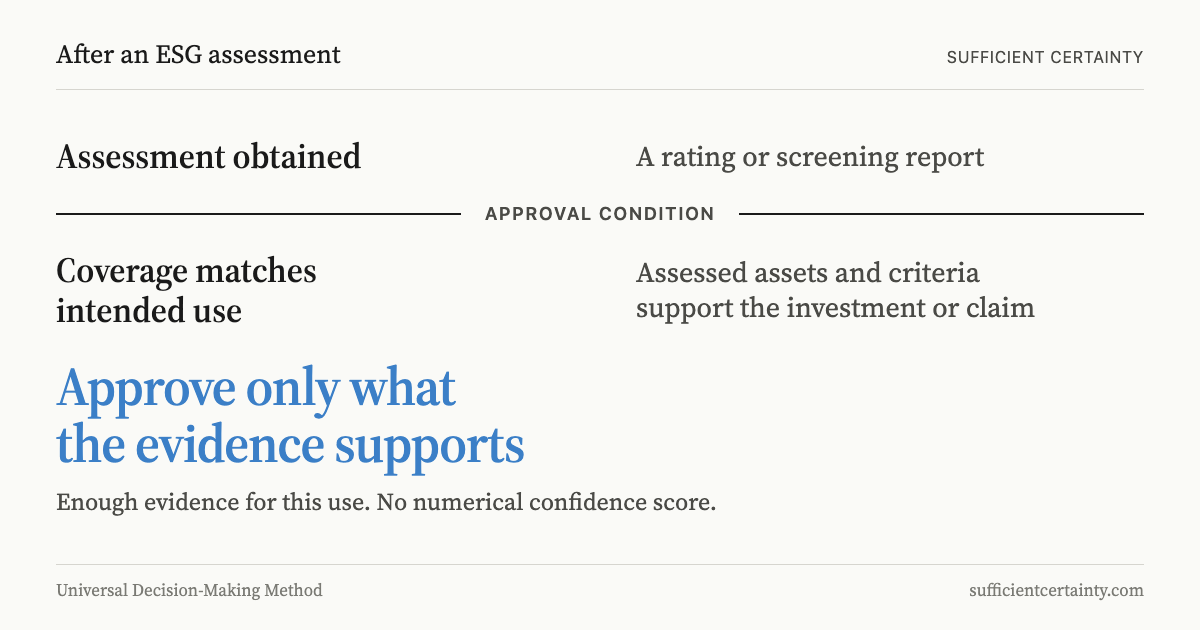
An ESG assessment can support a decision only when its coverage matches the use being approved.
Work through your decisionNo sign-up. Just pick your decision and start.
Grant Purdy is the co-author, with Roger Estall, of Deciding (2020), and the architect of the Universal Decision-Making Method.