
After an enforcement action, record the evidence that would require another investigation beside each corrective commitment. Paying a settlement can complete a legal task before the changed control has faced another transaction. Assign someone to check the control during normal work and bring unexplained results to the person who can act.
An enforcement action is a regulator's formal response to an alleged or established breach. Its terms determine the required response.
Assign the enforcement commitments to operating decisions
Start with the actual enforcement documents. Record the conduct they address, the required actions, the deadlines, and any continuing restrictions. Keep the wording and source location available. A management summary should help people carry out the terms without replacing the documents that define them.
Separate binding terms from the regulator's recommendations and the company's voluntary commitments. Those categories may require different approvals and evidence. The action register should show which category applies. A recommendation in a public notice does not automatically become a term of the company's settlement.
Connect each commitment to daily work. A new supplier check belongs beside the decision to approve an order. A payment restriction belongs beside the decision to release funds. A training commitment needs a clear connection to the tasks that employees are expected to perform differently.
Assign both a task owner and a person who can decide what happens when the task reveals a problem. The first may collect records. The second may need authority to pause an order, commission an investigation, or approve a revised control. The distinction between accountability and responsibility becomes practical at that handoff.
For sanctions matters, OFAC's Economic Sanctions Enforcement Guidelines include remedial response among the factors considered. That includes stopping the conduct and improving controls to prevent recurrence. Those factors do not turn a completed remediation task into proof about future transactions.
The chain below describes a possible sourcing failure. It is a proposed monitoring scenario, rather than a claim that these later events occurred at the company discussed below.
Preserve the link to the original conduct. Each task should state which part of that conduct it is meant to prevent. Otherwise, the register can fill with completed activities while leaving a decisive gap in the operating process.
An enforcement outcome defines specific obligations
A formal outcome can remove uncertainty about the response required for the matter it addresses. It can establish payment, reporting, corrective work, or limits on activity. The actual terms control which obligations apply. Read them before deciding that a general compliance program covers the response.
That gives management a concrete starting point. Teams can allocate work, preserve evidence, and track deadlines. They can also identify obligations that continue after the initial response. A payment date and an ongoing control requirement need different follow-up, even when they appear in the same register.
Track completion against the actual terms. Do not replace an agreed requirement with a convenient internal measure. If the terms require a particular report, a training attendance total is not an equivalent deliverable. If they require continuing checks, one completed inspection is not the whole task.
There is also a separate operating question: does the corrective work address the conditions that allowed the conduct? This is where governance and compliance intersect. Management must meet the formal obligations and decide what evidence is needed to rely on the changed process.
OFAC's Framework for OFAC Compliance Commitments includes testing and auditing among its five essential components. It recommends independent testing with adequate authority and resources. It also addresses changes in business activity and the sanctions environment. These are framework recommendations, not additional settlement terms for every company.
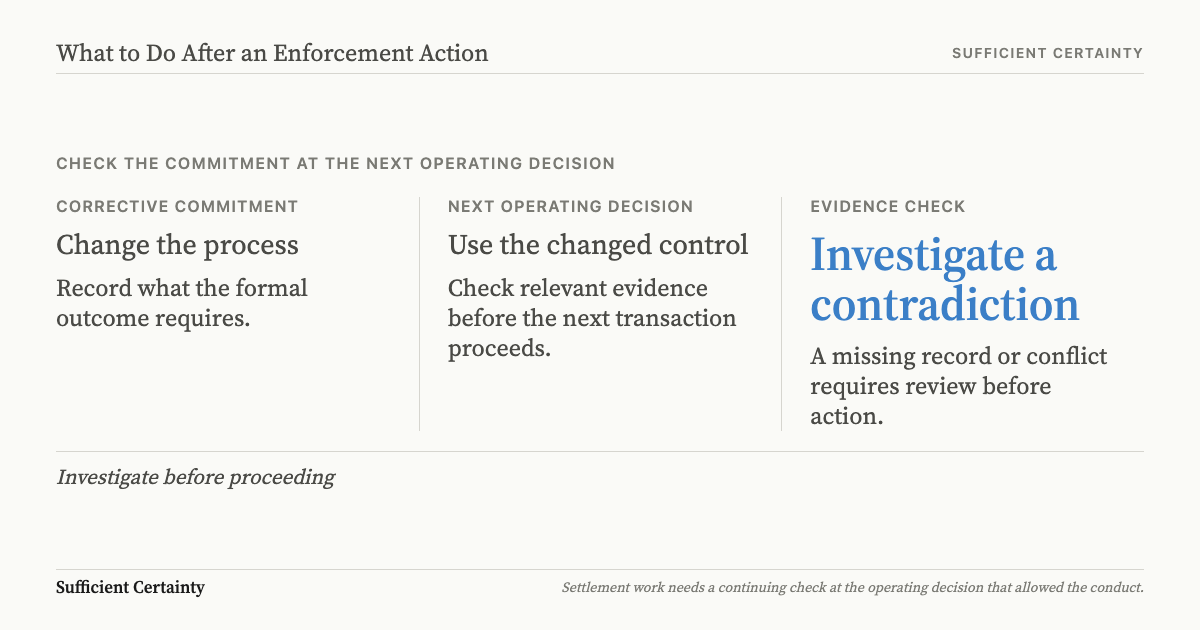
Check the process after implementation. A policy can be issued before employees have used it. A supplier certificate can be obtained before its claims have been compared with transaction records. Keep those distinctions in the evidence presented to management. After a supplier audit, check that remedies for findings about workers reached the people affected.
The formal outcome remains valuable. It makes the required response more specific. Monitoring extends that work into later decisions, when new suppliers, materials, staff, or payment arrangements may challenge the control.
Which new transaction would test whether the enforcement commitments prevent the same conduct? Start the Walk →
What would show the same breach returning?
Choose a signal tied to the conduct, rather than a generic measure of activity. For a sourcing failure, it could be conflicting material-origin records. For a payment failure, it could be a recipient that differs from the approved transaction. The signal should reach someone before the next consequential decision proceeds.
In January 2019, e.l.f. Cosmetics agreed to pay $996,080 to settle potential civil liability for 156 apparent sanctions violations. OFAC's enforcement notice concerned false eyelash kits imported from two Chinese suppliers during 2012–2017. The kits contained North Korean materials.
OFAC said supplier audits had failed to discover North Korean materials in approximately 80 percent of kits from those suppliers. It treated the matter as voluntarily self-disclosed and non-egregious. This was a civil settlement over apparent violations, rather than a criminal conviction.
The notice recorded ELF's reported corrective measures. These included country-of-origin audits, supplier compliance certificates, checks of payment information and bank statements, and training for employees and suppliers. They were company statements recorded by OFAC. The notice does not independently establish their lasting effectiveness.
The case shows why the scope of a check matters. A production review focused on product quality can leave a sourcing restriction unexamined. After an enforcement outcome, the follow-up must check the specific condition behind the conduct. This does not establish that ELF used the Universal Decision-Making Method.
Test the evidence behind a declaration. In a proposed sourcing follow-up, compare a supplier's statement with relevant material and transaction records. Decide how contradictions will be investigated. A certificate is useful evidence, but its existence alone does not resolve an unexplained difference.
A change in the supply chain should also prompt review. If production moves to a different subcontractor, the earlier origin check may no longer describe the goods being purchased. The work after a vendor risk assessment examines a related question: whether the assessed relationship still matches the actual arrangement.
Escalate a missing record as well. An overdue check or an inaccessible supplier record can leave the control untested. Define who investigates that gap, by when, and what happens to the pending decision. These are proposed operating practices, not a report of ELF's later monitoring.
From settlement work to recurring evidence checks
Build the monitoring record around the decision that could repeat the conduct. Name the condition that must hold, the evidence needed, the person collecting it, and the person acting on it. Record the check schedule and the observation that requires renewed investigation.
The Universal Decision-Making Method connects implementation with monitoring. Applied here, the aim is to keep corrective commitments useful when transactions resume. The method does not replace the enforcement terms or decide the legal meaning of a new fact.
The process below separates completed enforcement work from the evidence needed for the next operating decision. It is a proposed sequence for the reader's follow-up.
Make the response part of the check. A monitoring record should specify who can pause affected work and who reviews the new evidence. Route potential further breaches through the company's established legal and regulatory reporting process. Meet any applicable reporting requirement rather than waiting for a routine management meeting.
Use existing transaction records where they answer the question. Collect additional evidence when an important condition remains unresolved. A larger dashboard does not help if it omits the material origin, recipient, or approval that determines whether the transaction can proceed.
Set the review frequency according to the terms, the activity, and the consequence of missing a recurrence. Some evidence needs checking before each transaction. Other evidence can be reviewed periodically. A generic annual review should not delay a response to a contradiction already found.
Keep the record after the initial corrective tasks are complete. Changes in operations or external rules may require the decision to be reconsidered. This continuing use of monitoring makes the evidence relevant to the current process.
The organisational governance task is to keep authority, evidence, and action connected. Management should be able to see which commitments are complete, which checks are overdue, and which operating decisions require review. A formal outcome answers one matter. Continuing evidence helps prevent that matter from returning through the next decision.
An enforcement settlement addresses a particular matter; the next operating decision still needs evidence that the corrective controls work.
Work through your decisionNo sign-up. Just pick your decision and start.
Grant Purdy is the co-author, with Roger Estall, of Deciding (2020), and the architect of the Universal Decision-Making Method.