
After an external audit, write down the cash condition that must hold before approving the next commitment. Cineworld's 2021 annual report contained an unmodified audit opinion alongside an explicit warning about material going-concern uncertainty. The opinion and the warning addressed different questions.
For a board or finance director, the next task is to connect that warning to an actual spending decision. Confidence in the financial statements does not establish how much cash a new commitment can safely consume. The evidence needed for that commitment must be stated separately.
An external audit is an independent examination that supports an opinion on whether financial statements meet the applicable reporting requirements.
Cineworld disclosed uncertainty beside an unmodified opinion
In its 2021 annual report, pages 84–85, Cineworld published PwC's opinion on its financial statements. PwC considered the directors' use of going-concern accounting appropriate. It also reported material uncertainty that could cast significant doubt on continued operation. This was an unmodified opinion with a warning, not a qualified opinion.
The forecast depended on admissions recovering. The base case expected enough cash to reduce the revolving credit facility before a covenant test. A covenant is a condition attached to borrowing. The report said refinancing was likely to be needed. Its downside scenario could breach borrowing conditions. The audit report identified the uncertainty rather than removing it.
Cineworld later reported in its 2022 interim results that the group and certain subsidiaries began Chapter 11 cases on 7 September 2022. That later event does not establish that a particular spending check would have prevented restructuring. Nor does it establish that PwC should have modified its opinion. The original warning was already explicit.
The useful question for a reader is narrower. What would a new cash commitment require to be true? The following approach is a proposed application for a board or finance owner. It is not an account of how Cineworld approved particular commitments. Start with the cash obligation under review, including when payment becomes unavoidable.
Then name the dependency between that obligation and available cash. If approval relies on a lender's agreement, distinguish a signed agreement from an expected agreement. If it relies on trading recovery, identify the receipts needed before payments fall due. An audited historical balance cannot settle either condition by itself. Evidence for the commitment must address its timing.
A cash forecast can help, provided its starting position is current. Ask which expected receipts have become actual receipts since the report. Check whether funds can be used by the entity making the payment. An available balance elsewhere in a group may require further permission or a transfer. These are questions for the reader's own decision, not additional findings about Cineworld.
The same distinction applies when the audit contains no going-concern warning. Identify what the opinion covers before using it to support a commitment. The financial-audit discussion examines problems with audit evidence. Here, the starting point is different: the auditor disclosed uncertainty. Management still needs to decide what that uncertainty means for the proposed payment.
Keep expected financing separate from confirmed financing in the approval paper. Show when confirmation is required for this commitment, rather than treating all funding discussions as equivalent. A director should be able to trace the proposed payment to its supporting evidence without inferring that connection from the annual report.
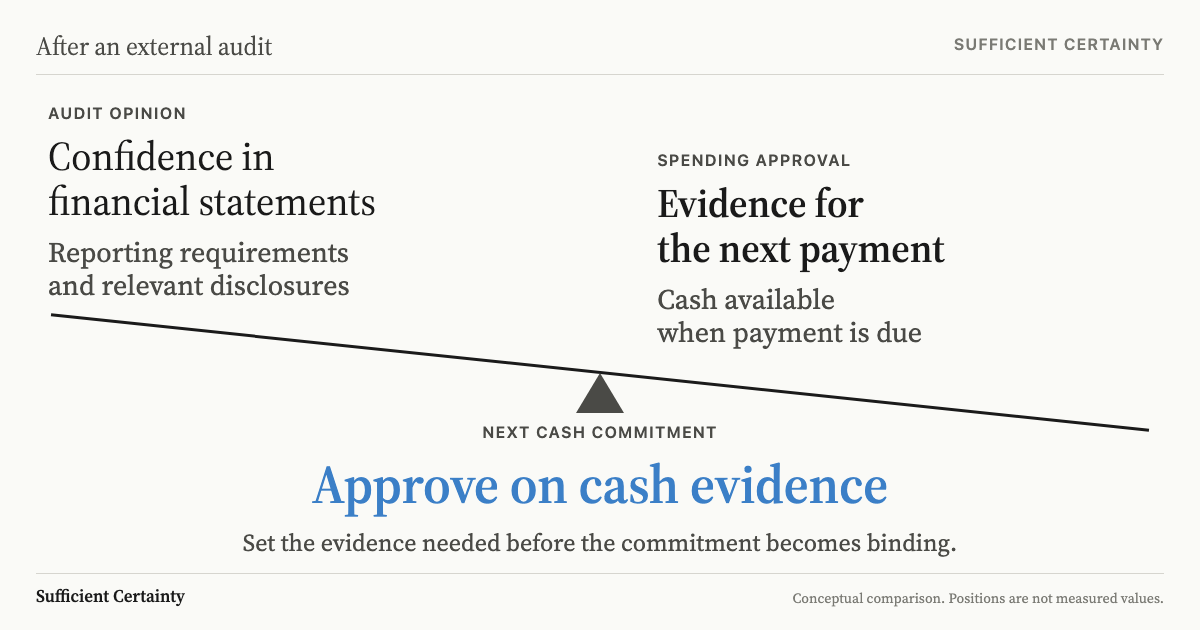
A board paper should preserve both conclusions. Record the opinion accurately, then state the current cash condition awaiting confirmation. Combining them into a general claim that the audit was satisfactory leaves the approver without the evidence needed for the commitment. This is a practical responsibility within organisational governance.
Turn the audit’s cash uncertainty into an evidence threshold for the commitment awaiting approval. Start the Walk →
What does an external audit opinion establish?
An audit provides independent scrutiny of financial reporting. The Financial Reporting Council's explanation of auditor responsibilities describes reasonable assurance as a high level of assurance about material misstatement. It is not a guarantee that every material misstatement will be detected. An unmodified opinion concerns the financial statements and their reporting requirements.
This gives the board useful evidence. It supports reliance on reported figures within the opinion's scope. Auditors also evaluate the accounting basis and relevant disclosures. The work can make important dependencies visible. Respecting the opinion's limits makes it more useful. Replacing a specific conclusion with a broad claim of safety makes it harder to use.
Going-concern reporting illustrates that distinction. The UK going-concern standard, paragraph 22, requires an unmodified opinion when material uncertainty is appropriately disclosed. A separate section draws attention to that uncertainty. The standard also explains that future events can cause an entity to cease operating. These statements are consistent with each other.
For the next commitment, the board needs a different conclusion: whether there is sufficient certainty to act on its cash assumptions. This does not mean repeating the audit. It means deciding what evidence is enough for the proposed action, given the consequences of being wrong. The discussion of having enough information to decide develops that judgment.
The evidence threshold changes with the commitment. A payment that cannot be recovered calls for stronger support than an arrangement that can be stopped before further cash leaves. State the cancellation terms in the approval paper. Also state how much cash becomes committed before the next review. Otherwise, a promise to monitor may arrive too late to affect the decision.
Approval needs a stated evidence threshold. Agreement that a forecast looks reasonable is too vague. Specify the condition the evidence must support and the uncertainty the approver accepts. This allows the finance owner to show why the commitment is affordable without claiming certainty about the whole business.
Set the evidence needed before the next cash commitment
Keep the approval note focused on the decision being made. Name the obligation and when it becomes binding. Then write the assumption that could change approval if it proves wrong. The work on surfacing assumptions helps separate a confirmed condition from an expectation. Avoid copying every audit observation into a new register.
Give the finance owner a clear evidence request. If affordability depends on borrowing, ask for the available facility and the conditions governing access. If the commitment depends on receipts, ask for the updated cash position against payment dates. Evidence should support the named dependency directly. A general statement that funding discussions are progressing does not establish that cash is available.
Record the result against the threshold before seeking approval. If support is insufficient, specify what is missing. The approver can seek confirmation or change the commitment so it relies less on the uncertain condition. Holding approval is also a possible decision. An audit's completion date does not create a deadline to spend.
The Universal Decision-Making Method connects assumptions to sufficient certainty before action. Applied here, it asks the approver to justify reliance on the cash condition for the actual commitment. It does not turn the audit opinion into a forecast or prescribe a universal cash buffer.
Assign a manager to check the condition again before the next irreversible payment. Define what change would reopen approval. Link the review to evidence the manager can obtain, and give that manager authority to raise the issue promptly. The guidance on monitoring decisions explains why observation must lead to reconsideration.
Make the decision record understandable to a director who did not attend the audit meeting. Include the evidence date and identify who can confirm that it remains current. Record any limits on approval, especially conditions that must be met before funds are released. If a condition is still uncertain, explain why the accepted uncertainty is sufficient for this commitment. A clear record makes a later change easier to assess without rewriting the earlier audit conclusion.
The review must occur while the commitment can still change. At that review, compare new evidence with the approval condition. If the condition no longer holds, return the decision to the approver. Keep the audit conclusion intact, but update the management decision when its supporting cash evidence changes.
You could accept an unmodified opinion and still leave the cash condition behind your next commitment untested.
Work through your decisionNo sign-up. Just pick your decision and start.
Grant Purdy is the co-author, with Roger Estall, of Deciding (2020), and the architect of the Universal Decision-Making Method.