
After a fire risk assessment, compare the evacuation plan with the people who use the building. On 31 January 2004, a fire at Rosepark Care Home killed fourteen residents. The later inquiry examined an assessment that had neither described their protection adequately nor led management to act.
The next decision concerns whether the precautions can protect the people who depend on them. A completed report can help identify weaknesses. It cannot establish that a door will close or that enough trained staff can carry out the evacuation plan.
A fire risk assessment examines how fire could harm people and whether the precautions and management arrangements can protect them.
Rosepark exposed weaknesses in the fire precautions
Ten residents died at the scene. Four died later in hospital. Sheriff Principal Brian Lockhart published the Fatal Accident Inquiry determination in April 2011. The determination describes several failures affecting fire prevention and the response. Its assessment findings matter because they connect a document with the actual demands of protecting dependent residents.
Management had engaged James Reid to produce an assessment. The sheriff found that document unsuitable and insufficient. He also found that management took no action after receiving it. The matron had not seen it. A drill she arranged shortly before the fire arose from her own initiative, rather than from the assessment.
Receiving the assessment did not verify the protection. The document failed to identify residents as people at risk. It gave limited attention to escape routes and evacuation arrangements. It did not systematically address a fire at night. These were conditions that could determine whether residents survived, rather than minor omissions in the report.
For the reader's proposed follow-up, put the evacuation plan beside the current shift roster. Ask the assessor which resident needs affect the required assistance. Record the particular arrangement being checked and the evidence that covers it. Treat an unanswered question as an open finding, rather than an invitation to assume capacity.
Keep the proposed acceptance check separate from routine task tracking. A completed training entry records attendance. It does not establish that the staff present can perform the planned response. Ask the responsible specialist to identify suitable evidence, with its limits. Preserve the original finding until that evidence has been reviewed.
These findings show why an action list needs an operational test. Closing a finding about evacuation requires more than issuing instructions. The people expected to follow those instructions must have a workable plan for the residents present. The same distinction appears when turning a continuity test into an operating decision: a plan must match the resources available when it is needed.
The relevant conditions included the night shift. A review held with daytime staff could miss that difference. The proposed follow-up here is to compare the assessment with an actual shift roster and resident evacuation needs. This is an application of the inquiry's findings. It is not a claim that Rosepark used the Universal Decision-Making Method.
The sheriff concluded that a suitable and sufficient assessment would have avoided the deaths, or some of them. That is a finding about this historical event. It does not establish that any single check guarantees survival in another building. Nor does the inquiry determine civil or criminal liability. Its reasoning helps identify what evidence was missing before the fire.
The decision after an assessment is therefore specific: can the proposed precautions protect these occupants under the conditions described? A general assurance about the building leaves that question unanswered. The graphic below sets out an evidence checkpoint. Its line represents a decision condition, rather than a calculated probability of safety.
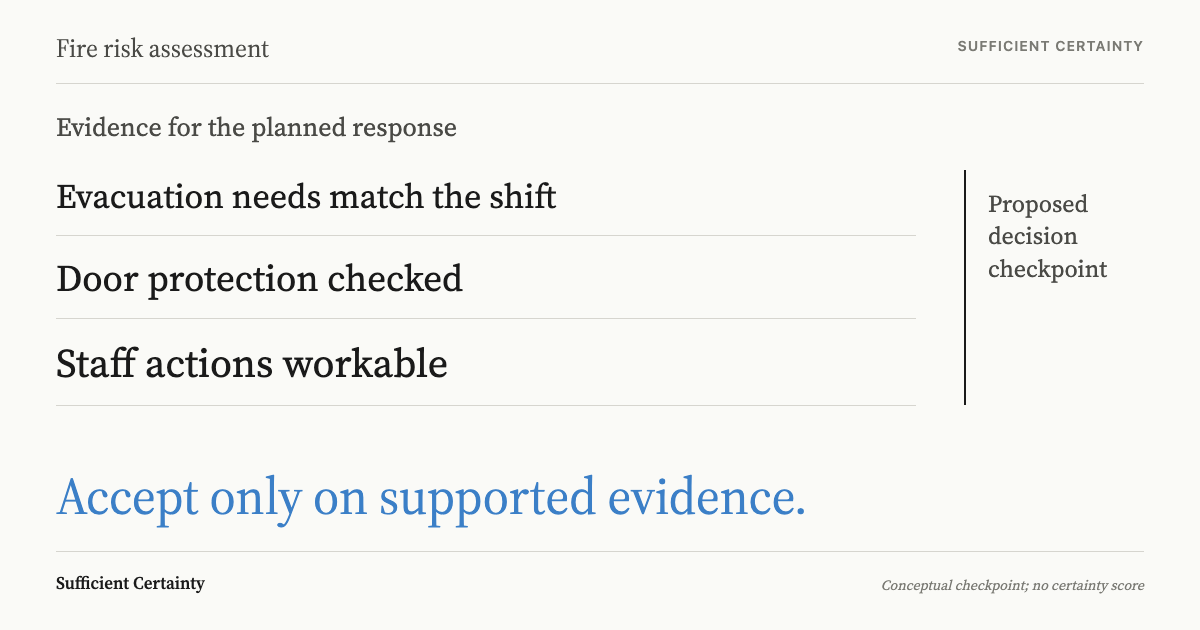
Start with the condition that could defeat the evacuation plan. Ask the assessor to explain how the proposed protection addresses it. Where that explanation depends on a building feature, obtain evidence about that feature. Where it depends on staff actions, examine whether the available staff can perform them.
Which fire precaution still depends on an unverified assumption about the people or staff present? Start the Walk →
How much evidence supports the fire action plan?
A useful assessment identifies people who could be harmed and the measures intended to protect them. It gives management a basis for planning improvements. Scottish Government care-home guidance describes assessment as a practical exercise and says its outcome needs action. The wider risk assessment discussion concerns the same move from findings to a decision.
Task completion needs evidence of the intended result. An invoice may show that work was bought. A training register may show attendance. Neither necessarily answers whether the protective arrangement works as intended. Ask what observation, competent inspection or rehearsal supports closing the particular finding. The evidence should match the claim being accepted.
More evidence is not always better evidence. Another review of the same drawing may add little when the unresolved question concerns the installed door. A further briefing may add little when the unresolved question concerns staff capacity. The issue is whether the information supports the decision, rather than how many documents have accumulated.
Scottish Government guidance on residents and staffing links evacuation strategy with resident dependency, available staff and the building. It also describes the added difficulty of reduced staffing at night. This supports checking the combination, rather than treating each item as an independent assurance.
Unresolved protection cannot be closed by a lower rating. A revised label does not repair a defective arrangement. If a finding concerns a life-safety measure, record what remains unknown and obtain suitable technical advice. Keep the acceptance decision open until the evidence supports it. The amount and kind of checking should reflect what could happen if the underlying assumption is wrong.
These are decision principles, not a substitute for current duties in a particular jurisdiction. Rosepark concerns a historical statutory setting. For a present building, use the applicable official guidance and competent fire-safety advice. This article does not certify a building or prescribe a universal evacuation design.
Verify the protection before accepting the assessment
Bring the assessment to the person responsible for implementing it. Choose one finding that affects how people will be protected. Write the exact condition that must hold before it can be closed. For a care home, that could concern the available assistance for residents during the night shift.
Name the condition before choosing the check. Ask the responsible specialist what evidence would show that the arrangement is adequate. Do not improvise a live evacuation or disable protection to create a test. Use an appropriate review or rehearsal that preserves resident safety. Record any limits in what that check can establish.
A contractor can finish an assigned repair without answering every question about the evacuation plan. Identify who accepts the combined protection before treating individual completions as closure.
The five steps of the Universal Decision-Making Method organise this follow-up around a decision, rather than another report:
- Frame the decision: whether to accept the proposed fire precautions for the people using this building.
- Set out tentative elements: the intended protection and the improvements still needed before acceptance.
- Identify assumptions: what must be true about occupant needs or staff response for that protection to work.
- Seek sufficient certainty: obtain evidence about the assumptions whose failure could change the acceptance decision.
- Implement and monitor: assign responsibility for the improvements and define changes that require another review.
This sequence is a proposed use of the method. It does not replace the assessment or the assessor's technical work. It helps management state the decision that work must support. The distinction between evidence and assurance is developed further in evidence-based decision making.
Keep the reason for acceptance visible. Record which finding was closed and the evidence used. Include who checked it and the conditions considered. If an assumption remains unresolved, record the next action and who owns it. A due date alone does not explain whether continued use is appropriate.
Review when the protective conditions change. Resident needs can change. Staffing arrangements can change. Alterations can affect doors or escape routes. Assign someone to identify those changes and reopen the relevant decision. Monitoring a decision starts with naming the condition that would make its earlier basis unreliable.
The first comparison should leave a clear result. Either the evacuation plan matches the people and staff present, or a specific gap needs investigation. Use that result to direct the next competent check. Acceptance should follow evidence of workable protection, rather than the arrival of the finished assessment.
A fire action plan is ready to accept only when its protective arrangements have supporting evidence.
Work through your decisionNo sign-up. Just pick your decision and start.
Grant Purdy is the co-author, with Roger Estall, of Deciding (2020), and the architect of the Universal Decision-Making Method.