
After a HAZOP study, add an evidence requirement beside each safety recommendation before marking any action complete. The action tracker can show a closed row while the operating team still lacks a clear account of what was checked. Start with the equipment, operating state and safeguard named in that row.
A HAZOP study uses guide words to examine deviations from intended operation and identify hazards or operability problems.
Assign evidence to each HAZOP recommendation
Keep the final worksheets beside the action register. For each recommendation, preserve the deviation, its cause and the consequence it addresses. Then name the person responsible for implementing the action. The person accepting completion needs enough technical knowledge to assess whether the proposed evidence answers the original concern.
Separate questions needing further analysis from agreed changes. An instruction to investigate an alarm is not an instruction to install one. Record what the investigation must establish and who will decide what follows. Otherwise, an investigation can finish without anyone deciding whether the process needs a different safeguard.
For US processes covered by the process safety management standard, OSHA requires documented resolution of findings, a written action schedule and communication to affected employees. Its pre-startup requirements for new facilities include resolving or implementing PHA recommendations before introducing highly hazardous chemicals. Modified facilities must meet the management-of-change requirements.
Build a release evidence sheet from the existing register. Add the operating state covered, the required check, its result and the person who accepts it. Link to the underlying inspection or test record. Avoid copying a vague status such as “engineering approved” into the evidence column.
This fits the wider risk assessment task: deciding whether a particular operation can proceed under stated conditions. Checking a safety audit fix on site raises a similar follow-through question, although a HAZOP starts from possible process deviations rather than audit findings.
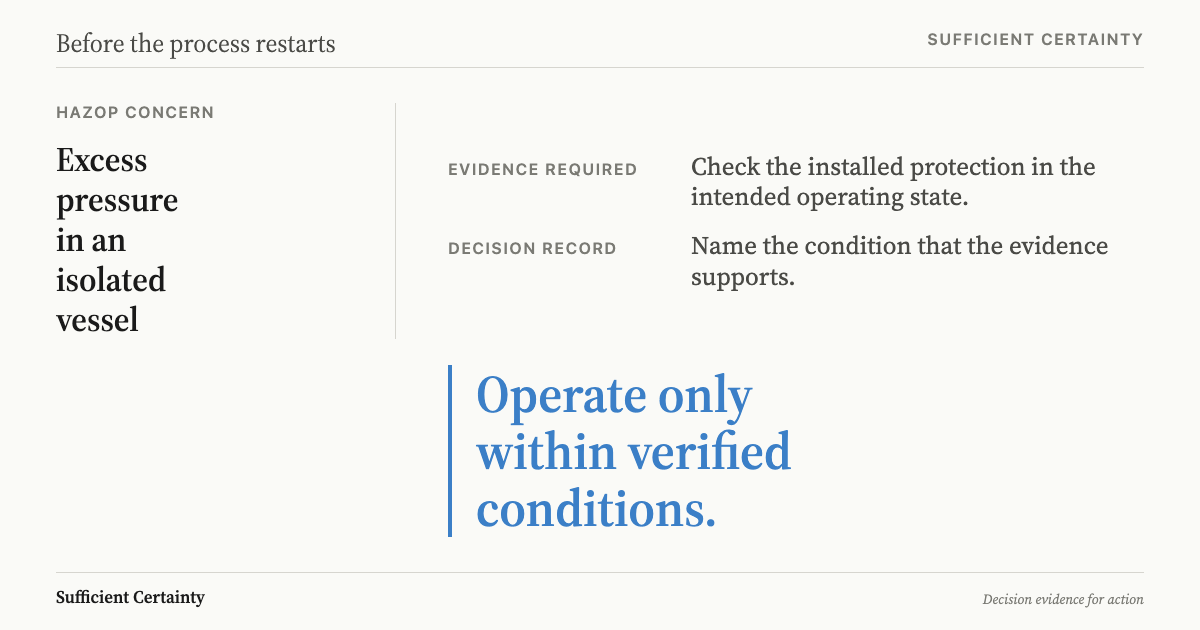
The release evidence must show that the original safety concern has been addressed in the intended operating state.
A HAZOP explains how deviations could develop
The study gives people with different knowledge a structured way to examine a process. A question about reduced flow can expose a consequence that appears only when a pump, vessel and control system interact. Keeping that reasoning in the worksheet helps later reviewers understand why the team requested an action.
IEC 61882:2016 covers guide-word studies, their preparation, examination, documentation and follow-up. Follow-up belongs within the technique's scope. A missing implementation check should not be treated as something that a properly managed study necessarily leaves outside its remit.
The worksheet also preserves disagreements and questions for specialists. If the team cannot establish whether a safeguard handles the identified deviation, an explicit open question is useful. It makes the missing information visible before someone turns the study into permission to operate.
Related methods can contribute different evidence. Following up an FMEA involves checking actions tied to identified failure modes. Neither worksheet replaces the technical work needed to establish how an installed control performs.
A useful HAZOP recommendation states the safety concern clearly enough for another person to verify its resolution.
Which evidence would show that the next HAZOP action is ready to close? Start the Walk →
What evidence is enough before a process restarts?
The difficult question comes when the action owner requests closure. A purchase order shows that equipment was ordered. An installation record shows that work occurred. Neither establishes every claim about protection during startup, normal operation or standby. Match the evidence to the claim being relied upon.
State whether the evidence comes from a drawing review, field inspection or functional test. Record its date and scope. If the configuration has changed since that check, the reviewer needs to establish whether the result still applies. A link to an old test record does not answer that question.
For example, a proposed check of a pressure-relief arrangement should identify the vessel and operating configurations covered. A competent engineer must determine the required design and verification work. A general decision-making method cannot supply relief sizing, inspection criteria or the technical basis for safe operation.
The practical decision is how much uncertainty remains about the protection required for the next operation. Having enough information to decide means addressing the information that could change the decision. For a major accident hazard, missing evidence about a necessary safeguard can require withholding release.
The threshold must be specific. Name the unresolved claim, why it matters and the evidence needed to resolve it. Apply required engineering standards and legal duties first. Sufficient certainty is a judgment about the remaining uncertainty within those requirements, not permission to reduce them.
Where a recommendation changes equipment or procedures, review the effects of that change. HSE's plant modification guidance includes checking that intended HAZOP actions were implemented and that modifications achieved their design intent. Use the appropriate site review to establish what must be checked before release.
Set the evidence requirement before the completion date creates pressure to accept whatever is available.
Williams recorded a safeguard that was not in place
On 13 June 2013, a reboiler ruptured at the Williams Olefins plant in Geismar, Louisiana. Two workers died and 167 reported injuries. Heat entered a vessel isolated from its pressure-relief device. The CSB investigation documents process hazard analyses, or PHAs. It does not identify those studies as HAZOPs.
The 2001 PHA missed overpressure as a safety consequence. In 2006, a PHA recommended locking open valves so both reboilers could receive relief protection. The action was recorded as complete in January 2010. The standby reboiler remained isolated and unprotected.
The 2011 PHA relied on tracking records that showed completion. Its team did not field-check the documented safeguards against the equipment. The investigation identified wider failures in change management, startup review and operating procedures. The accident cannot be explained as one study failure.
This sequence supports a specific follow-through lesson. A later review can inherit an earlier completion error if the record substitutes for checking the safeguard. It does not establish that a HAZOP alone would have prevented the rupture. The proposed release evidence sheet addresses that information gap without replacing the wider process safety program.
When a later study relies on a closed recommendation, check the underlying evidence rather than carrying its status forward.
A useful review question is whether the evidence covers the actual operating configuration. If it covers only equipment in service, ask what protects the equipment on standby. Keep that question open until the responsible specialists establish an adequate technical answer.
An unresolved protection question belongs in the operating decision even when the action register shows completion.
Set the release condition before closing the action
Apply the Universal Decision-Making Method to the operation awaiting approval. Use the HAZOP worksheets as technical input. The five prompts help connect that input to a decision; they do not replace the required process safety reviews.
- Frame: State the operation being considered, its Purpose and who can authorise it.
- Tentative Elements: Specify the proposed operating configuration, including the safeguards needed for it.
- Assumptions: Identify which claims about those safeguards remain uncertain and could change the decision.
- Sufficient Certainty: Compare available evidence with the agreed requirements and resolve any gap that prevents release.
- Implement+Monitor: Assign the checks and responses needed to keep the operating conditions valid.
Record the resulting release condition beside the action. State what must be demonstrated before the operation begins. If the required evidence is unavailable, record the hold and the next technical task. An overdue date can justify escalation; it cannot demonstrate that a safeguard works.
Define what will reopen the decision after release. A changed valve arrangement, modified setpoint or failed safeguard test may invalidate the earlier evidence. The response should identify who reviews the change and which operation must stop or remain on hold under the site's procedures.
As with the decision after risk evaluation, the evidence requirement needs to be agreed before acceptance. Start with the next recommendation due for closure. Ask the action owner to provide evidence against its original concern, then have the authorised reviewer assess the result.
Close the action only when its evidence supports the stated decision, and retain the condition that will reopen it.
How confident are you that the safeguards listed in your HAZOP protect the process in its next operating state?
Work through your decisionNo sign-up. Just pick your decision and start.
Grant Purdy is the co-author, with Roger Estall, of Deciding (2020), and the architect of the Universal Decision-Making Method.