
After an ISO 27001 audit, ask the owner of one completed action for evidence that it works. A corrective-action register can make that request easy to miss. The owner has finished the task, the due date has passed, and the status has changed. The next decision is whether those changes justify closing the information-security finding.
An ISO 27001 audit examines an information security management system against defined requirements. Follow-up connects an identified gap to a corrective action and evidence of its effectiveness.
An ISO 27001 audit routes findings into corrective action
Start with the audit report and the response arrangements agreed with the auditor. Check which findings require a response. Record the person responsible for each response and the evidence needed for review. Where a certification body controls formal closure, keep its decision separate from the organisation's internal action status. Finishing an internal task does not itself change the auditor's finding.
Keep the immediate correction distinct from the action intended to prevent recurrence. Replacing a missing document deals with the missing document. Changing how documents are reviewed addresses a possible cause. The second action needs a reasoned account of what went wrong. Otherwise, the register can show a completed task while the same process still allows the lapse.
For each finding, preserve the relevant requirement and the original evidence. State the cause in words the process owner can check. Then explain how the proposed change addresses it. If the cause remains uncertain, record that uncertainty rather than selecting a convenient label. A useful follow-up to root cause analysis tests the proposed cause before treating the remedy as settled.
The subject is the management of information security. ISO's description of ISO/IEC 27001 covers establishing and continually improving an information security management system. That system is usually called an ISMS. An audit finding can concern how security work is managed, as well as a particular security control. Match the response to the finding's actual requirement.
Use the existing register if it can retain the evidence and the closure decision. A new dashboard will not resolve a missing effectiveness check. Give each action a place for the result of that check. Keep a link to the underlying record so another person can inspect it. The closure record should show why the action works.
These are practical follow-up arrangements, not a separate certification scheme. Their purpose is to make the pending decision visible. The wider organisational governance question is who can accept the evidence and who must respond if the change stops working. Set those responsibilities while the finding is still open.
What does closing an ISMS finding establish?
A supported closure gives management a usable conclusion about the identified lapse. It connects the cause to the corrective action, then connects that action to observed results. This allows the process owner to move from remediation to routine operation. It also leaves the reviewer a clear account of what was accepted, rather than a status field with no explanation.
For an ISMS owner, the important distinction is between carrying out a security activity and achieving its intended result. ISO/IEC 27004:2016 provides guidance on evaluating information-security performance and ISMS effectiveness, including processes and controls. Measurement therefore has a purpose beyond counting completed actions. Choose evidence that answers the question raised by the finding.
| What audit follow-up produced | What closure assumes | Gap to test |
|---|---|---|
| A revised security procedure | The cause was an unclear instruction | Check whether the revised instruction changes the work |
| A completed corrective action | The intended security result now occurs | Inspect evidence from the changed process |
| A closed finding | The conditions supporting closure still hold | Name the change that would require another review |
The table proposes questions for the reviewer. It does not describe extra requirements imposed by ISO. The relevant question depends on the finding. A process correction may need records of how the changed process operates. A control correction may need evidence of the security result. The evidence must fit the claim being accepted.
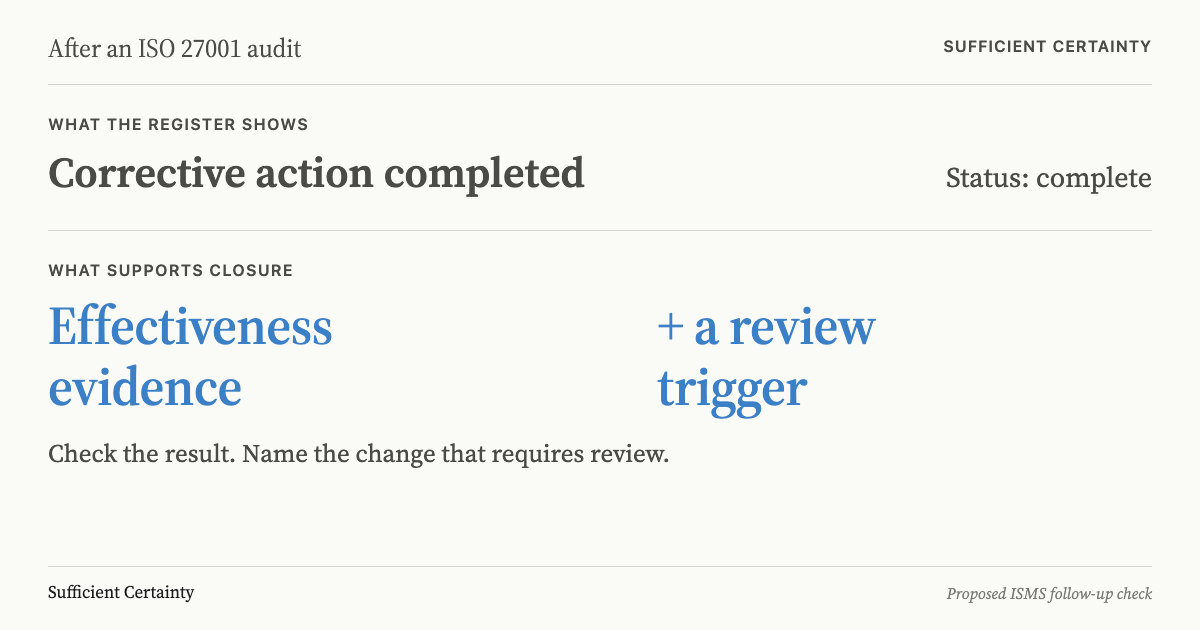
Acceptance has a date and applies under identifiable conditions. A change to the process can reduce the value of earlier evidence. Record those conditions before closing the finding. Closure should include a reason to review the result again.
An ISO 27001 closure needs sound evidence; identify the change that would require its owner to review that evidence again. Start the Walk →
HCPC followed closed actions into the next surveillance audit
The Health and Care Professions Council provides a documented example of follow-up reaching a supported conclusion. Its June 2019 Audit Committee papers include the ISO audit reports. The BSI surveillance assessment took place from 29 April to 1 May 2019. The report carried forward an earlier corrective-action finding for review.
The BSI report, pages 6 and 10 of the ISO 27001 assessment, records the earlier gap. In 2018, Improvement Log entries 417 and 516 showed as closed. Neither had an assigned root cause. The check for the same nonconformity elsewhere and the effectiveness review had not taken place.
The 2019 follow-up sampled a root-cause update to the improvement-log process and marked the finding closed. The report also states that earlier corrective actions had been reviewed and effectively implemented. This was a successful follow-up. The assessment used ISO/IEC 27001:2013. Its clause 10.1 reference belongs to that edition.
The report supports the later closure. It does not establish a breach or a continuing failure.
Link the closure decision to review evidence. Apply that distinction to a current finding. Read the closure entry beside the evidence that supports it. Can the reviewer identify the cause addressed by the action? Can the reviewer see the intended result in operation? If the entry only points to task completion, ask the owner what further evidence would support acceptance. These are proposed reader checks, rather than a description of additional work performed at HCPC.
A future change can create a new reason to review that conclusion. Consider a security process transferred to a service provider. Earlier evidence may depend on an internal review step that no longer occurs. The trigger should be the removal of that step, with responsibility assigned to someone who will learn about the change. The general work of making assumptions explicit helps identify this dependency.
Corrective-action effectiveness is not a rule unique to information-security audits. The ISMS application matters here: keep the security result under review as the processes handling information change. A changed process can require fresh effectiveness evidence.
Set an effectiveness check before closing the finding
Choose the pending closure decision, then state the result the corrective action should produce. Ask the owner what observation would support that result. Agree when it will be available. If the process has not operated under the changed arrangement, record what remains untested. Use the closure procedure agreed with the auditor rather than inventing a new acceptance rule.
Then name a condition that would require another review. Make it observable by the responsible person. A change in how a service provider handles information may be relevant. A changed security objective may require a different measure. Select the condition that affects this corrective action, and explain why. A monitoring trigger must identify when someone needs to act.
- Corrective action completed
- Finding closed
- The cause addressed by the change
- Evidence of the intended security result
- The condition requiring another review
- The person responsible for that review
Keep the trigger beside the effectiveness evidence. Assign the next action as well as the person responsible. A notification without a review task leaves the response uncertain. The owner should know which evidence to revisit and who can change the decision. This is a practical use of monitoring a decision after implementation.
Closure also lets management stop spending effort on a resolved finding. Keeping every action open indefinitely would obscure the work that still needs attention. Set a sufficient basis for acceptance and keep the reason on record. The question of having enough information to decide is about the consequence of being wrong, rather than an unlimited demand for more documents.
Use the Universal Decision-Making Method to state what the closure decision depends on. It helps connect an assumption about the corrective action to a check and a response. Keep that work inside the existing ISMS process. The method supports the decision; it does not replace the auditor's role or the organisation's requirements.
Bring management a clear result: the corrective action is complete, the effectiveness evidence supports closure, and a relevant change has an assigned response. If the evidence is insufficient, state what is missing and when it can be checked. Close the finding when the evidence supports it, then monitor the conditions behind that conclusion.
Which condition behind your ISO 27001 corrective-action closure needs a monitoring trigger?
Work through your decisionNo sign-up. Just pick your decision and start.
Grant Purdy is the co-author, with Roger Estall, of Deciding (2020), and the architect of the Universal Decision-Making Method.