
After a KYC review, put the final customer finding beside the evidence that supports continued account access. In its 2023 final notice, the FCA found that GT Bank UK used existing information to close customer-file remediation gaps that this information had not resolved. Completing the review requires a supported customer decision.
A KYC review checks whether customer identity and relationship information remains adequate for the services and obligations involved.
GT Bank accepted incomplete remediation evidence
The FCA final notice on GT Bank UK describes a Look Back exercise that reviewed 1,156 active customer files. Every file required additional due diligence information against the bank’s improved standards. During remediation, customer responses and outstanding actions were not adequately tracked or resolved. The issue concerned the evidence supporting customer files, rather than whether a review had taken place.
The notice says a later simplified process used information already held, account history and public sources for 314 files. The FCA found that this did not adequately consider changed customer circumstances. Without expected activity retained in the bank’s systems, actual account usage could not establish whether the recorded due diligence was adequate.
The notice concerns historical systems and controls failings during 2014–2019. It does not establish that the customers laundered money. Nor should those historical regulations be treated as the complete current regime. The case demonstrates a gap between declaring remediation complete and resolving the reason that the file required remediation.
For a relationship owner, the practical question is whether the missing information affects the proposed service now. A document can arrive without answering that question. An address confirmation may resolve an address discrepancy while leaving ownership unclear. These are illustrative checks, not additional findings about GT Bank or any named customer.
Write the unresolved finding as a statement that can be examined. “More documents needed” is too broad to guide a decision. “The evidence does not establish who controls this company” gives the compliance team a specific issue. Keep the finding linked to its source and date, including contradictory information that needs assessment.
Clarify the decision before asking for another review. Is the business considering continued access to the same service, an expanded facility, or a specific transaction? The required evidence may differ. The relationship owner should explain the commercial request, while compliance determines the applicable due diligence and escalation requirements through the firm’s approved process.
Do not let a program deadline decide the adequacy of an individual file. The FCPA compliance review checkpoint concerns anti-bribery controls. A KYC decision instead needs the customer-specific identity and relationship evidence relevant to continuation, restrictions or exit. Keep that distinction visible in the decision record.
Preserve both the customer’s response and the reason the reviewer accepted or rejected it. A later reviewer must be able to understand the decision without reconstructing an email thread. Link an unresolved issue to the person responsible for the next action, so the relationship owner can see what remains outstanding before making a promise.
The internal audit follow-through provides a related distinction between reported completion and demonstrated effect. Here the required effect is an adequately supported customer decision. A closed remediation ticket is only useful when its record explains how the relevant finding was resolved, or why the authorised next step remains restricted.
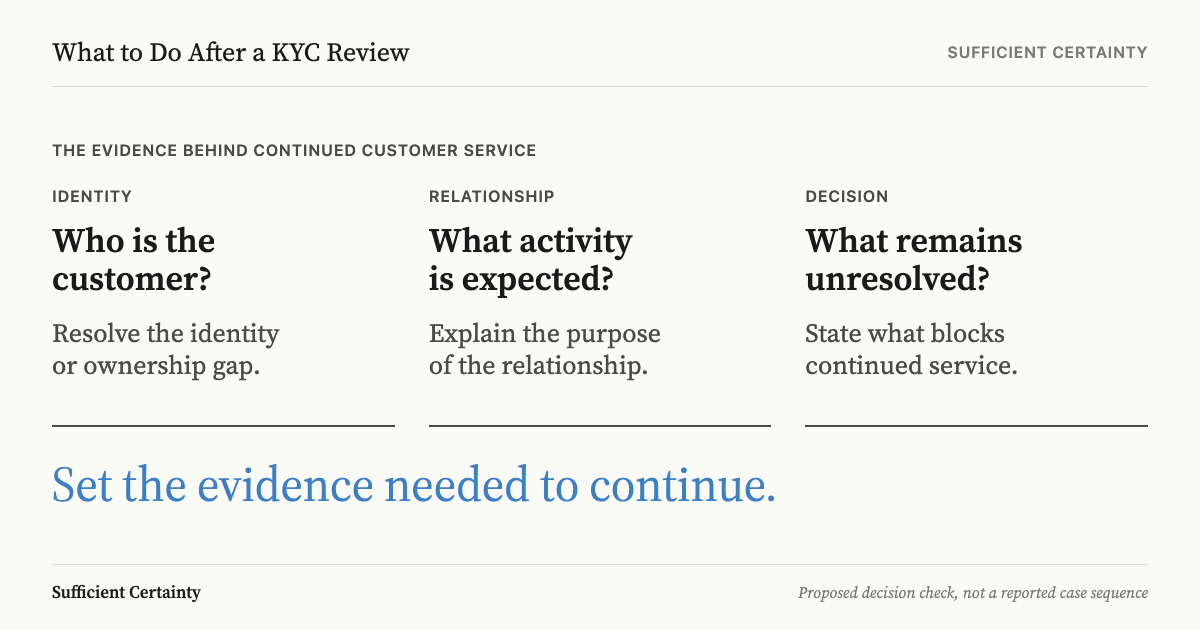
What does a completed customer review establish?
A properly completed review can update what the firm knows about its customer and the intended relationship. It can identify gaps requiring further work. It can support a reasoned decision about service. It does not guarantee that every future transaction is legitimate or remove the need for ongoing monitoring.
The FCA findings on customer due diligence controls describe weaknesses including inadequate information on the purpose and intended nature of relationships. The useful question after a review is therefore not simply whether the file contains documents. Ask whether the information permits the firm to understand the relationship and carry out the required monitoring.
The business owner can help resolve uncertainty by explaining the service requested and obtaining appropriate information through approved channels. That role does not include overruling compliance because the customer is valuable. Nor does it include deciding that every missing item requires immediate exit. The response depends on the finding and the applicable requirements.
Keep a distinction between an incomplete administrative field and a substantive evidence gap. A record may need a clerical correction while adequate supporting information already exists. Another file may look complete while ownership or purpose remains unsupported. Ask the reviewer to explain the decision consequence of the gap, rather than rely on a completion label alone.
Assess conflicting evidence explicitly. If a customer explanation differs from reliable independent information, preserve both accounts and escalate the discrepancy. Do not combine them into a more convenient narrative. The compliance assessment checkpoint helps connect a finding to an actual commitment, rather than a generic action plan.
The FCA Financial Crime Guide discusses customer due diligence and ongoing monitoring. Use the current guidance and the firm’s approved procedures with the compliance team. A proposed management record should support that work by making the unresolved finding and service decision clear; it cannot authorise an exception to a legal requirement.
The wider organisational governance issue is who has authority to act on the finding. Identify who can approve continuation and who can impose or remove restrictions. The relationship owner needs a reliable answer before telling the customer what will happen. A review result sent to several teams does not itself assign that authority.
The customer review needs a clear evidence threshold for the next service decision. Start the Walk →
Set the customer evidence needed for continued service
Ask compliance to identify the evidence required to resolve the finding and explain its relevance. State the proposed service and the period involved. The sufficient-certainty question is whether the available evidence supports that decision within the applicable requirements. It is not permission to accept an otherwise mandatory gap because the business wants to continue.
Compare the permitted options through the existing process. The firm may be able to continue the relationship, apply restrictions while a defined issue is resolved, or decide that continuation is not permitted. Do not describe these options as freely interchangeable. Compliance must determine which are available for the facts and obligations concerned.
Record the reason for the chosen option. Identify the finding, evidence assessed, unresolved uncertainty and authorised service position. Include the decision owner and required follow-up. The governance audit checkpoint can help clarify the decision rights where commercial and compliance teams have different responsibilities.
Set a useful completion condition for outstanding work. Receiving another document may be an action; resolving the ownership discrepancy is the intended result. Say what the reviewer needs to establish and who will assess it. That lets the relationship owner request relevant information without repeatedly asking the customer for material that does not answer the issue.
The FCA explanation of the risk-based approach says firms need due diligence and monitoring arrangements suited to their business. Do not replace this with a universal annual review rule. The interval and event triggers must reflect the requirements and the firm’s customer-specific assessment, with compliance responsible for interpreting the obligations.
Use the Universal Decision-Making Method to preserve the reason behind the choice. Name the customer commitment and the assumption on which it rests. If the decision relies on an expected type of activity, record what evidence would require reconsideration. Pass that condition into the existing monitoring process rather than create an unowned note.
Before communicating with the customer, confirm what can be said through the approved process. State the actual service position and the information request accurately. Do not promise approval when a further decision remains. The customer handoff should match the authorised result, including any restrictions or next review that the firm has determined are appropriate.
Finish with an actionable record. The relationship owner should know whether service can continue, what remains unresolved, and who decides the next step. The compliance team should be able to see the evidence and reasoning. A completed KYC review then supports a customer decision that can be examined when the circumstances change.
Which unresolved customer finding still prevents continued service?
Work through your decisionNo sign-up. Just pick your decision and start.
Grant Purdy is the co-author, with Roger Estall, of Deciding (2020), and the architect of the Universal Decision-Making Method.