
After an FCPA compliance review, the step before accepting the response is to trace one recent payment to an intermediary. A stronger approval rule can still leave the same payment route in use. Before closing the findings, examine what the proposed response changes in the transaction itself.
An FCPA compliance review examines how a business addresses foreign bribery concerns and related accounting controls. Its findings support legal assessment and decisions about how the business operates.
SAP changed the payment model after bribery findings
In January 2024, SAP entered a three-year deferred prosecution agreement with the US Department of Justice. The agreement and its statement of facts recorded SAP's acceptance of responsibility for bribery schemes involving South African and Indonesian officials. These are historical facts about the 2024 resolution.
A South African Department of Water and Sanitation contract shows the payment route. The criminal information described a bribe routed through an intermediary, then another company. SAP engaged two intermediaries for that contract. Each received a commission of 14.9% of SAP's revenue, the maximum per intermediary before significantly higher approval was required.
The Justice Department's January 2024 announcement reported substantive remediation. SAP eliminated its third-party sales commission model globally. It prohibited all sales commissions for public sector contracts in high-risk markets. It also adjusted compensation incentives to reduce corruption risk.
That sequence matters when deciding what a review response must achieve. The issue reaches beyond whether an approval appears on the invoice. It includes why the business pays an intermediary and how a contract creates the money for that payment. The transaction belongs inside the review response.
The proposed reader check is to compare the old payment route with the route that would exist after remediation. Draw both using a real transaction from the business. Show where money leaves the company, then identify the recipient. Where another company receives money further along the route, ask what evidence explains that transfer. For customer accounts, the follow-up to a KYC review applies a related check: whether the final finding supports continued access.
Put the commercial reason for each transfer beside it. A general promise to help win business needs examination. Ask what service the intermediary actually performs and who can confirm it. If the service remains unclear, a new approval signature does not supply the missing explanation. Take that gap to the people responsible for the review.
Then examine the incentive attached to the contract. Determine when the employee earns a bonus and when the intermediary earns a fee. Compare those conditions with the point at which compliance can stop the arrangement. Ask whether the response changes what people get paid to do. This is a proposed question for the reader, not a claim about SAP's review method.
Do not infer that every commission arrangement is unlawful from this case. The reader needs qualified counsel to assess the specific facts and applicable law. The commercial question is which route can deliver the intended service with supportable payments. The distinction between governance and compliance helps keep that business decision explicit.
In a response paper, describe a changed payment route in enough detail for a manager to follow it. Explain what would happen to the next invoice under that route. Where the same money could still reach the same unexplained recipient, identify the remaining uncertainty. Avoid declaring success because a revised policy has been issued.
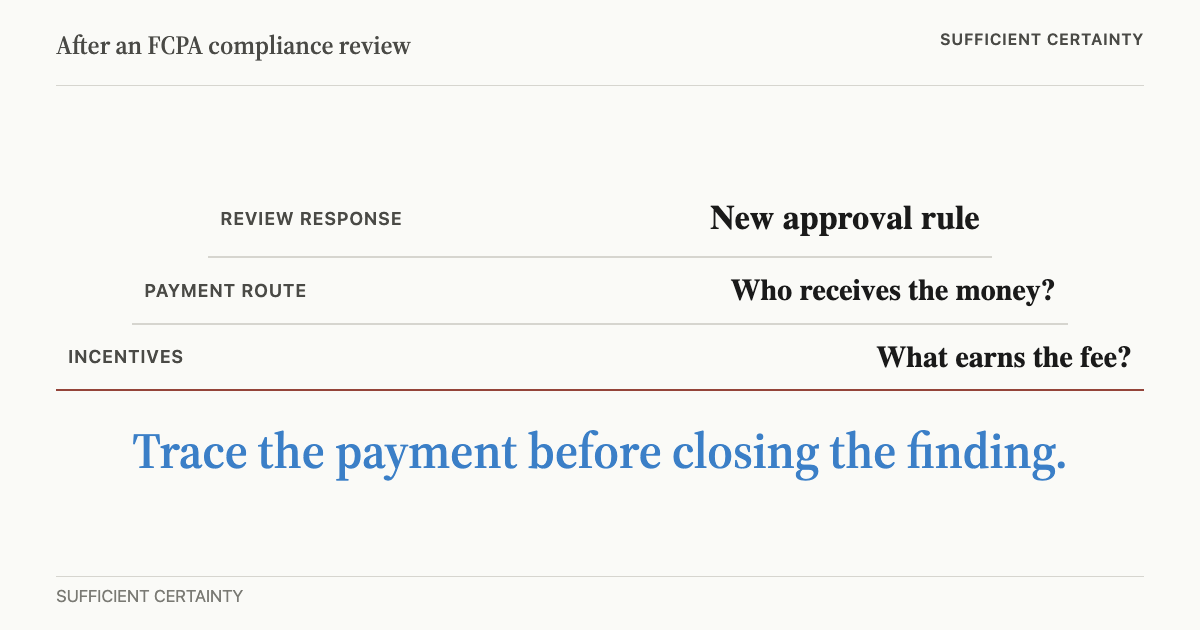
Use the case to examine the scope of the decision. The public documents do not establish that SAP used the Universal Decision-Making Method. They show why changing the commercial arrangement can be part of remediation. The reader must judge their own proposed response against their own evidence.
An FCPA review identifies concerns; the decision is whether the proposed payment route resolves the concern in the transaction. Start the Walk →
Which transaction is the compliance review meant to protect?
A useful review can identify weaknesses in a payment process and direct attention to an unresolved concern. Its findings deserve a documented response. Counsel and the compliance team should determine the legal work required. The manager who owns the commercial arrangement still needs to decide what can continue and under what conditions.
Frame that decision around a specific transaction. For example, a proposed reader question is whether to renew an intermediary agreement before the next public sector bid. That question makes the consequence of closing the finding visible. It also makes clear which contract needs evidence. The problem framing examples explain how an opening question changes the work that follows.
Closing a recommendation about due diligence may require evidence that a revised check now operates. Continuing an intermediary relationship requires evidence about that relationship. Treat these as separate judgements. A response paper should explain how the first judgement supports the second, rather than leave the reader to assume that it does.
The Justice Department's September 2024 compliance program guidance asked about the business reason for third parties. It also asked whether contractual work was performed and whether compensation matched the services. That historical guidance supports examining actual activity alongside the documents. Counsel should assess any current guidance relevant to the business.
Define the business decision before choosing the evidence. If the decision concerns continued use of an intermediary, the response needs to address that use. A revised training slide may support the program, but it cannot establish what service a particular recipient performed.
Keep the review's limits visible. A transaction outside its scope should not acquire approval merely because the report has no finding about it. Use the question of enough due diligence to target the missing evidence. An unanswered payment question remains open after a paperwork change.
Trace one payment before accepting the review response
Choose a recent payment connected to the finding. Work through the original records with the compliance team, using counsel's direction where an investigation is involved. Follow the payment from the company's account to the intermediary. Establish what can be verified about any further recipient through lawful access to records.
Compare the invoice description with evidence of the work. Ask the person responsible for the service to explain the difference, if there is one. Record that explanation with its supporting evidence. A signed invoice is one record to examine. It should not end the enquiry into whether the described work occurred.
Next, test what the proposed response would do to that same transaction. Would it stop an unsupported payment before money leaves the business? Which person could require a different route? Name the authority needed to make that change. A decision rights framework can help clarify that responsibility.
Could the same unexplained payment still pass through the proposed approval rule?
Where the answer is unclear, state the assumption behind continuing the arrangement. It might be that the intermediary performs a necessary service. Identify who could verify that assumption and what evidence would change the proposed decision. The discussion of assumptions in decision making provides a way to make that belief explicit.
Consider an alternative way to obtain the service. The business may be able to contract directly with the provider. Another option may be to change the intermediary's role. Ask counsel and compliance to examine any proposed arrangement before committing to it. Comparing alternatives prevents the response from assuming that the existing route must stay.
Use the Universal Decision-Making Method to connect the review findings to this choice. State the intended commercial outcome. Examine the assumptions needed for the proposed route to work. Seek sufficient certainty about those assumptions before making the decision, while keeping required legal work with qualified counsel.
Record the condition that would reopen the decision. An unexplained change in the receiving account could require renewed examination before another payment. Assign someone to receive that information and act on it. Monitor the transaction that the response was meant to change.
Have the response owner demonstrate the revised process using the selected payment. Check what happens when evidence of the service is missing. Ask who receives the unresolved question and who can stop the payment. This practical check can expose a gap that a written description leaves unclear.
The organisational governance task is to make that decision accountable. Accept a response on the strength of evidence about the payment route. Keep an unresolved finding open where the evidence does not support closure. A completion date should reflect completed work on the concern.
Could an intermediary still receive an unexplained payment after the FCPA review findings are marked closed?
Work through your decisionNo sign-up. Just pick your decision and start.
Grant Purdy is the co-author, with Roger Estall, of Deciding (2020), and the architect of the Universal Decision-Making Method.