
After a manufacturing readiness review, compare the proposed production rate with the rate demonstrated in the review. In its 2010 report, GAO described an MQ-9 assessment that identified five areas needing review and two production risks. It also reported evidence supporting a defined production rate. A useful review can support a limited commitment while leaving other questions open.
A manufacturing readiness review examines evidence that manufacturing processes and resources can support the intended production commitment.
Connect the readiness result to the proposed rate
Open the production release request beside the completed review. Find the rate the business proposes to commit to customers. Then locate the evidence for that rate in the review. Keep the delivery period visible. A quantity without a period does not tell the approving executive how quickly the factory must produce acceptable units.
The review may support starting production, with work still needed before output increases. Record those limits in the release decision. They should travel with the approval when planning converts it into supplier orders and factory schedules. A general statement that manufacturing is ready gives those teams too little information about the commitment they can make. Before accepting installed equipment, use the site acceptance follow-up to compare test exceptions with its intended use.
The release must state the production rate its evidence supports. Include the product configuration and the conditions under which that rate was demonstrated. If the proposed schedule uses different conditions, ask what supports the change. A plan for extra capacity needs its own evidence before the business relies on it.
This differs from the broader budget question after a stage-gate review. Here, the immediate decision concerns manufacturing output. Money may be available and a project phase may be approved, yet the first committed rate still needs support from the factory and its suppliers.
Identify the dependency most likely to constrain that rate. Start with the review finding that could prevent the factory from delivering acceptable units on time. Ask whether the proposed release depends on that finding being closed. If it does, the release needs evidence of closure or a smaller commitment that does not depend on it.
The proposed timeline below marks the point where the rate should be checked. It illustrates a reader's approval process, rather than a documented sequence from the MQ-9 program.
A review assembles evidence across production dependencies
Manufacturing readiness reviews bring evidence from different functions into one decision. Production staff can see whether suppliers support the intended schedule. Quality staff can examine whether the process produces acceptable output under representative conditions. The approving executive can then see where one unresolved dependency limits the proposed commitment.
NASA's definition of a production readiness review connects readiness to producing the required number of systems. It includes production plans and the people needed to begin. That is useful beyond aerospace. Readiness has to concern the output required, rather than the completion of a meeting.
A production demonstration is useful only within the conditions it actually tested. Record whether it used the intended suppliers and normal staffing. Identify exceptional support that helped achieve the result. This proposed check does not invalidate a demonstration. It makes clear what the business must preserve, or verify again, when production starts.
The NIST explanation of process capability compares the output of a stable process with specification limits. That evidence helps answer whether a process can make acceptable parts. The release decision must also establish whether the whole production system can supply those parts at the proposed rate.
Keep the evidence for quality connected to the evidence for output. Check demonstrated yields against the schedule's allowance for rejected or reworked units. Ask whether qualified suppliers can sustain the required deliveries. These are proposed checks for the reader, not findings attributed to the MQ-9 assessment.
A completed vendor evaluation can help establish who should supply a part. The manufacturing release still needs evidence for the required deliveries. Use the wider decision-making frameworks discussion to keep each tool's output connected to the specific decision it informs.
GAO examined manufacturing maturity for the MQ-9
In GAO's April 2010 manufacturing-readiness report, Air Force officials described assessments of key MQ-9 Reaper manufacturing processes and technologies. The account is specific about what the work established. It records evidence for a production goal alongside findings that still needed attention.
Officials said the assessments identified five areas requiring review before a milestone C production decision. They also identified two risks to full-rate production. Mitigation was still in progress when reported. Alongside those findings, the assessment provided evidence supporting the contractor's ability to produce two aircraft per month.
Evidence for a defined rate does not establish readiness for a higher rate. That is the limit an approving executive should preserve. The report does not establish that the two risks were resolved. It also does not establish that any greater production rate was supported by the same evidence.
The case shows the value of retaining the detail behind a readiness conclusion. The assessment exposed work still needed while supporting a particular production goal. Reducing that account to a simple ready status would remove information needed for a later rate decision. GAO's account provides no basis for treating the assessment as an unlimited production approval.
An open mitigation needs a condition for reassessment before the next commitment. For a reader applying this lesson, identify which planned increase depends on the mitigation succeeding. State what evidence must be available before that increase is released. This is a proposed application; the source does not document the monitoring triggers used by the MQ-9 program.
The question is more specific than whether a technical feasibility study supports further development. A product may be technically feasible while manufacturing evidence supports only a limited rate. The production decision must retain that distinction when customer demand or a revised schedule calls for more output.
Your review supports a production rate. What change would make that evidence insufficient? Start the Walk →
Set a trigger before releasing more production
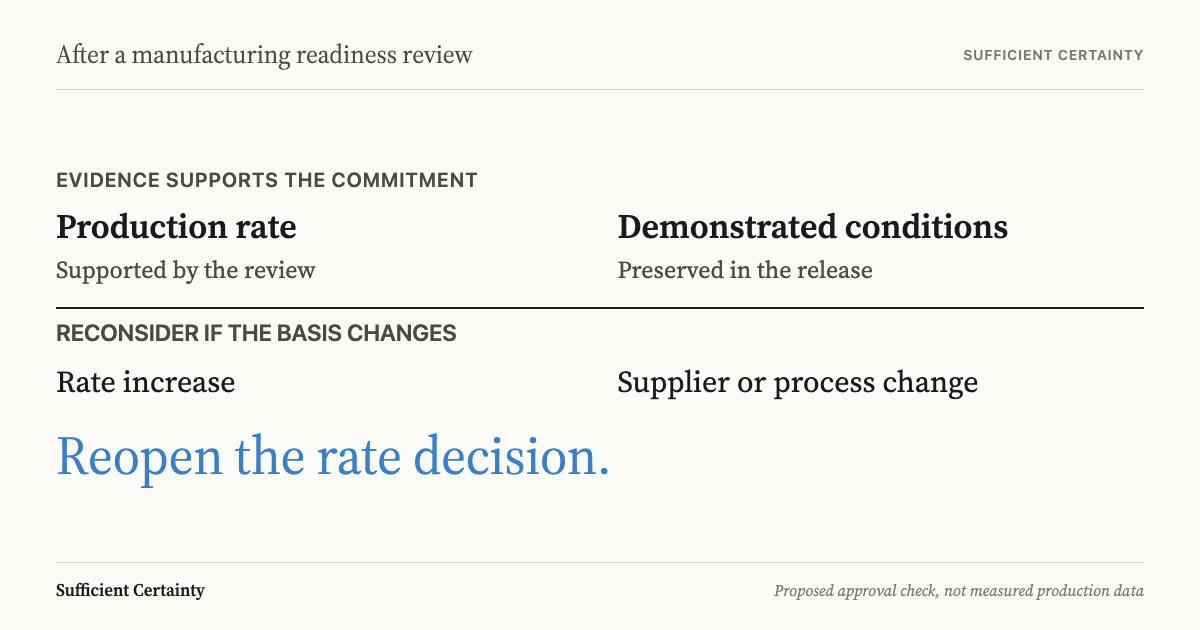
Write a short condition beside the rate in the release decision. Identify the observation that would require the approving executive to reconsider it. Choose a condition tied to an unresolved dependency. A proposed increase beyond the demonstrated rate is one trigger. Loss of a supplier qualification may be another, where the approved schedule depends on it.
The trigger must reach someone who can change the production commitment. Name the responsible role and specify the decision that pauses for review. A factory report may reach many recipients without telling anyone to act. Connect the signal to the next release before orders make that release difficult to change.
The proposed flow below shows what the decision needs beyond the review's documented findings. It does not imply that every readiness review lacks monitoring arrangements.
Use the Universal Decision-Making Method to connect the intended outcome with the evidence needed to commit. Keep the practical record beside the release request. It should let another reviewer find the supported rate and see what change requires the decision to be reopened.
Review the trigger before the next production release becomes binding. If output falls below the basis for approval, compare the new evidence with the remaining commitments. Decide whether the approved rate still holds. Do not wait for a missed customer delivery to start that comparison.
Keep the response proportionate to the change. A missing record may require a supplier check before the next release. Evidence that a critical process no longer produces acceptable output may require a different response. Decide which authority handles each condition under the business's existing production controls. The note should make that handoff clear.
Check that the signal arrives in time to affect the decision. If the supplier report comes after material orders are fixed, move the evidence check earlier. Record where the reviewer finds the latest result. A trigger that depends on inaccessible or late information cannot support the release decision when it matters.
This is decision monitoring applied to manufacturing approval. Preserve the completed review as evidence. Add the observation and response that keep its conclusion relevant. Tomorrow's task is complete when the proposed rate has a stated evidence basis and a named person must reconsider it when that basis changes.
Before approving more production, name the condition that would require the rate decision to be reopened.
Work through your decisionNo sign-up. Just pick your decision and start.
Grant Purdy is the co-author, with Roger Estall, of Deciding (2020), and the architect of the Universal Decision-Making Method.