
After a vendor evaluation, the step before awarding the contract is to ask the preferred vendor for evidence that it can meet the first delivery date.
On 17 July 2012, G4S supplied 4,389 security staff, approximately 35% below LOCOG's demand for G4S staff, according to the House of Commons investigation. That figure concerns the contractor's contribution on that date, rather than the whole Olympic security workforce. A preferred vendor needs to show how its promised capacity will become available when the buyer needs it.
Keep the evaluation result. Add a short evidence check before the next commitment. Its purpose is to decide whether the available proof is strong enough for this particular contract.
Vendor evaluation assesses potential or existing suppliers against requirements to support selection or review their performance.
G4S could not supply the staff London 2012 needed
The venue security contract was awarded in December 2010. A December 2011 change increased the contribution required from G4S to 10,400 staff. The parliamentary report describes concerns about unreliable management information before G4S acknowledged, on 11 July 2012, that it could not deliver the contract. Armed forces personnel helped cover the gap.
The committee recognised the value of a supplier's past performance. It also warned buyers against putting too much weight on size and reputation. The Games' security operation ultimately passed without significant problems. That outcome depended on contingency arrangements, rather than full delivery by the principal contractor.
This was an actual security contract failure. The report does not establish that LOCOG used a weighted vendor scorecard. Applying the case to a completed vendor evaluation is a decision-making inference: evidence about a supplier's organisation must be connected to the service being purchased.
Consider a buyer preparing to award a staffing contract. A supplier's total workforce does not show which people are available for that buyer. Staff may already serve other customers. New recruits may still need training. The buyer needs a dated capacity plan that separates available staff from people who might become available.
Which records show that the promised staff can cover the required shifts?
Ask whether the same people appear in commitments to other customers. A roster can contain real staff and still overstate the capacity available for this contract.
Ask the operations lead to explain how each category becomes usable capacity. For a staffing service, examine allocation to shifts and locations. Check that required qualifications will be completed before deployment. Where recruitment is unfinished, inspect the recruitment schedule and the point at which another supplier could still take over.
Check the buyer's part of the delivery plan too. If staff cannot enter the site until the buyer issues passes, record when those passes will be ready. If a supplier needs access to equipment for training, confirm that access. A capacity assessment is incomplete when the supplier's delivery schedule depends on buyer actions that nobody has agreed to complete.
These checks need to match the promised service. A manufacturer would need evidence about production load and available machine time. A software supplier might need to demonstrate that its implementation team can complete the agreed migration. Copying a staffing checklist into either evaluation would leave the main delivery question unanswered.
The amount of due diligence needed depends on the commitment. A delayed trial may be recoverable. A fixed-date event gives the buyer less time to correct a shortage. Before award, establish what evidence would justify accepting that difference.
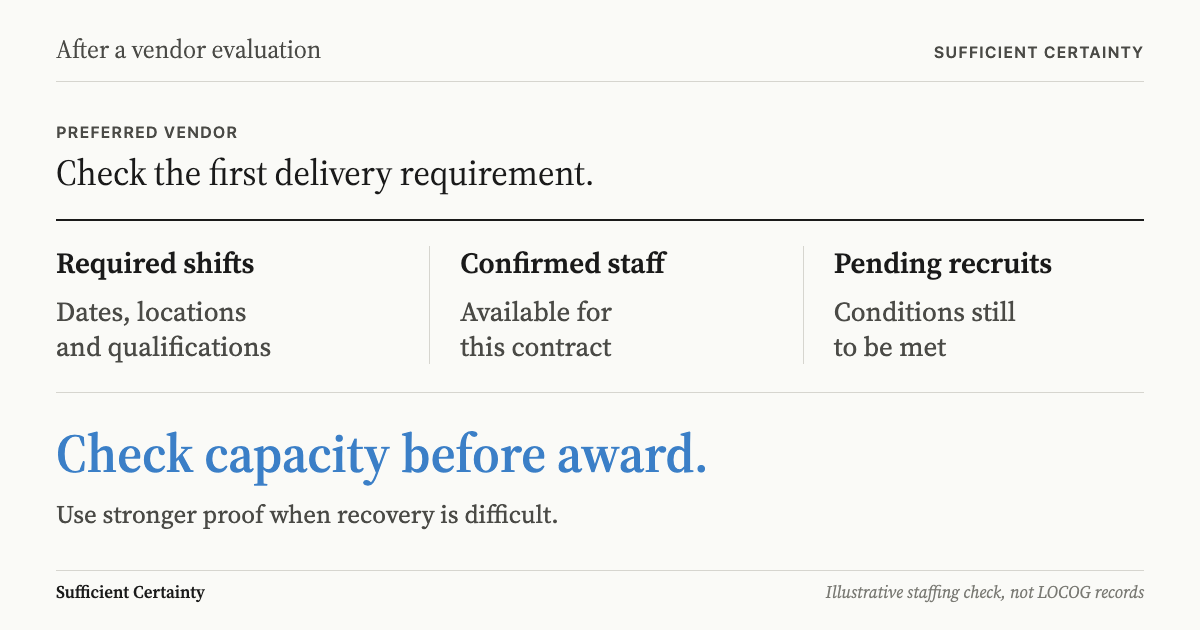
For the next award, establish the evidence standard before accepting a capacity claim. Identify which shortage would prevent the service from working and how long recovery would take. That makes the required proof specific to the purchase, rather than to the supplier's reputation.
The vendor ranking is complete. Which delivery claim still needs proof before the contract is awarded? Start the Walk →
Which vendor claims need proof before contract award?
A vendor evaluation can compare offers against a common requirement. It can record the reasons for preferring one supplier. The CIPS supplier evaluation guide distinguishes desk appraisal from field research and third-party appraisal. The information can therefore come from more than the supplier's questionnaire.
Preserve that work when moving to negotiation. Keep the requirement alongside the evidence used to score it. If a vendor received a strong capacity score, identify what supported that score. A reference from a previous customer may establish experience. The current workload may require separate verification.
Start with the claims that could prevent delivery altogether. Ask the person responsible for using the service which failure would make the contract unusable. Then trace that requirement through the preferred vendor's offer. This keeps the evidence request focused on delivery, rather than adding another general questionnaire.
For example, a buyer considering an outsourced service could ask the vendor to demonstrate coverage for the first operating week. Compare the required shifts with the staff allocated to them. Mark vacancies separately. Ask who can authorise replacement staff and how long replacement takes. This is a hypothetical check, not a description of LOCOG's procurement process.
For manufacturers, an article hosted by NIST's Manufacturing Extension Partnership recommends examining what a supplier's stated capacity means and whether it can support growth. Apply the same question to the actual purchase: how much capacity remains after existing commitments?
A weighted result can still help compare acceptable offers. However, a good price should not compensate for failure to meet a requirement essential to the purchase. Revisit the conditions behind a multi-criteria ranking before treating the highest total as an award decision.
Keep the units consistent when comparing capacity with demand. Headcount may conceal part-time availability or different qualifications. A weekly production total may conceal a shortage on the day a delivery is due. Ask for the evidence in the same units and time periods as the requirement. Otherwise the comparison can look satisfactory while a specific obligation remains uncovered.
Also distinguish today's evidence from a promise to produce evidence later. A supplier may genuinely need the contract before hiring the entire delivery team. In that situation, assess whether the hiring plan is achievable before signing. Identify which commitments can be verified now and which require later acceptance checks.
Do not require every resource to exist before any contract is signed. That could exclude a capable supplier unnecessarily. The issue is whether the delivery plan contains unresolved dependencies that the buyer cannot accept. Record those dependencies explicitly among the assumptions supporting the decision.
Set the evidence required before committing to the vendor
Open the contract award recommendation and add an evidence requirement for each essential delivery claim. Specify the document or demonstration that would satisfy it. Name the person who will examine it. Set the check before the commitment that would make a failed assumption costly to reverse.
The standard should reflect the consequences of a shortage. If the buyer has a usable alternative and can recover without much disruption, a limited trial may provide sufficient certainty. If the service must start on a fixed date, request stronger proof of readiness before accepting that exposure.
A staffing plan should reconcile the required coverage with confirmed availability. Examine any remaining recruitment separately. If the delivery plan depends on subcontractors, request evidence of their commitment through the proper procurement process. Treat a proposed subcontractor as unconfirmed until the agreement needed for delivery has been established.
For transition planning, the UK government's contract management guide recommends starting mobilisation planning before award where possible. It calls for realistic milestones and tracking whether mobilisation obligations can be delivered. The work after a contract review connects each obligation to the person and record needed to operate it. These are preparation tasks, not reasons to change tender requirements after evaluation.
Record the source date as well as the result. A roster checked during evaluation may change before the award meeting. Where a key dependency has changed, ask for an updated confirmation through the agreed procurement channel. Keep the earlier evidence so the decision record shows what changed and why the award recommendation still holds.
If the evidence falls short, decide what can change. Delay the award while obtaining missing proof, reduce the initial scope, or reconsider an eligible alternative. Use the procurement procedure that applies to the purchase. Avoid an informal promise that gives one bidder a different requirement from its competitors.
Agree how unresolved capacity will be reported after award. Require a clear distinction between resources already available and resources still being secured. Give an accountable buyer authority to act on a missed readiness milestone. That action must happen while a useful alternative remains available, rather than after the promised service has already failed.
Write down the reason for proceeding in the decision record. State which evidence has been accepted and which uncertainty remains. Include the latest date for corrective action if a remaining dependency fails. A general instruction to monitor the supplier leaves that decision unresolved.
The Universal Decision-Making Method makes sufficient certainty an explicit part of deciding. Among decision-making frameworks, vendor evaluation contributes a useful comparison. Complete the award recommendation by showing why the preferred vendor's delivery evidence is sufficient for the contract now being authorised.
How strong is the evidence that the preferred vendor can meet the first delivery commitment?
Work through your decisionNo sign-up. Just pick your decision and start.
Grant Purdy is the co-author, with Roger Estall, of Deciding (2020), and the architect of the Universal Decision-Making Method.