
After a pay equity audit, write the employee groups and pay components covered by the findings at the top of the adjustment proposal.
Salesforce reported that 8.5% of its global employees needed adjustments in its seventh equal-pay assessment in 2022. A repeated assessment had produced another set of corrections. The decision after an audit therefore needs a clear purpose: correct the evaluated differences while deciding how future pay decisions will be checked.
A pay equity audit examines compensation differences between employee groups and the job-related factors used to explain those differences.
A pay equity audit identifies differences within its chosen scope
A completed audit gives the compensation owner evidence to review individual pay differences. It can identify which differences remain unexplained after the selected comparisons. It can also show where records need correction before a pay conclusion is reliable. Those are useful results, even when the next decision extends beyond the audit.
The OECD describes equal-pay audits as going beyond headline pay reporting. They examine workforce representation and job evaluation, as well as detailed pay differences. That wider examination helps an employer investigate the reasons for a difference rather than act on a single aggregate figure.
For a compensation proposal, preserve the audit's scope beside its findings. Record the date of the employee data and which pay components were included. State how jobs were grouped for comparison. Include any groups that could not be assessed reliably. This lets the person approving adjustments see what the evidence actually covers.
A correction proposal should distinguish a confirmed data error from an unexplained pay difference that needs a decision. The actions differ. A wrong job code needs a corrected record and possibly a new comparison. An unexplained difference needs a considered response based on the employee's actual work and relevant obligations.
Keep the explanation for each proposed adjustment with the underlying comparison. Otherwise, the total budget becomes the only visible result. A later reviewer then cannot tell whether the response addressed the finding or simply stayed within the available amount. The distinction matters in organisational governance, where an approval needs a stated purpose and accountable owner.
The audit's scope also sets the limit of any claim made about the result. If the review covered base salary, describe the conclusion about base salary. If certain employees were excluded, explain why. As with responding to a gap analysis, the measured difference needs an explicit decision about what will change.
Correcting the audit’s pay differences still leaves a decision about who checks the next salary offer. Start the Walk →
What compensation decision does the audit leave unresolved?
The question “Which employees need an adjustment?” can be answered from the audit and individual review. The question “How will compensation remain equitable as the workforce changes?” requires decisions about the process that sets pay. Those decisions include which comparisons are required before a new offer is approved and how an acquired workforce enters the review.
Write both questions on the compensation proposal. Give each its own owner and proposed response. This avoids making the correction budget carry a promise it cannot fulfil. It also avoids delaying identified corrections while the organisation debates a larger redesign of its pay process.
There is also a distinction between like-for-like pay comparisons and the distribution of people across roles. The Workplace Gender Equality Agency explains that a gender pay gap compares typical earnings across a population. Equal pay concerns the same work or work of equal or comparable value. An employer can need to examine both questions.
Choose the comparison that matches the decision rather than use one headline result for every purpose. A finding about comparable roles does not answer whether access to higher-paid roles is equitable. Equally, a whole-workforce pay gap does not establish which individual salary adjustment is justified. These are separate questions for the response paper.
Check the explanations accepted by the audit as well. If a difference is explained by performance ratings, ask whether the ratings are a sound basis for this decision. If job level explains it, confirm that the employees' duties support that classification. Making assumptions explicit prevents a recorded category from becoming an unquestioned reason.
Salesforce included equal pay in its annual compensation review
In its March 2022 equal-pay update, Salesforce described its seventh assessment. The population was nearly 70,000 global employees at the time of the audit. It included Slack, its largest acquisition, which had closed the previous year.
The company reported spending $5.6 million to address unexplained pay differences identified in that assessment. It also said equal pay was incorporated into its annual compensation process. Salesforce explained that acquisitions bring other companies' pay scales, while market conditions and competition for talent can affect pay.
Salesforce described annual audits with adjustments as needed. It was also examining stock-grant eligibility and extending the scope of its analysis. These are reported company practices. They show repeated assessment of a changing population, rather than treating the first correction as a permanent conclusion about future employees.
The decision-making lesson is to include workforce change in the purpose of the response. This is an interpretation of the reported practices. It is not evidence that Salesforce used the Universal Decision-Making Method, or proof that its entire compensation system was equitable.
For another employer, the practical question is what happens when the comparison population changes. If an acquisition is planned, specify who will map the incoming roles to existing roles. If hiring expands a job family, specify who will review the starting salaries against current employees. The audit response should assign these questions before they become disconnected projects.
A public adjustment total cannot establish how every employee was treated. Assess the organisation's own evidence before making a broader claim about pay fairness.
The same separation helps when reporting to employees. Explain the scope of the completed review and what was done about its findings. Describe proposed process changes as proposals until they are approved and implemented. Governance and compliance require attention to different questions; a public announcement should not erase either distinction.
Rewrite the compensation decision before approving the response
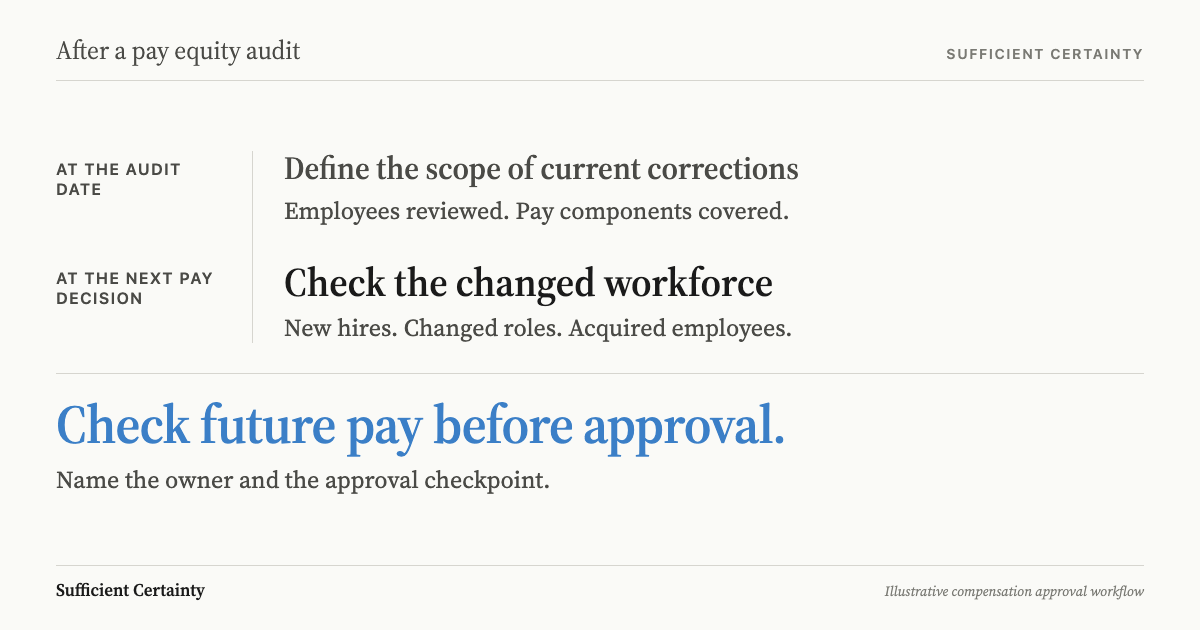
Before the adjustment proposal goes to its approver, add a short section called “Future compensation decisions”. State the purpose in plain words: maintain equitable pay when people enter the organisation or their work changes. Name the employee groups and pay components the process will cover. Identify any exclusions and who must decide how to handle them.
Specify the approval checkpoint for future pay decisions, not just the date of the next audit. For a new hire, the proposal might require a comparison with employees doing comparable work before the offer is approved. For an acquisition, it might require a role-mapping review before incoming employees are placed in the existing salary structure. These are possible responses to evaluate, not claims about current practice.
The Fair Work Ombudsman's best practice guide distinguishes correcting identified differences from addressing their underlying causes. It also identifies hiring and allocating pay rises as occasions to consider gender pay differences. That supports examining pay decisions where they occur, alongside repeat assessment.
Name the person who approves an exception and the evidence they need. A recruitment manager may request a higher starting salary to fill a difficult role. The response should explain how the compensation owner will examine comparable employees before deciding. Recording an exception without a review of its effect leaves the central pay question unanswered.
Use the Universal Decision-Making Method to state the purpose before choosing the response. This broadens the options beyond a correction budget alone. It can bring changes to offer approval or job classification into consideration without assuming that every pay process needs replacement.
Keep the current corrections and the future process decisions together in the approval paper, with separate responsibilities. A decision record can preserve what was approved and the evidence behind it. The approver should be able to identify who implements each part and what evidence will confirm that it happened.
Set a review trigger that matches the organisation's actual changes, such as an acquisition or a revised job structure. Follow the applicable requirements and specialist advice for the workforce concerned. The completed response should say which pay decisions will be checked, by whom, and before which approval.
How will the compensation process check equitable pay when the next hire or acquisition changes the workforce?
Work through your decisionNo sign-up. Just pick your decision and start.
Grant Purdy is the co-author, with Roger Estall, of Deciding (2020), and the architect of the Universal Decision-Making Method.