
After a penetration test, write the evidence required to close the most consequential finding beside that finding. In its January 2023 report, the Interior Inspector General recovered 21 percent of active account passwords; 99.99 percent of cracked accounts met departmental complexity requirements. The next decision needs evidence that a repair changes the weakness the test found.
The risk assessment hub considers how findings support decisions. Here, the immediate decision is whether a specific repair provides enough evidence to close a finding.
A penetration test uses authorized technical testing to identify and validate exploitable weaknesses within agreed systems and limits. The authorization also specifies the permitted methods.
Findings lead to repairs and an acceptance decision
A completed penetration test gives the system owner findings to review. The report identifies affected assets and observed behavior. It provides evidence for each finding. Severity ratings and suggested repairs help the owner assign work. Keep the original report available while assigning the work. A short ticket can leave out a condition that explains why the weakness matters.
NIST SP 800-115 addresses planning technical security tests and analyzing findings. It also covers developing mitigation strategies. It also identifies benefits and limits of testing techniques. Use that distinction when reading the report: the test result describes work within a boundary, while the operating decision may concern a wider service.
For each finding, identify the service affected and the person who can approve continued operation. Give the repair to someone with authority to change the relevant system. Record the target date and the evidence that must return with the completed ticket. If a proposed repair changes the original scope, ask the tester to confirm what follow-up work is authorized.
Closing the ticket requires a stated evidence standard. A screenshot of a new setting can show that someone made a change. It may leave unanswered whether the affected service now behaves as required. Name the behavior that matters before choosing the evidence.
Separate the repair task from the acceptance decision. A developer can complete a change while the system owner still needs to decide whether unresolved exposure permits continued operation. The distinction also matters after risk evaluation, when a rating must support an actual choice.
Do not wait for the whole report to become a green dashboard. Start with the finding whose consequences could most affect the proposed operation. Ask what decision its closure would permit. If that answer is unclear, the repair ticket needs a clearer purpose before anyone defines its completion evidence.
What does a successful retest establish?
An authorized retest can establish whether the reported weakness remains observable under specified conditions. That is useful evidence. It allows the owner to compare the original result with the behavior after a change. Record the finding identifier and affected asset. Keep the relevant version with the test date and result so that the comparison can be checked.
A retest result must name the conditions it covers. Ask whether the tester used the relevant account type and configuration. Confirm the access conditions separately. If the production service differs from the tested environment, record the difference. A result from one environment needs an explanation before it supports a decision about another.
NIST SP 800-53A provides customizable control assessment procedures and guidance on assessment plans and results. It supports choosing assessment work for the question being asked. The following checks are a proposed application, rather than a claim that every retest must follow one fixed procedure.
Write the expected result in terms the owner can understand. For an access-control finding, that could mean confirming the affected role cannot perform the prohibited action. Have the authorized tester specify the permitted check and its limits. Include any relevant legitimate activity that must still work after the repair.
Successful retesting supports a bounded conclusion. Keep the conclusion as narrow as the evidence. “The reported weakness was not reproduced in the agreed retest” leaves room to list exclusions. “The application is secure” needs much wider evidence than closing one finding provides.
A scoped retest also differs from an objective-led attack campaign. A red-team exercise can examine how several defenses work together against an adversarial objective. Choose that wider work when the decision needs it. Do not quietly expand a repair check into activities outside its authorization.
If the check cannot run safely within the approved limits, record that constraint. The owner can then choose another authorized assessment or retain the finding as unresolved. Lack of permission to retest cannot serve as evidence that the repair worked.
Before accepting a penetration-test repair, state what result would justify closing the finding. Start the Walk →
Interior testing exposed passwords behind compliant rules
The Interior OIG password inspection recovered 18,174 passwords from 85,944 active accounts. The requirements included a twelve-character minimum and three character types. Almost every cracked account met those requirements. The report included 288 accounts with elevated privileges among the cracked accounts.
The inspection concerned Active Directory accounts and excluded systems with separate authentication and third-party accounts. Investigators agreed rules of engagement with the Department. They explicitly excluded exploiting the findings to compromise its network. This case supplies evidence about password controls, rather than a completed network attack or a successful repair retest.
A compliant setting can leave the relevant weakness unresolved. The case gives a reason to ask what a changed password rule would actually establish. It does not tell another organization what its own test would find. Local acceptance needs local evidence within an agreed scope.
For a reader dealing with a similar finding, the proposed next step is to define the control outcome. Ask the authorized assessor what evidence would show that the affected account controls now meet that outcome. Keep policy changes separate from implementation evidence in the closure record. Record the test results separately. Each answers a different question.
Consider a proposed response that only updates policy text. The owner still needs evidence that the change reaches the affected accounts. Consider a response that only records a software installation. The owner still needs evidence that the installed control applies to the relevant service. These are illustrative checks, not statements about what Interior later did.
The service's consequences determine how much evidence is enough. Ask what unauthorized access could affect in the operation being approved. Identify whether the account can change critical settings or expose sensitive information. Check separately whether it can interrupt a required service. Then decide whether the proposed evidence addresses that consequence.
Keep the original finding visible during that decision. A lower severity label after a change should come with reasons and evidence. The problem is similar after a data breach assessment: the conclusion must remain traceable to what the assessment actually established.
Agree on the evidence before closing the finding
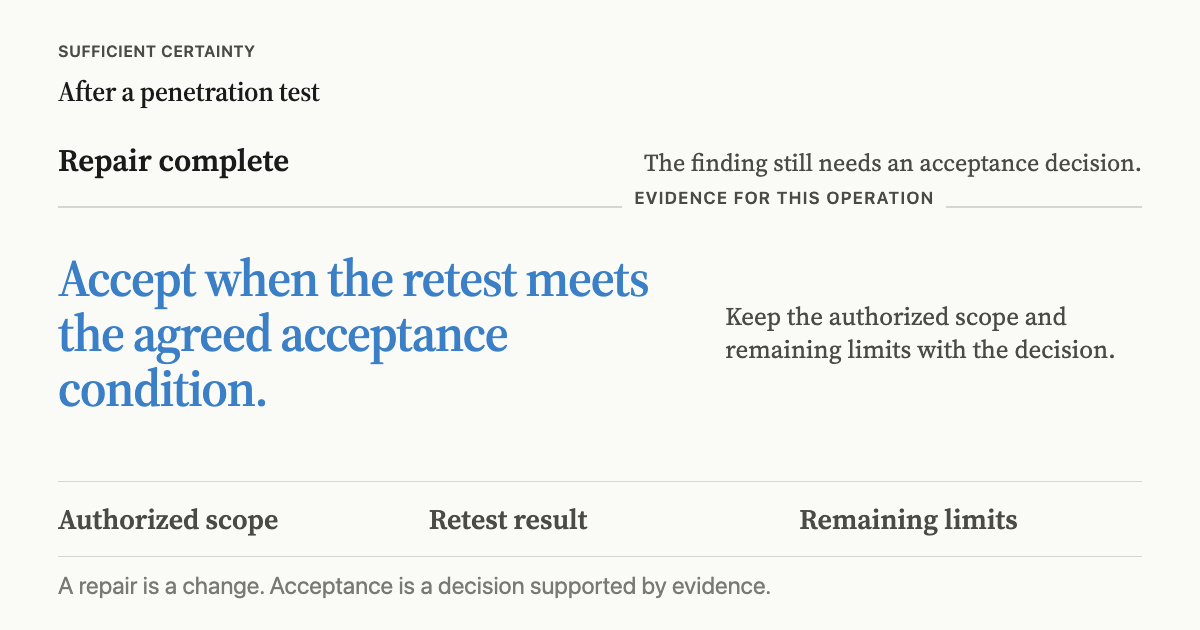
Bring the owner and repair lead to the same closure record. Include the authorized tester. State the operation being approved and the finding being addressed. Then write the expected result. Record the agreed retest scope and the evidence needed. Name who can accept any remaining exposure.
Set the acceptance condition before seeing the retest result. Otherwise, a convenient result can become the standard after the work has finished. For a consequential weakness, unresolved exclusions may require another check or a limit on operation. For a less consequential issue, a narrow result may support closure with a recorded limitation.
This applies the Universal Decision-Making Method to one operational choice. Sufficient certainty means enough confidence to make that choice, given its purpose and consequences. It does not mean eliminating every possible weakness or demanding the same evidence for every finding.
Use the closure record to explain why the evidence is enough. If another authorized check could change the decision, identify that check and who will arrange it. If further work would add detail without changing acceptance, record why. The question of having enough information to decide needs that explicit stopping condition.
NIST's continuous monitoring guidance addresses ongoing visibility into assets and threats. It also covers the effectiveness of deployed controls. Apply that principle by recording what later change would reopen this finding. A configuration change could prompt review. A newly exposed service could also require another check. Evidence that the repaired control stopped working should reopen the finding.
Acceptance needs a reason and a review trigger. Save the result with its limits. Record the owner's decision and the trigger alongside that evidence. That gives the next reviewer a concrete basis for checking whether the accepted conditions still hold.
How much evidence does the proposed operation need before a penetration-test finding can be closed?
Work through your decisionNo sign-up. Just pick your decision and start.
Grant Purdy is the co-author, with Roger Estall, of Deciding (2020), and the architect of the Universal Decision-Making Method.