
After a structural risk assessment, test the assumptions behind the engineer's ratings and urgency language, then decide as the owner, before the report is filed into the capital plan or the reserve schedule. The engineer describes the building. Nothing in the report decides how long the building can wait.
In October 2018 an engineer told a Florida condominium board that the slab under its pool deck had major structural damage. The first payments for the repairs were due a week after the building fell.
A structural risk assessment is an engineer's survey of a building's load-bearing elements that rates their condition, traces defects to cause and recommends priced repairs.
Champlain Towers South and the assumption nobody checked
In 2018 the Champlain Towers South association in Surfside, Florida, hired Morabito Consultants to survey its 12-storey, 136-unit building ahead of the 40-year recertification due in 2021. The structural field survey report, dated 8 October 2018, was direct: the waterproofing below the pool deck and entrance drive had failed, and "the failed waterproofing is causing major structural damage to the concrete structural slab below these areas."
The report traced the problem to the original design. The slab was flat, so water sat on the membrane until it evaporated. In the garage it found "abundant cracking and spalling" in columns, beams and walls, and spalls in the slabs above with exposed, deteriorating rebar. It warned that failing to replace the waterproofing "in the near future" would cause the deterioration "to expand exponentially."
What the report did not do was say the building was in danger of collapse. It closed by describing its findings as "required maintenance" and offering to discuss how the repair work "coincides with the owner's desires and constraints." That is ordinary engineering courtesy. It also handed the timing decision to the owner without saying so.
On 15 November 2018 the town's building official attended a board meeting. The minutes record him saying the report had collected the necessary information and "it appears the building is in very good shape," the Associated Press reported. The next day he wrote to the town manager that the main concerns over the recertification had been addressed.
The board then spent two and a half years on the money. Five of its seven members resigned in 2019 amid disputes over the repairs. In April 2021 the association approved a $15 million special assessment, and board president Jean Wodnicki wrote to owners that the damage "has gotten significantly worse since the initial inspection." Payments were due to begin in July.
On 24 June 2021 the building partially collapsed. Ninety-eight people died. NIST's technical findings, released in June 2026 ahead of its final report, place the start of the failure at column connections beneath the pool deck slab. They conclude that the structure's margins against failure "were too narrow from the start," mainly because of deviations in the original design and construction, and that added loads and corrosion reduced them further.
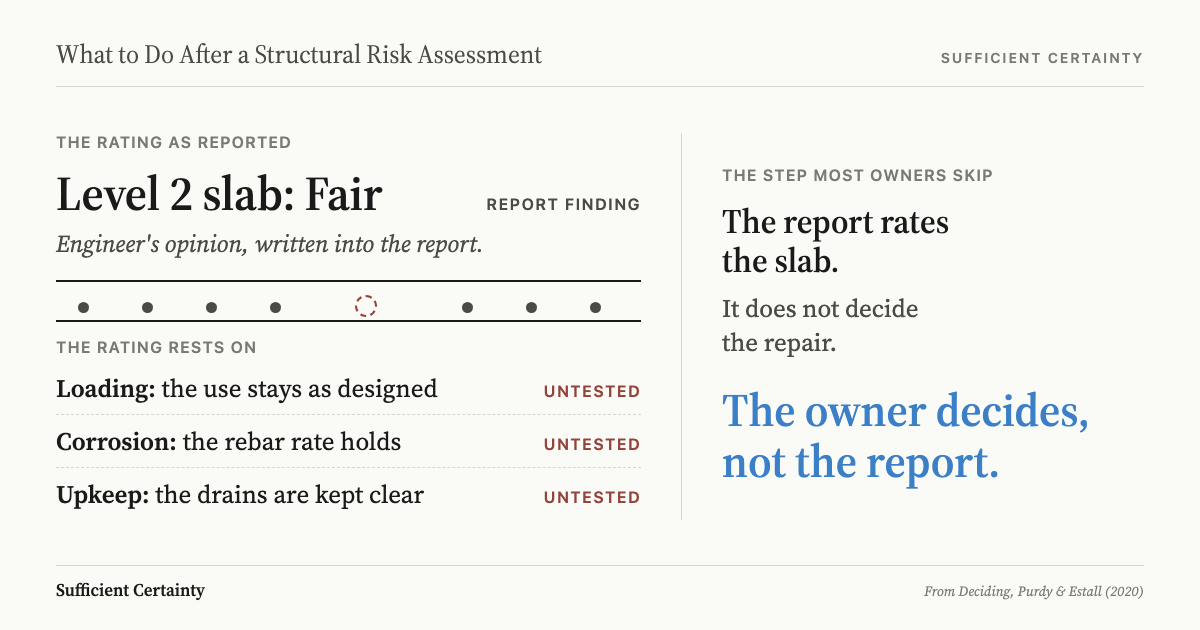
Whether earlier repairs would have saved the building is not something the record settles, and no claim is made here that they would. The decision failure is narrower. The readers who shaped the timetable treated "major structural damage" without the word "danger" as permission to follow the normal cycle: consult, budget, assess, repair. Nobody tested the assumption that the building could wait for the budget.
Pick the repair your budget is deferring and write down what has to stay true about the structure for that repair to wait. Start the Walk →
What a structural risk assessment gets right and where it stops
The assessment does real work. A competent engineer inspects what owners cannot see, identifies defects, traces them to cause and prices a repair scope. The Morabito report did all of that, including naming a design error nearly forty years old. For an owner, that is the analysis half of the job done properly: what is wrong, where, and roughly what it will cost.
Regulators have since pushed more of that work into the open. Florida's 2022 building safety law introduced milestone inspections for condominiums of three storeys or more at 30 years (earlier near the coast, a trigger since left to local officials) and a structural integrity reserve study every ten years. Owners now get more assessments, sooner, with reserve figures attached.
Where the assessment stops is the page. In the terms of a formal risk assessment, the report delivers identification and analysis, and leaves evaluation to someone else. Its ratings are the engineer's opinion, formed under a scope, a fee and a duty of care. Words such as "timely" and "near future" are judgements about deterioration rates, not deadlines.
The report cannot control what its reader does with "near future." That meaning is assigned later, and the same report reaches several readers, each asking a different question of it.
Each reading was reasonable from where that person sat. None of them was a decision about how long the slab could safely carry the damage. That question belongs to the owner, and neither a condition grade nor a cell on a risk matrix answers it. A report read four ways has not yet been decided once.
The checkpoint between analysis and action
The checkpoint sits between receiving the report and filing it into the capital plan. A board, asset manager or facilities lead pauses there and treats the engineer's findings as inputs to a decision, not the decision itself. The five-step method gives that pause a shape.
Frame the decision in the owner's terms. The question is not whether to approve the repair scope, but how long the building can safely carry what the engineer found, and what the owner is relying on to believe that. Then set out the Tentative Elements: the repair itself, its timing, the funding route and any interim measures, such as load limits on the deck or temporary shoring.
Assumptions is where Surfside turned. Write down the ones the timetable depends on: that deterioration is progressing at the rate the report implies, that "near future" means years rather than months, that no mention of danger means no danger. Each can go back to the engineer as a direct question. An urgency phrase the engineer will not convert into a date is itself a finding.
Sufficient Certainty asks how much confidence the owner needs before accepting the delay a budget cycle imposes. For a slab carrying a pool deck over an occupied garage, the bar is high, and a visual survey may not reach it. Wodnicki's 2021 letter conceded that the extent of rebar damage could not be known "until the concrete is opened up." A tolerance statement does not settle that gap.
Implement and Monitor means naming, before the report is filed, what would bring the decision back to the table: new cracking, spalling at a column head, standing water, a revised estimate. At Champlain Towers South, the point to do all of this came early.
The same checkpoint applies after a workplace risk assessment or any survey that ends in ratings and a recommended scope. The assessor supplies the evidence and the opinion. How long the building can wait is the owner's decision, and no report can make it for them.
You could schedule repairs by the report's priority ratings and still leave the assumptions about how fast the damage is moving untested.
Work through your decisionNo sign-up. Just pick your decision and start.
Grant Purdy is the co-author, with Roger Estall, of Deciding (2020), and the architect of the Universal Decision-Making Method.