
After a supply-chain risk assessment, the step before approving treatments is to write the delivery outcome those treatments must protect. Adding another source can leave a supply chain just as dependent on one failure point. Before spending money, check whether the assessment covered every activity needed to deliver that outcome.
A supply-chain risk assessment identifies and evaluates disruptions that could prevent a network of suppliers and operations from delivering required goods or services.
The assessment maps dependencies and possible disruptions
A completed assessment should give the decision-maker something more useful than scores beside supplier names. It should connect required outputs to the materials, operations and routes on which delivery depends. That makes it possible to trace a disruption through the network, rather than consider each business separately.
NIST's guidance for small manufacturers recommends mapping suppliers and their suppliers. It includes site activities, alternative sites and the time needed to begin shipping from an alternate site. Those details help distinguish an available alternative from one that could resume the required work soon enough.
The usual next step is to develop treatments, name owners and seek funding. A concentrated source may prompt an alternative supply arrangement. Long replacement times may prompt a stockholding decision. A vulnerable operation may need a recovery plan. Each response should have an explanation of which disruption it addresses.
Trace the required output. Start with a product or service the organisation must deliver. Follow its dependencies through to the customer. Check that the map includes internal operations as well as external supplies. An internal testing delay can matter to delivery even when purchased materials arrive on time.
Preserve the assessment's evidence when it moves into a spending proposal. Record which map was used, when its information was checked and which dependencies remain uncertain. A diagram with an unexplained line should prompt a question, rather than be treated as confirmation that the connection works.
The broader risk assessment question is how the findings support a particular decision. The assessment can locate exposures and help explain their consequences. Funding decisions still require a choice about the outcome to protect and the level of disruption that can be accepted.
That distinction matters when interpreting a risk matrix. A high score is a reason to examine an exposure. It does not establish that the proposed treatment will preserve delivery. Keep the supporting evidence attached to the recommendation so that this question remains open to review.
Use The Walk to examine whether your supply-chain treatments protect the delivery outcome you need. Start the Walk →
Which continuity outcome did the assessment leave outside its boundary?
The boundary can be wrong even when every entry inside it is accurate. An assessment focused on purchased inputs may miss the internal process that makes those inputs usable. A plan focused on production volume may miss the testing needed before output can be released.
Name the continuity requirement. Specify what must reach whom, by when, and in what usable condition. Include any minimum service that must continue during a disruption. Agree these conditions with the person responsible for delivery before comparing treatments. Otherwise, different departments can recommend actions against different versions of success.
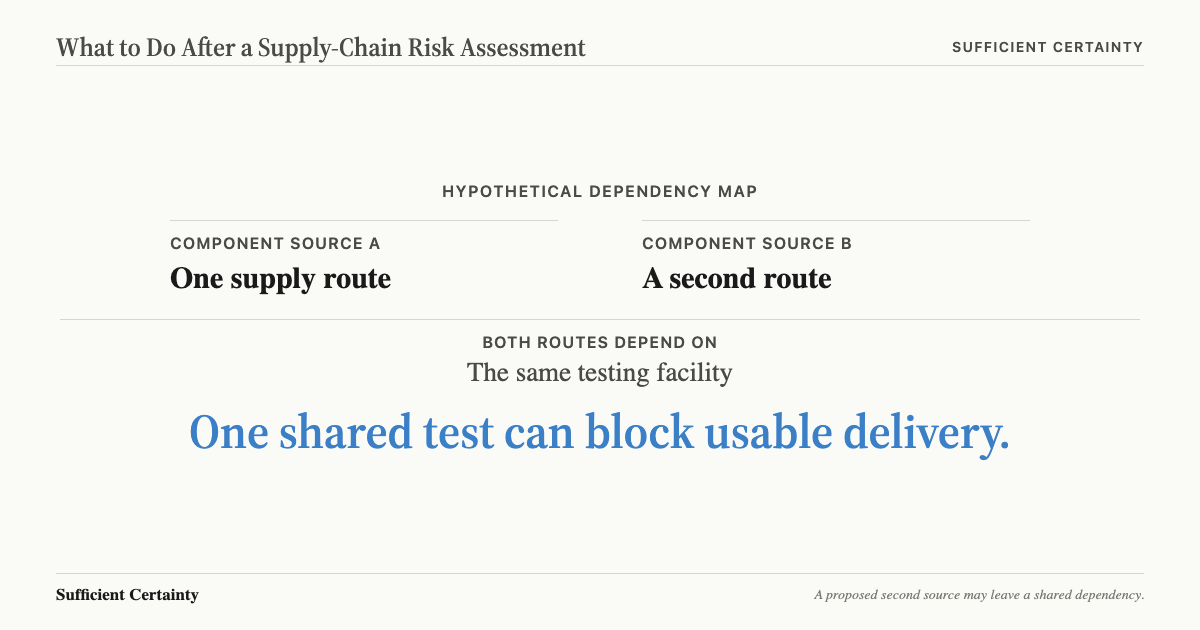
Consider a hypothetical manufacturer with two component suppliers. Both send components through the same specialist testing facility. A second supplier gives purchasing another source, but it does not provide another way to release tested components. The relevant decision may be about testing access, temporary demand reduction or a different product specification.
This hypothetical chain shows why checking shared dependencies belongs in the review. Ask whether alternative paths share facilities, skills or approval processes. Mark any common dependency on the map. Then consider whether the proposed response changes it or only changes the organisation supplying an earlier stage.
The UK supply chains resilience framework includes demand management alongside diversification, stockpiling and capacity options. That widens the choices available after assessment. Preserving the required service may involve changing what is demanded, rather than maintaining every existing supply arrangement.
Use scenario planning to examine how a proposed response works when a shared dependency becomes unavailable. Keep the scenario tied to the delivery requirement. A test that ends when materials reach the factory cannot establish whether the customer will receive usable output.
NNSA's broad register versus its narrower resilience plan
The National Nuclear Security Administration's explosives program provides a documented example of this scope gap. GAO's March 2025 report described annual supply-chain maps and risk registers covering 11 key explosives. The assessment process identified and tracked risks across the network.
GAO identified 10 risk categories spanning 64 threats and two issues. However, the primary resilience plan addressed sole-source supplier and infrastructure risks. It aimed to provide adequate production capacity. GAO found that it omitted strategies for other categories, including testing challenges and legacy materials or processes that were difficult to reproduce.
GAO recommended a comprehensive resilience strategy covering all identified risks. NNSA agreed with the recommendation. These are findings from the public report. Its separate controlled unclassified annex is not needed for this example, and no additional supply details are assumed here.
- Sole-source supplier risks
- Infrastructure risks
- Can required output pass testing?
- Can replacement processes produce usable materials?
- Which dependencies remain outside the funded plan?
- Who can act when those dependencies change?
The lower questions are a proposed decision review, rather than a description of NNSA practice. The framing question is whether production capacity covers the required continuity outcome. Compare the plan with the full map. Check where the approved projects end and whether delivery still depends on activities beyond that boundary.
A practical review would put the register beside the treatment proposal. For each relevant dependency, identify the proposed response or record why no response is needed. An uncovered dependency should become an explicit decision for the responsible person. It should not disappear because it falls outside the project's budget.
The same issue arises after risk evaluation: selecting priorities can narrow attention before the decision is framed. Record what the plan leaves uncovered. This review can expose a scope gap. It cannot establish that a particular treatment will guarantee resilience.
Write the continuity decision before funding the treatments
Before approval, produce a short decision note that connects the intended delivery outcome to the assessment and proposed actions. Include the network boundary and explain exclusions that could affect delivery. Keep it with the funding request so that the approver can challenge the scope before committing resources.
The Universal Decision-Making Method provides five steps for this work. Apply them to one continuity decision, such as whether to fund additional production capacity or protect another dependency first. Avoid turning the entire assessment into one decision with no clear owner.
- Frame. State the required continuity outcome and who needs it. Define the network that contributes to delivery, including internal activities. Check whether the decision concerns more supply, faster recovery or a changed service commitment.
- Tentative Elements. Set out the proposed response and credible alternatives. Compare options against the same outcome. Include changing demand or delivery commitments where those choices are available, rather than treating the current arrangement as fixed.
- Assumptions. Name the dependencies each option requires. Distinguish independent alternatives from routes that share facilities or skills. Record which assumptions have evidence and which need checking before the approval can proceed.
- Sufficient Certainty. Decide what evidence is enough for this commitment. Obtain the missing information that could change the choice. A reversible stockholding adjustment may need different evidence from a long construction commitment.
- Implement+Monitor. Assign responsibility for the response and for checking its conditions. Specify the change that requires reconsideration. Give someone authority to act before the remaining recovery time becomes too short.
Set a review trigger. Use a condition linked to the decision, such as an alternative route losing its testing slot. Name the person who checks that condition and the person who can change the plan. A scheduled register update alone may occur too late for the required response.
Keep the risk register's role clear in this note. It supplies evidence about exposures. The note records the continuity choice, its scope and the conditions for continuing with it. Approval should cover that choice, with its unresolved dependencies visible to the approver.
How confident are you that your alternative supply routes remain usable when a shared dependency fails?
Work through your decisionNo sign-up. Just pick your decision and start.
Grant Purdy is the co-author, with Roger Estall, of Deciding (2020), and the architect of the Universal Decision-Making Method.