
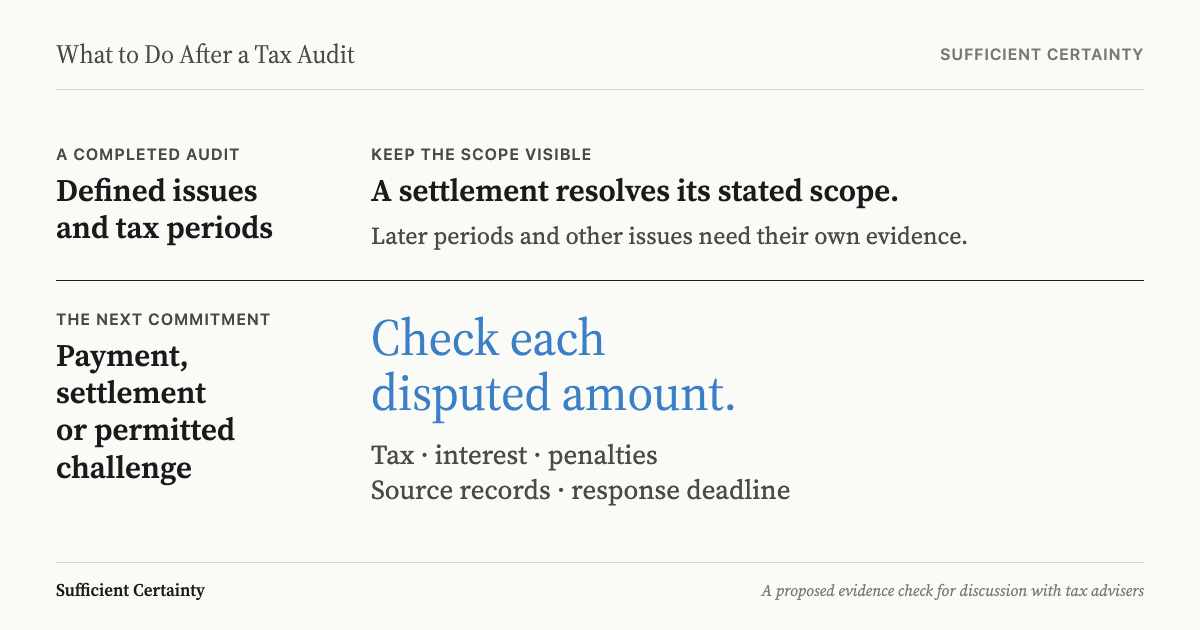
After a tax audit, put each disputed amount beside its source records and response deadline before meeting the tax adviser. Caterpillar’s September 2022 IRS settlement resolved issues for tax years 2007 through 2016. That defined scope matters when deciding what a completed audit allows a business to settle, pay or challenge.
A tax audit examines records and reported tax treatment for specified periods to determine whether the reported tax is correct.
Caterpillar settled specified years and disputed amounts
Caterpillar disclosed the settlement in its 2022 Form 10-K. It included disputed tax treatment of profits earned by Caterpillar SARL from certain parts transactions. The final tax assessed for all issues within the ten-year settlement was 490 million US dollars. Associated interest was $250 million. The settlement included no penalties.
The company said it had contested particular IRS legal theories and that the settlement did not include US tax increases based on those theories. It also reported that tax years 2017 to 2019 were under examination at that time. These are historical disclosures, not a statement about Caterpillar’s present tax position.
The distinctions prevent several misleading summaries. The principal tax amount was not a penalty. Interest was a separate component. Resolving the specified years did not establish that later years were resolved. A headline total cannot tell a finance manager which issue, period or legal conclusion belongs in a decision about another business.
The report does not provide a universal formula for deciding whether to settle an audit dispute. It records one company’s outcome. The managerial application is to separate the components before comparing options with advisers. A business should know whether the amount under discussion represents proposed tax, agreed tax, interest, penalties or another item.
For a completed audit, start with the actual report and notices. Preserve the tax authority’s description of each adjustment, the period covered and the stage of the process. Put the business’s position beside it. A disagreement about the facts needs different work from a disagreement about the tax treatment of facts both parties accept.
The board paper should retain those differences. A sentence saying the audit is complete may mean the examination has ended while a dispute remains open. A sentence saying the issue is settled may cover only named periods. Ask the tax adviser to identify exactly what the document establishes before using either phrase.
This is more specific than the action after a government audit. That task connects findings to evidence of corrective action. A tax audit may require a choice about quantified liabilities and procedural rights. An action owner and completion date do not answer whether a particular adjustment should be accepted or contested.
Keep the consequences of waiting visible. Request the applicable response date from the actual notice and have the adviser verify it. Record who must approve the response early enough for preparation and delivery. A management meeting scheduled after the response deadline cannot be the first point at which the disputed amount receives attention.
An evidence schedule helps make the discussion concrete. Give each disputed adjustment a reference. Link it to the relevant return, underlying records and tax authority explanation. Distinguish evidence already held from evidence that still needs retrieval. Ask the adviser which gaps could affect the available response, rather than requesting every historic document indiscriminately.
The comparison should also state the limits of management’s knowledge. A finance manager may verify payment records while relying on advisers for a legal interpretation. Identify both contributions. The decision needs enough reliable evidence for the chosen response, with unresolved matters stated plainly rather than hidden inside a single assurance that advisers are comfortable.
Which evidence supports the proposed response to each disputed amount?
Set that evidence requirement before debating the preferred outcome. Otherwise a desire to close the matter can shape what gets reviewed. The case supports careful distinctions about amounts and periods; the proposed evidence requirement is a decision practice for the reader. It is not a claim about Caterpillar’s internal approval process.
What evidence supports the response proposed for each disputed tax amount? Start the Walk →
Which audit findings support payment or challenge?
Within organisational governance, a completed tax audit gives the business a defined set of findings to examine. It can identify records the authority considered, calculations it made and treatment it disputes. That is useful progress. It allows the finance team to replace a broad concern about the audit with specific questions about the proposed adjustments.
For US federal audits, the IRS description of audit conclusions distinguishes no-change, agreed and disagreed outcomes. A completed examination therefore does not necessarily mean agreement. The right next step depends on the actual outcome and notice, with advice appropriate to the business and tax involved.
Read the report at the level of individual issues. Ask whether a disagreement concerns a missing record, a calculation, the character of a transaction or the application of a rule. Have the adviser identify the evidence and analysis needed. Do not assume that commissioning a longer memo will resolve a missing invoice or reconcile a faulty calculation.
The relevant check after a financial audit is also tied to the decision that relies on the findings. Financial reporting and a tax authority dispute have different purposes. A financial statement provision is not, by itself, an instruction to pay the same amount or accept the authority’s legal position.
Compare possible responses only after advisers establish which are available. The business may need to decide whether to agree, seek further review or pursue a permitted challenge. Do not present those as interchangeable options. Eligibility, procedure, time limits and the consequences of payment require advice on the actual case.
For an eligible US administrative appeal, the IRS protest instructions require attention to the letter offering appeal rights and the disputed items. Use the applicable letter as the starting point. This article does not select a procedure or calculate a deadline for a particular taxpayer.
Enough evidence is decision-specific. A record may establish the amount of an expense without settling its tax treatment. Advice may explain the treatment without showing that the recorded transaction occurred as described. Ask what each source supports, and what it leaves unresolved, before describing the case as ready for approval.
One undivided audit amount
- Periods combined into one total
- Tax, interest and penalties merged
- Response described without its evidence
Evidence for the response
- Each period and adjustment identified
- Each monetary component separated
- Records, advice and deadline linked
This also informs the work after a forensic audit: distinguish what a record establishes from the conclusion someone proposes. For a tax dispute, the approving manager needs that distinction in the response paper, alongside advice about the available legal route.
Define the evidence needed for each disputed amount
Before authorising a payment, settlement or challenge, ask the tax adviser to review the issue schedule. For each amount, show the authority’s position, the business’s position, the supporting records and the proposed response. Identify the legal entity and tax period. Record the response deadline and the source used to verify it.
Then state what evidence is sufficient for the specific commitment. Do the records reconcile the amount? Does the advice address the disputed treatment? Are material gaps identified? Can the business carry out the proposed response within the applicable time? These questions make the approval review concrete without asking the manager to act as a tax specialist.
If a gap could change the response, identify the next investigation and its owner. Ask how the gap can be addressed while preserving applicable rights. Do not assume a request for more time will be granted. Have the adviser confirm what can be done under the actual notice and procedural stage.
The Universal Decision-Making Method asks what certainty is sufficient for a defined decision. Here that means evidence adequate to support the response being authorised. It does not mean waiting until every legal uncertainty disappears, or accepting a liability merely because the audit has taken a long time.
Bring the approved decision into the payment and filing instructions. State the amount, component, period, recipient or filing destination, responsible person and evidence of completion. Have the relevant specialists check the instructions. A sound decision can still be carried out incorrectly if an agreed tax amount becomes confused with the total including interest.
The discipline after internal audit helps keep closure evidence visible. Retain the signed approval, submitted response or confirmed payment alongside the issue schedule. Record what remains open. Later accounting and management reports should distinguish the matter resolved from any further period or issue still requiring advice.
Finish with a record that another authorised manager can understand. It should show what was decided, the evidence relied on and the limits of that decision. That is a firmer basis for action than either accepting every proposed adjustment or contesting every finding as a matter of habit.
Separate tax, interest, penalties and periods before deciding how to respond to the audit.
Work through your decisionNo sign-up. Just pick your decision and start.
Grant Purdy is the co-author, with Roger Estall, of Deciding (2020), and the architect of the Universal Decision-Making Method.