
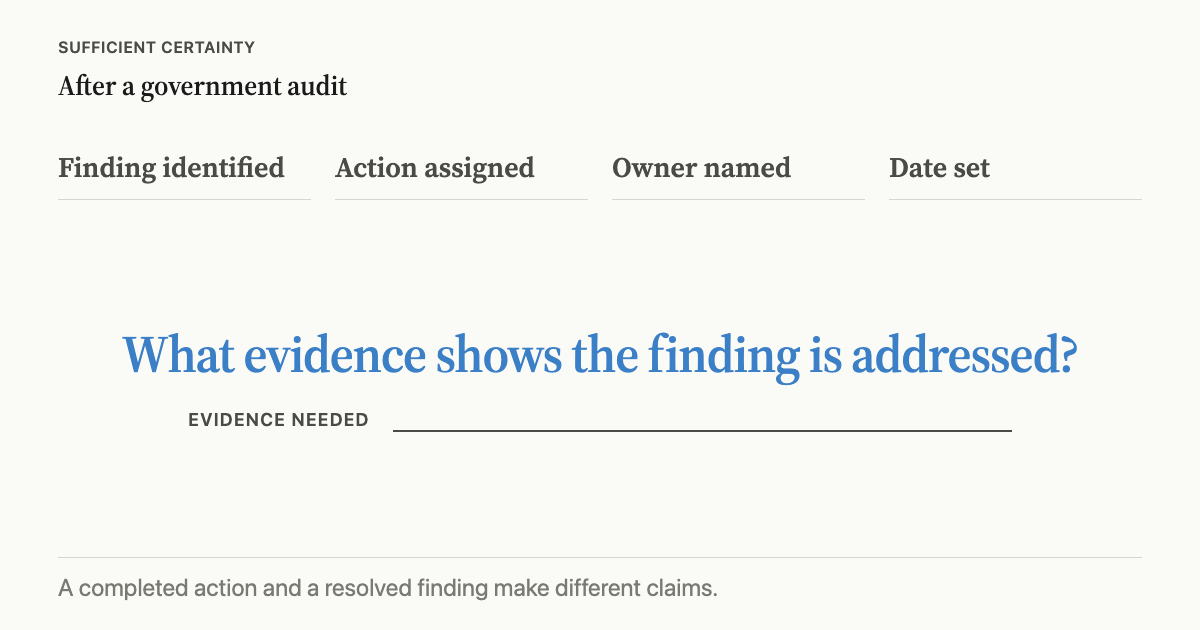
After a government audit, write the evidence needed to close one finding beside its proposed action. An action-plan row can name an owner and a date while leaving that evidence blank. Before approving the response, make clear what someone must inspect to show that the action addresses the problem.
A government performance audit examines how a public organisation uses resources and achieves results, then identifies where improvement is needed.
Recommendations need a management response
A published audit gives management findings to answer. The response should explain the action proposed for each finding and who has authority to carry it out. This article concerns public-sector performance audits. The next decision after a financial audit concerns a different assurance question: what the financial statements support.
For a performance audit, start with the report's exact finding. Keep its scope and time period visible. If the audit found missing contract records, the response needs to address missing records. A broad promise to improve procurement leaves readers unable to judge whether that particular problem will change. For disputed tax amounts, the follow-up to a tax audit keeps each amount with its source records and response deadline before the adviser meeting.
Keep the finding beside the action. This makes the proposed response easier to challenge before resources are committed. It also lets the responsible manager explain a disagreement. If an action cannot address the finding, revise it or state the reason for taking another approach. Do not hide that decision in a general statement of agreement.
The value of this discipline extends beyond preparing a report for a committee. It connects public organisational governance to work someone can inspect. The manager responsible for the work should be able to explain what will change on a real file, and when that change becomes visible.
INTOSAI's performance audit principles distinguish implementing a recommendation from addressing the underlying problem. Follow-up examines whether the situation has been corrected. That supports a practical distinction for management: an implementation date and evidence of changed practice answer different questions.
A deadline needs a test of the result. The timeline below shows where to add that test. It is a proposed management check, not a prescribed sequence for every government auditor.
Retain the official reporting requirements. Add the evidence test to the existing action plan rather than creating a competing report. A response can then show what management has promised and what remains to be checked. This is more useful than treating every row marked complete as equally well supported.
Your audit response names the action. Test the assumption that makes it a suitable answer to the finding. Start the Walk →
Does the proposed action address the finding?
A proposed action rests on a belief about how work will change. Revising a procedure assumes that staff can follow it under actual workload. Introducing a review assumes that the reviewer can see missing evidence before approval. Assigning responsibility assumes that the named person can obtain records held elsewhere.
State what must change on the next file. For a finding about missing invoice detail, a possible test is whether a reviewer can connect an invoice to the authorised work. This is a proposed example, not a description of any agency's current practice. The purpose is to make the action's central assumption open to examination.
Write that assumption beneath the proposed action. Use ordinary words: the invoice reviewer can identify the project before payment. Then ask what would show it is wrong. A new form may contain a project field while contractors still supply codes that refer to several projects. The form alone would leave the original uncertainty unresolved.
That is why making assumptions visible matters here. The audit establishes what its evidence supports about the period examined. Management still needs support for its belief that the proposed action will prevent the same problem in future work. Those are separate claims.
Check ordinary work, including exceptions. Ask the manager to identify which files the proposed action covers. Include the route used when a request is urgent or documentation is incomplete. A procedure that works only for routine requests may leave the relevant problem untouched. Keep the check within the finding's scope rather than using it to launch a wider review without a reason.
Before collecting evidence, agree what would justify the proposed status. A procedure issued may be enough to report that a procedure exists. Reporting that it operates requires evidence from its use. Reporting that the finding is addressed requires evidence relevant to the finding. A clear evidence threshold prevents the review from expanding without a decision.
If evidence is unavailable, say so. Management may still need to act while testing continues. Record the remaining uncertainty and the date of the next check. Do not turn missing evidence into a completed result. A clear statement of what has not yet been verified gives oversight bodies a useful question to ask.
ArriveCAN exposed missing records and weak contracting
Canada's Auditor General examined the management of ArriveCAN in Report 1 of the 2024 reports. Poor records and controls prevented the auditors from determining the precise cost. They estimated approximately C$59.5 million. They also found little documentation explaining the initial non-competitive award to GC Strategies, and missing details about work on approved invoices.
These were specific evidence failures. An accurate cost estimate depended on being able to attribute expenses to the right project. Explaining a contracting decision depended on retaining its reasons. Make the next records verifiable. A commitment to better oversight alone would not demonstrate either change.
The CBSA's detailed management action plan accepted the financial-record recommendation. It set out requirements for invoice codes and procedures for consistent coding. It also planned compliance reviews. The document separates expected results from milestones and completion dates. These are management commitments and reported actions, not independent proof that the expected results were achieved.
Public Services and Procurement Canada's March 2024 committee briefing addressed the recommendation for clear tasks and deliverables. It reported directions to procurement staff and client departments, alongside a planned guidance update. The briefing documents the response. It does not establish that every later task authorization contained adequate deliverables.
A status marked complete belongs to the action described in that row. Check its scope before treating it as assurance about the whole finding.
A useful reader application is to ask for reviewed invoice files when assessing the coding action. For the deliverables action, ask what the reviewer could verify from an actual authorization. These suggested checks follow the findings. They are not reported ArriveCAN follow-up results, and they do not replace an independent audit.
Attach evidence to the audit response
Return to the one finding selected at the start. Attach a short evidence note to its action-plan row. State the condition that must change and identify the record that can show the change. Give the evidence note to the person who will recommend closure before that person approves the proposed test.
Make the status claim match the evidence. If the evidence is a revised procedure, report the procedure's issue date. If evidence comes from reviewed files, identify the period and the files covered. State unresolved exceptions. Someone reading the public response should be able to understand what was checked without accepting an unexplained claim that controls were strengthened.
Keep the explanation proportionate to the finding. One short note with a reference to retained records may suffice. A finding involving several agencies may require each agency to supply its part. Identify the point where responsibility changes hands. The owner of the response needs a way to see whether those parts support the same conclusion.
This differs from simply transferring the action-tracking routine used after an internal audit. A public response must explain what its assurance claim rests on. The Universal Decision-Making Method helps management identify the assumptions behind that claim and judge whether the available support is sufficient.
Name the event that would require another check. A missing project allocation on a newly reviewed invoice, for example, would challenge a claim that consistent coding now operates. Give someone authority to respond when that event occurs. Do not wait for the next audit to rediscover evidence that management already has.
Leave a reason someone else can inspect. A record of the evidence and remaining uncertainty supports accountability for the decision. It shows why management approved an action or recommended closure at the time. The next committee report can then distinguish promised work from an observed change in practice.
What evidence would justify telling the public that this audit finding has been addressed?
Work through your decisionNo sign-up. Just pick your decision and start.
Grant Purdy is the co-author, with Roger Estall, of Deciding (2020), and the architect of the Universal Decision-Making Method.