
After a forensic audit, mark every disputed figure in the next approval paper. In May 2020, Akazoo reported that its special committee had found its historical financial statements materially false and misleading. The investigation changed what could safely support another decision. A completed report still leaves the decision owner responsible for finding where those figures remain in use.
A forensic audit examines financial records to investigate suspected wrongdoing and establish evidence about particular transactions or claims.
The investigation identifies disputed evidence
A forensic audit gives the organisation a basis for responding to specific findings. It may establish that an invoice lacks supporting evidence. It may show that a reported customer did not exist. Its value depends on the questions examined and the records available. Read the report's scope before treating its conclusions as a statement about the whole business.
In the Akazoo case, the company-filed special committee announcement reported falsification of books and records, including materials supplied for the 2019 business combination. That finding made the source of later calculations important. A figure copied into another document could still depend on the disputed material.
For the reader, start with the report's actual wording. Record which figure was challenged and the period it covers. Keep a reference to the underlying finding. Preserve the original document under the investigation's retention arrangements. Removing a number from an approval paper should not mean deleting evidence needed for the investigation.
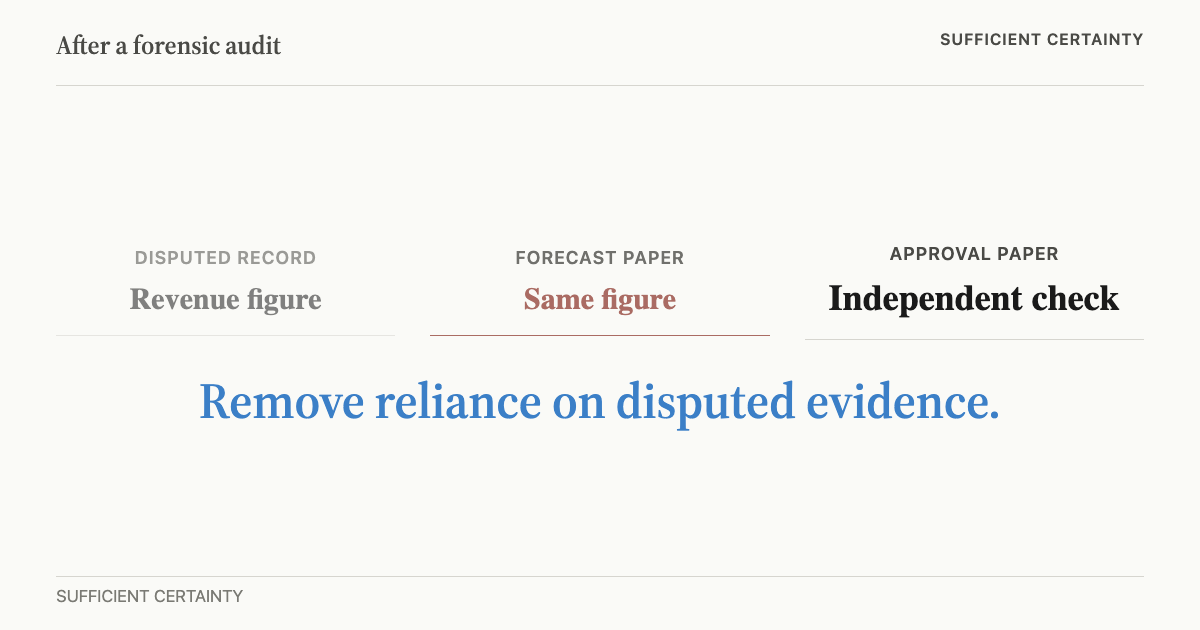
The flow shows a proposed reader application. It does not describe Akazoo's internal workflow. The report supplies a finding; the decision owner must trace its effect into the paper being considered. A disputed input remains disputed when it moves into another calculation. Reformatting a spreadsheet does not give its contents a new source.
Keep this task separate from obtaining a financial audit opinion. The question here concerns reliance after specific forensic findings. It also differs from assigning responsibility after a whistleblower investigation. Both processes can inform the response, but this checkpoint asks which inputs remain usable. Trace the finding into the next decision before approving it.
A forensic finding changes which figures can support the commitment awaiting approval. Start the Walk →
Which later decisions still rely on that evidence?
The most useful place to look is a paper awaiting approval. Choose the next consequential commitment and find the figure that makes its recommendation look affordable. Ask the paper's author where that figure came from. Follow the reference back through earlier versions until it reaches a source outside the disputed records, or reaches the disputed records themselves.
Consider a hypothetical contract renewal that depends on revenue from a customer account. If the investigation disputes that account's sales, the renewal forecast needs attention even when its arithmetic is correct. A formula can accurately multiply an unsupported starting figure. The problem lies in the input, so recalculating the formula will not resolve it.
Separate the decision's dependencies. A forecast may use a disputed revenue baseline but an independently confirmed bank balance. Check the connection between the finding and each input. Rejecting every figure can stop useful work without a reason. Accepting every unmentioned figure can mistake the report's limited scope for confirmation.
An input outside the investigation's scope is still unverified. State that status plainly in the paper. If the report establishes that one account was fabricated, examine related figures only where there is a reason to suspect the same source. Ask the investigator about that connection rather than extending the finding beyond its evidence.
This is a practical use of making assumptions explicit. Write the condition behind the recommendation as a complete sentence. For example, a proposed renewal might assume that recorded customer sales represent genuine business. Once the investigation challenges that condition, the paper needs fresh support or a different recommendation.
Then locate copies already in circulation. Tell the people preparing related approvals exactly which figure is disputed. Give them the report reference and the affected period. Ask them to flag reliance in their own papers. This makes the warning usable without circulating confidential investigation details more widely than authorised.
A replacement source needs its own check. If the forecast owner supplies a new spreadsheet, ask whether its starting balance came from the old ledger. If so, it retains the same unresolved dependency. Independent support means evidence that establishes the relevant condition without depending on the challenged material. Record that connection so another reviewer can follow it.
The decision owner should record what happens next. A short deadline may justify a temporary arrangement supported by independently checked evidence. It does not make the old baseline more reliable. Time pressure changes the available choices, not the status of the evidence. Before the meeting, show which part of the recommendation still depends on an unresolved finding.
Akazoo challenged its historical financial statements
Akazoo's May 2020 announcement said the special committee had substantially completed its investigation. It reported negligible actual revenue and subscribers over several years. The company also said it intended to seek recovery for investors, including an attempt to unwind the business combination. It directed advisers to make regulatory referrals. These were reported findings and intended actions, not proof of completed recovery.
The SEC complaint, filed on 30 September 2020, alleged that claimed revenue relied on supposed relationships with aggregators. Those companies allegedly either did not exist or had no relationship with Akazoo. The complaint also alleged that investor presentations repeated false subscriber and revenue claims. These are the SEC's allegations, distinct from the committee's findings.
The relevance to the reader is the connection between records and repeated claims. An independently prepared presentation cannot establish a figure's truth if it merely repeats the same source. Two documents can contain one unsupported claim. Checking that their numbers agree only establishes consistency between the copies. It does not establish that the underlying business exists.
In October 2021, the SEC announced a settlement ordering $38.8 million in disgorgement. It described satisfaction through a $35 million payment to investors and related private settlements. Akazoo had agreed to injunctive relief without admitting or denying the allegations. Those terms do not, by themselves, establish completed investor payments or an unwound transaction.
A proposed application for another organisation is to distinguish the status of the evidence from the status of the remedy. A recovery plan is a decision about future action. It cannot repair the historical source on which another decision depends. Keep disputed financial claims out of fresh approval papers unless independently supported replacement evidence is available.
The case supports a narrow lesson for organisational governance: responsibility includes changing what later papers may rely on. The cited documents do not show Akazoo using the process proposed here. The reader's task is to prevent a known evidence problem from supporting another commitment.
Remove contaminated inputs before making the next decision
Apply the Universal Decision-Making Method to the actual commitment awaiting approval. The method helps the decision owner connect a finding with the conditions needed for that choice.
- Frame: State the purpose of the pending decision and the result it must achieve.
- Tentative Elements: Describe an available course of action, including a temporary arrangement where appropriate.
- Assumptions: Identify the conditions that course requires, especially any supported by disputed records.
- Sufficient Certainty: Decide what independent evidence is enough to proceed with this commitment.
- Implement+Monitor: Assign the checks and specify which new finding will reopen the decision.
For the hypothetical renewal, suppose four inputs matter. A direct bank confirmation supports the available cash figure. The customer sales figure remains disputed. Retention is unverified, as is the forecast built from those sales. The illustration below counts inputs in this invented example. It does not measure evidence quality or represent findings at Akazoo.
The count does not set the approval threshold. One unresolved condition could determine whether the whole commitment works. Use evidence appropriate to the decision, rather than approving because most cells have been checked. State which source could establish the disputed condition and who will obtain it.
Record the permitted action in a decision record. Name the input removed from reliance. State the replacement source, or explain why the proposed commitment must wait. Specify the next review date and the finding that would require an earlier review. A forensic finding is acted on when the next decision stops relying on the disputed evidence.
Which figures in the next approval paper still depend on records the forensic audit challenged?
Work through your decisionNo sign-up. Just pick your decision and start.
Grant Purdy is the co-author, with Roger Estall, of Deciding (2020), and the architect of the Universal Decision-Making Method.