
After a transport risk assessment, the step before approving the journey is to write the conditions each critical control needs. On 6 July 2013, a Montreal, Maine & Atlantic Railway train ran away and derailed at Lac-Mégantic, killing 47 people. The official investigation summary describes a securement failure that shows why those conditions matter.
A transport risk assessment examines what could cause harm during transport and whether the proposed precautions are adequate.
At Lac-Mégantic, the brake test depended on air pressure
The train had been left unattended at Nantes, on a descending grade. Seven hand brakes were applied. The locomotive's independent brakes, which use compressed air, also helped hold it. During the night, the running locomotive was shut down in response to a fire. Air pressure fell. The hand brakes could not hold the train alone, and it rolled towards the town.
A hand brake effectiveness test should establish that the hand brakes can prevent movement without help from the air brakes. The engineer had left the independent brakes applied during the test. The train's lack of movement therefore did not establish that the hand brakes were sufficient. These are the findings of TSB report R13D0054, particularly its securement analysis and findings.
The test supported a narrower conclusion than the operating decision required. It showed the train remained stationary while additional braking force was present. Leaving it unattended required confidence in securement when that support disappeared. An observation can be accurate and still fail to answer the question that matters.
The assessment history also needs care. The TSB found that MMA had assessed single-person train operations at Transport Canada's request. That assessment omitted how one person would perform train securement, a task previously performed by two. It also found no risk assessment when the crew-change location moved to Nantes. Existing securement rules were treated as a reason that another assessment was unnecessary.
This was not a sound, complete assessment followed by one inexplicable mistake. The documented assessment missed a changed task. Another significant operating change went unassessed. The case supports checking the scope of an assessment as well as the evidence behind its controls. A reader should not infer that filling in the same form would have prevented the accident.
For an operator reviewing a transport assessment now, the useful question is precise: does the evidence demonstrate the control under the conditions in which it will be needed? A control described as effective during attended operation may depend on someone being present. A check performed with temporary support may say little about the unattended condition.
Record the conditions of the test beside the claim that the control will work. Include anything that supplied support during the check but may be absent later. Ask the competent person responsible for the operation whether the evidence still applies. The task is to identify the gap before approval, using the applicable technical rules.
The investigation also found wider weaknesses. Its published findings describe insufficient training and supervision, alongside ineffective management of operational changes. Securement was part of a wider failure. A written instruction needs evidence of correct use, and an assessment needs evidence that its proposed precautions were put in place.
Keep the distinction visible in the working document. “The procedure requires a check” describes an instruction. “The check was completed correctly for this operation” describes a claim that needs evidence. That distinction also matters after risk analysis, when conclusions become instructions for people doing the work.
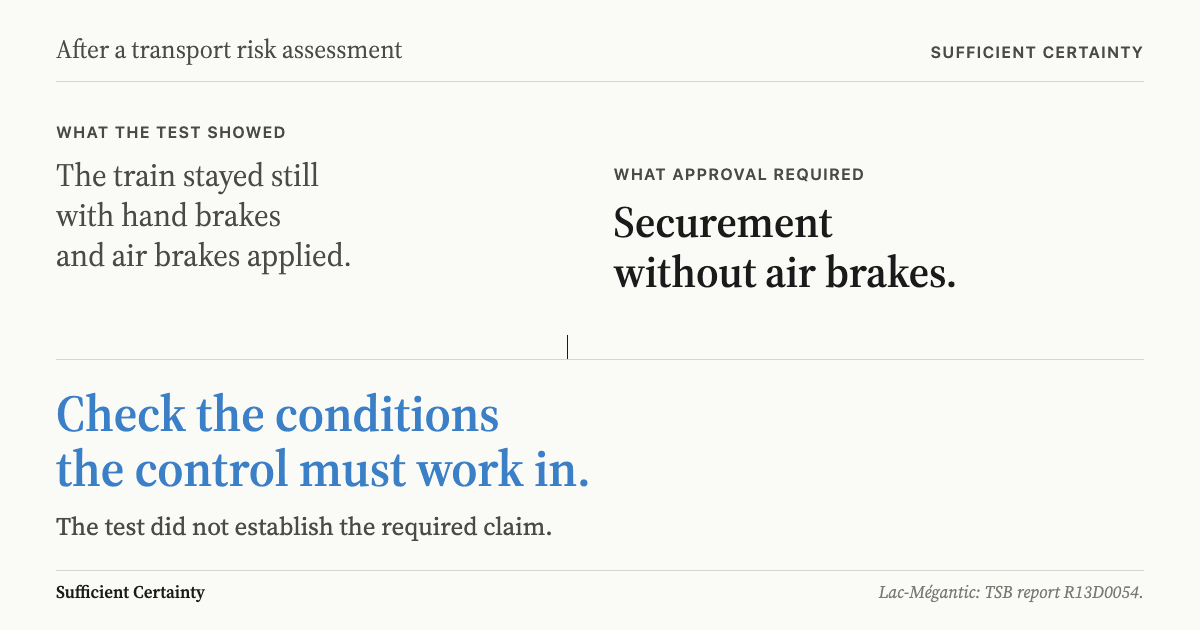
The case concerns a railway operation. It does not establish the technical requirements for aviation or marine transport. Those require their own evidence and competent review. The decision lesson is to match the control claim to the conditions that were actually checked. That is the assumption to examine before authorising the operation.
Use The Walk to examine the conditions behind one transport approval before the operation starts. Start the Walk →
What does the transport assessment let you approve?
A completed assessment gives the person approving transport a record of the hazards and the proposed precautions. It helps identify work that needs attention before movement starts. The next step is to implement those precautions, assign responsibility and tell the people affected what has changed. The parent risk assessment topic covers that broader work.
For workplace transport, the UK's Health and Safety Executive guidance includes prioritising improvements and setting dates for action. It calls for regular review and reassessment before significant changes. This is useful guidance for workplace vehicle movements; it should not be presented as a complete rulebook for every transport mode.
A proposed precaution belongs in the action plan until its implementation is confirmed. When reviewing the assessment, separate what exists from what somebody intends to install or change. Otherwise the approval can depend on equipment that has not arrived, or an instruction that has not reached the people who must use it.
Use the assessment to distinguish a planned change from permission to start. A completion date can identify when a precaution should be ready. It does not establish that the precaution works. Before approving a departure, ask for the result of the required check. If that result is unavailable, the person approving the work needs to know what remains unresolved.
For a workplace vehicle movement, consider whether the assessment covers the actual location at the planned time. A daytime observation may leave an assumption about visibility during a night shift. This is a hypothetical review question, not an additional finding from the railway case. The relevant evidence should come from the operation being approved.
The review should also ask what a lower rating relies on. Has the assessor allowed for a precaution being followed perfectly? Does the evidence cover changed conditions? The companion discussion of risk evaluation explains why a rating needs to be connected to a decision.
Approval should identify the operation and conditions covered by the evidence. A general statement that transport is acceptable leaves the next supervisor guessing when that conclusion stops applying.
Check the control conditions before the next departure
Take the current assessment and choose one operation awaiting approval. Add a short note beside each control whose failure could cause serious harm. State the condition it needs and identify the evidence available. Use a direct question: does this control still work when the support present during the test is absent?
Ask the people who will carry out the work to review those notes. Where evidence is missing, assign the check to someone competent to perform it. Do not create an improvised technical test. An unchecked condition must remain visible until the responsible person can resolve it. Record any required hold on approval through the organisation's established process.
The Universal Decision-Making Method provides five steps for examining the decision behind the assessment:
- Frame: State the purpose of this operation and who must approve it.
- Tentative Elements: Describe the proposed journey and the precautions it will use.
- Assumptions: Name the conditions those precautions depend on, including conditions not yet checked.
- Sufficient Certainty: Decide what evidence justifies proceeding, with competent review and applicable requirements satisfied.
- Implement+Monitor: Assign the approved actions and specify which changes require the decision to be reviewed.
Keep each note specific enough to resolve. “Drivers are trained” leaves open which task the training covers. “The assigned driver can carry out this changed task” identifies a condition that a supervisor can check. Use the organisation's existing competence records where they answer that question. Request further evidence only for a gap that matters to the approval.
Capture the result in a Decision Record. The existing assessment can remain attached. The record should show the decision and the unresolved conditions, so a handover does not erase them. The article on assumptions in decision-making explains how to make those conditions explicit.
A handover should carry the unresolved notes forward. If the next person assumes every precaution is already verified, the same gap remains. Give each pending check an owner and a point at which it must be resolved. This lets the person approving the next movement see whether the earlier conclusion still applies.
Set review triggers alongside the approval. A changed route or equipment fault can invalidate its conditions before the next scheduled review. The TSB's route-planning recommendation called for periodic assessments to ensure railway control measures work. State who must reconsider the approval when a critical condition changes. Give that person the evidence they need before the next movement.
How confident are you that each critical transport control will work when the conditions of its test change?
Work through your decisionNo sign-up. Just pick your decision and start.
Grant Purdy is the co-author, with Roger Estall, of Deciding (2020), and the architect of the Universal Decision-Making Method.