
After a workplace violence risk assessment, the step before approving the response plan is to trace one reported concern to the person responsible for acting on it. A plan with more reporting channels can still leave nobody responsible for joining the reports. Start with a recent concern and ask where it went, who reviewed it and what happened next.
The assessment gives managers reasons to change working conditions. Before treating the resulting plan as ready, check the assumptions that make its reporting procedures work. The immediate task is to establish whether information reaches someone who has authority to respond.
A workplace violence risk assessment identifies situations that could expose workers to violence and evaluates whether existing precautions are adequate.
Turn each finding into an assigned action
The usual next step is to choose controls, assign responsibility and put the controls into use. Findings might concern isolated work, public access or repeated threats. Each needs a response suited to the actual work. A general instruction to remain vigilant gives workers little help with any of those conditions.
The Health and Safety Executive's assessment guidance directs employers to examine existing precautions, consult workers and decide how to control the hazards. It also says an assessment alone does not reduce violence. The actions taken afterwards must do that work.
Carry each finding into an action record. State the change, its owner and the evidence needed to confirm completion. Distinguish an installed measure from a proposed measure. A funded alarm is still unavailable until it has been installed and tested. A reporting procedure is still uncertain until workers can use it.
Start with actions that address current exposure. An immediate threat requires the established emergency response, rather than waiting for a planning meeting. For other findings, record interim precautions while permanent changes are arranged. Staff should know which precautions apply during that interval.
Assign someone to verify that each action works under the conditions identified in the assessment. This continues the wider work after a workplace risk assessment. Completion needs evidence about protection, rather than a date entered beside a task.
A violence assessment makes local hazards visible
A careful assessment brings workers' experience into decisions about their safety. People on a late shift may face conditions that a daytime inspection misses. Someone serving customers can describe repeated threats that have never produced a recorded injury. These reports help managers choose precautions that match the work.
OSHA's hospital guidance describes worksite analysis, worker involvement and responsibility backed by authority and resources. Its setting is healthcare. Its useful contribution here is the connection between identifying a hazard and giving someone the means to address it.
The assessment also gives managers a shared record. They can compare what workers reported with the precautions already in place. A recurring concern can justify changing staffing or access arrangements. That record can support a budget request without requiring workers to repeat their account at every meeting.
A completed assessment can justify a change to working conditions. It also provides a starting point for the wider risk assessment process. Before approving the response, however, managers need to check whether the information used to maintain that response will reach them.
A workplace violence response plan depends on reports reaching someone who can act on them. Start the Walk →
Who connects reports that arrive separately?
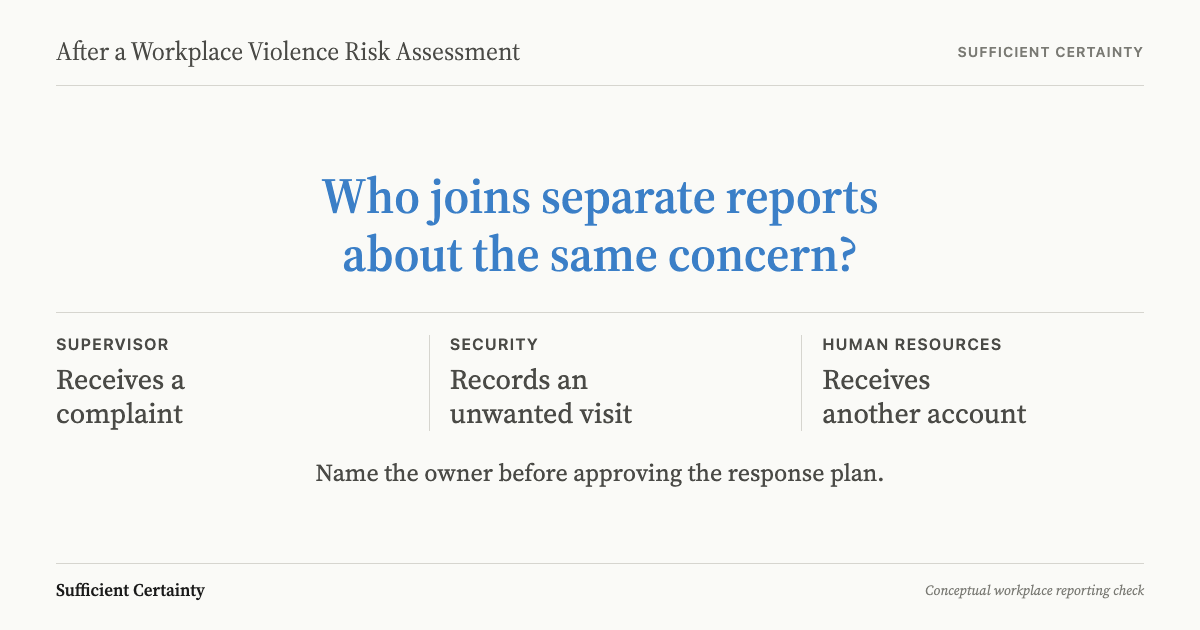
A response plan can depend on information passing between people who have different duties. A supervisor receives a complaint. Security records an unwanted visit. Human resources receives another account. Each person may respond properly within their own role while lacking the information held elsewhere.
The hidden assumption is that someone can identify the connection and decide what it requires. An assessment may document reporting channels without testing this assumption. A channel answers where a worker sends information. It does not establish who follows up when several reports concern the same situation.
The person who receives a report needs a clear route to someone who can act on the wider concern. That route needs a named owner and a substitute during absences. The owner needs access to relevant information within agreed privacy rules. A committee name alone does not explain who makes an urgent decision.
Who joins separate reports about the same concern?
Silence in the incident log is another assumption to examine. HSE's reporting guidance identifies reasons workers may not report violence. They may fear blame or believe nothing will happen. A difficult reporting process can also discourage them.
Ask workers whether they know how to report a concern and whether they receive useful follow-up. Check the process across shifts. These questions test the information behind the assessment without asking workers to diagnose a person or predict violence.
Separate what the organisation has checked from what the response plan assumes. Recording these assumptions in a decision makes them available for review before a manager signs off the plan.
Virginia Tech lacked a joined view of the warnings
On 16 April 2007, Seung Hui Cho killed 32 students and faculty at Virginia Tech. The governor's review panel report examined events before the shootings as well as the response. Its findings show how relevant information can remain divided across an institution.
The panel found that different individuals and university departments knew about incidents of concern. They did not bring all the information together or intervene effectively. Chapter IV describes unwanted contact reported by female residents. A suitemate gathered several concerns into a report that passed through residence staff to Judicial Affairs.
Chapter V identifies misunderstanding of privacy laws and conflicting practices around sharing information. The panel's recommendation IV-4 called for dangerous or threatening behaviour to be documented, reported to a college threat assessment group and acted on promptly. Recommendation V-1 sought clear guidance about lawful sharing.
Information reaching an individual department did not establish that the institution had a complete view. That is the relevant failure for a manager reviewing a reporting procedure. The presence of reports did not, by itself, establish effective ownership of the combined concern.
This was a college case involving student services and education privacy rules. It does not establish that Virginia Tech had completed a formal workplace violence risk assessment. Nor does it prove that one reporting change would have prevented the shootings. The workplace application is narrower: test who receives connected information and who decides what follows.
A workplace has different duties and reporting relationships. Its arrangements for accountability and ownership must reflect those conditions. The transferable question is whether relevant reports reach an authorised person who can consider them together.
Test one reporting route before signing off the plan
Take the action record to the people named in it. Select one recent, appropriately anonymised concern. Trace its route from the first report to the response decision. Check the evidence of receipt and follow-up. If no suitable record exists, use an agreed exercise clearly labelled as an exercise.
Test the route that workers must actually use, including during an owner's absence. Confirm who checks for related reports and who can request protective action. Record what information they need and the agreed limits on sharing it. Resolve uncertainty with the appropriate privacy or legal specialist.
These are questions for verification, not findings about a particular workplace. Mark an assumption as checked only when the test provides evidence. If the report stopped at a handoff, assign the correction before declaring the reporting action complete.
Keep a record of the handoff as well as the final response. Record when the concern arrived and when someone accepted responsibility. That separates a report that was sent from one that was received. It also gives the action owner a clear place to investigate a delay.
The Universal Decision-Making Method makes assumptions explicit before commitment. Applied here, the commitment is approval of the violence response plan. The test supplies evidence for that decision. It supports the manager's judgment alongside specialist advice and the measures needed for current exposure.
Approve each action on the evidence available, and name what would require another review. A missed handoff or a new pattern of reports should prompt another review of the relevant assumption. Record the owner who will notice that change. A plan is ready to use when its required actions and reporting responsibilities are clear enough to carry out.
Who can connect the reports your workplace violence response plan depends on?
Work through your decisionNo sign-up. Just pick your decision and start.
Grant Purdy is the co-author, with Roger Estall, of Deciding (2020), and the architect of the Universal Decision-Making Method.