
When to use decision coaching is usually clear after the old logic breaks. The sponsor has left, the contract still rolls over, and everyone talks as if the original decision made itself. Start when yesterday's answer is still running and nobody can say why it should continue.
I usually get called in after the third renewal. The sponsor has left, the contract still rolls over, and everyone talks as if the old decision made itself. If you want to know when to use decision coaching, start when yesterday's answer is still running the place and nobody wants to own today's call.
Roger Estall and I wrote Deciding for this exact problem. In my experience, the paperwork is usually immaculate when the thinking is not. There will be minutes or a model, sometimes both, and people will still pretend the papers have answered a question nobody has truly reopened. That is a lovely arrangement if you sell reports. It is a rotten one if you actually have to decide.
Decision coaching is worth using when the analysis is complete but the person who must commit still cannot name the assumption that is holding them back.
When decision coaching helps most
It helps most when the decision is live and the accountable person still cannot say why this option is safe enough, or necessary enough, to sign. The Ottawa manual for the Decisional Conflict Scale treats that as serious. It says support is most useful when a choice carries risk or loss and the person is still unsure what matters enough to decide. That is a recognisable condition, not a branding exercise.
That is a far better test than the coaching trade usually offers. A 2026 piece from the International Coaching Federation talks about promotions and isolation at the top. That may suit longer-run executive coaching. It is no use when a board paper is due next week and somebody still owns the call. Promotion stories and loneliness stories travel well because they sound humane and offend nobody. The live decision stays untouched, which suits the seller and suits the committee that wants one more month of respectable delay.
The broader category in decision coaching matters, but this is the narrower test I use. That is when to use decision coaching: when the owner is obvious and the grounds for action are still muddy. When that happens, people do not need more encouragement. They need the decision forced into the open before another workshop appears to decide nothing at all.
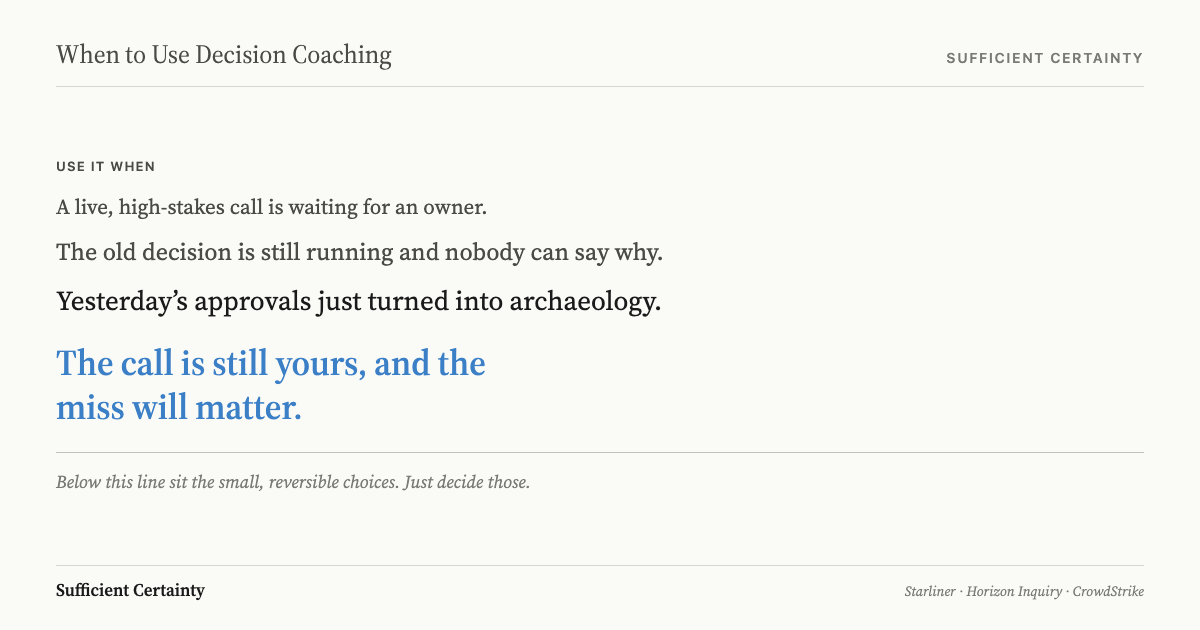
When to use decision coaching on a live, high-stakes call
Use it when expert work has already been done and the judgement is still sitting there, waiting for someone to own it. NASA's August 24, 2024 decision on Starliner is a clean example. The spacecraft launched on June 5 for what was meant to be an eight-day crewed test flight. By late August, testing had reduced some uncertainty, not enough. NASA said experts still disagreed about thrusters and helium leaks, so the capsule returned uncrewed on September 6 and the astronauts stayed on the ISS.
I like that case because it shows what grown-up judgement looks like. Nobody got to hide behind the phrase "more analysis required" and pretend that was a decision. People wait for total certainty when uncertainty lets them postpone ownership. Sufficient certainty is not perfect comfort. It is enough clarity to choose and enough discipline to watch what could still prove you wrong. The Universal Decision-Making Method helps here because it keeps the live call in view and asks whether the remaining uncertainty is acceptable for the option in front of you.
Reopen the decision your paperwork is carrying and see whether yesterday's logic still holds. Start the Walk →
When to use decision coaching when the old decision is still running
This is the case most organisations miss. If an organisation is still doing something important and nobody can reconstruct why it still makes sense, the decision is live again. The sensible move is not to defend the history. It is to rebuild the context and decide again whether to continue. In my experience, inherited decisions survive because reopening them is awkward and awkward work rarely wins awards. The manager avoids the fight and the adviser keeps billing against yesterday's logic. The committee is rarely unhappy with that arrangement.
The first volume of the Horizon Inquiry report shows how ugly this gets when nobody reopens the call. Horizon was rolled out in 1999. Problems were reported almost from the start, yet operating decisions and prosecutions continued for years as though system reliability were settled fact. The report says many hundreds of people were wrongly convicted. That is what inherited logic does when a settled assumption is treated as a moral fact instead of a decision that needs fresh grounds.
I see milder versions of the same thing constantly. A pricing formula survives because the sponsor retired. An outsourcing arrangement rolls on because nobody wants the row that would come with asking whether it still serves the business. In most firms, drift looks polite. It arrives as a rollover or a paper marked "for noting". That is when to use decision coaching, because the organisation is not preserving wisdom. It is renewing a stale judgement by inertia, one quiet meeting at a time.
When disruption makes yesterday's logic useless
Use it fast when the context changes and the old paperwork turns to theatre. During COVID, none of the organisations I dealt with reached for their risk register first. They were deciding how to reduce vulnerability and what course made sense now. None of them wanted a register. They wanted current judgement about what to stop and what to protect first. That annoyed the risk-management faithful, of course, because live judgement is harder to package than a framework with coloured boxes.
The July 2024 CrowdStrike outage made the same point in public. Microsoft said 8.5 million Windows devices were affected, including systems used by airlines and hospitals. CrowdStrike later wrote about phased deployments and stronger operator controls added after the failure. Once the context changes, old approvals are just archaeology. That is the territory of decision coaching, because disruption reopens a decision people thought was settled. It also humiliates anyone who imagined last quarter's documents could keep deciding for them.
When not to use decision coaching
Leave it alone if the choice is small and easy to reverse. Leave it alone if what you really want is a longer run of executive coaching, or somebody to keep nudging half-formed ambitions along. I am not there to pep people up. If you want somebody else to do the thinking, you are closer to consulting. I use this work when the decision is still yours and the miss will matter.
You could renew the contract again and let yesterday's decision keep running today.
Work through your decisionNo sign-up. Just pick your decision and start.
Grant Purdy is the co-author, with Roger Estall, of Deciding (2020), and the architect of the Universal Decision-Making Method.