
Which context changes matter before you commit is the question most organisations answer with paralysis or indifference. New information hits and teams either freeze or barrel through. A three-band filter sorts the change by its proximity to the decision and asks one question: does this alter an assumption we are relying on.
Which context changes matter before you commit is the question no risk register answers. Organisations track everything and treat every change as equally threatening. The useful question is narrower: does this change affect the assumption the decision depends on. If it does, revisit. If it does not, proceed. Without that filter, every piece of information freezes the decision.
I watched a program board freeze for six weeks over a supplier repricing. It affected two line items in a forty-item budget. The repricing was real. It changed nothing the decision depended on. But nobody in that room could say so with confidence, because nobody had written down which items the decision actually rested on. Every change looked equally threatening, so the board treated a rounding error as though the business case had collapsed.
I have sat in dozens of these rooms. Both responses are wrong, and both come from the same failure. Neither group has a way to judge whether the new information actually changes the decision. They are reacting to the existence of change, not to its significance.
The question is never "has something changed?" Something has always changed. The question is: does this change affect the assumptions your decision depends on? Most of the time, it does not. Occasionally, it does, and proceeding anyway is how organisations spend billions on strategies that were already broken before they launched. That is the cost of treating all new information as equally urgent.
A material context change is one that weakens an assumption your decision depends on. If the assumption still holds, the change is noise.
Why most context changes are noise
Context changes constantly. Markets move and internal conditions shift. The instinct to treat every change as significant is the most popular form of indecision, because it looks like vigilance. It produces organisations that cannot commit to anything because they are perpetually reopening decisions that were sound.
Without a filter, vigilance produces chaos. Without a recorded set of assumptions, every piece of new information looks equally urgent. A supplier raising prices by 2% sits alongside a regulatory change that invalidates the entire business case, and the team has no mechanism to distinguish between them. The committee treats both with equal gravity, which flatters the first and insults the second.
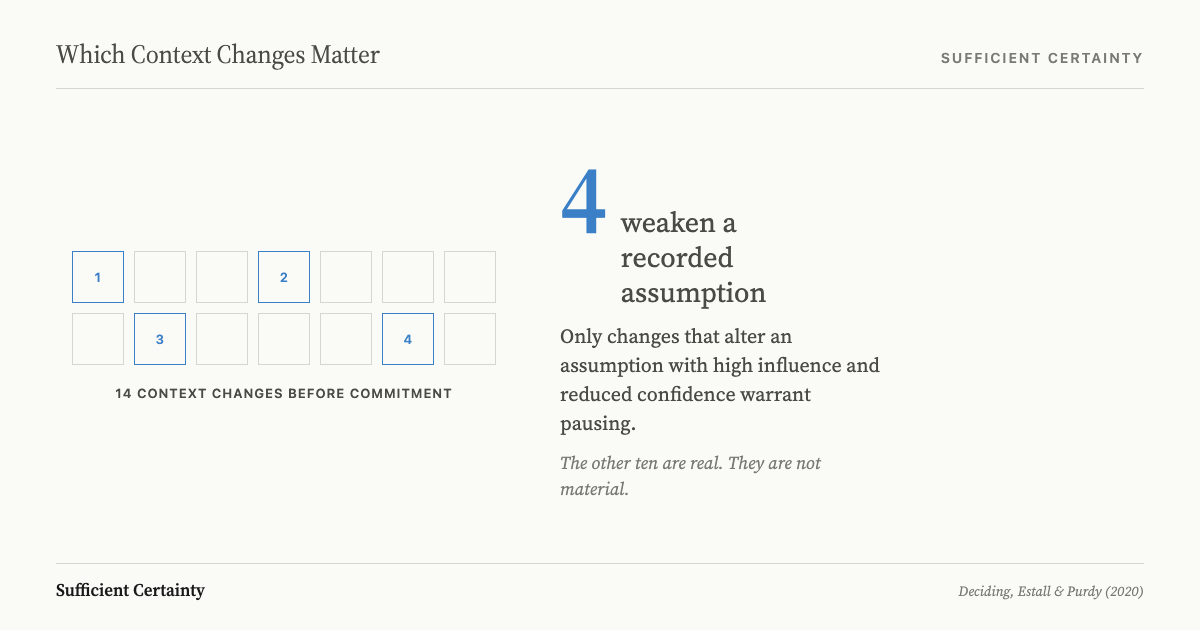
In my experience, roughly four in every fourteen context changes that surface before a commitment genuinely affect the decision. The other ten are real changes in the world that do not touch the assumptions the strategy depends on. Getting the ratio right, pausing for the four and proceeding through the ten, is the difference between disciplined monitoring and paralysis.
The three bands where context changes matter
Context is not a flat list, though most frameworks flatten it into one because flat lists are easier to print on a slide. It sits in three concentric bands around the decision, and each band carries different kinds of assumptions at different rates of change.
The internal band covers the organisation's own conditions: staffing, working capital, operational readiness. These are the assumptions closest to the decision and, paradoxically, the ones teams most often treat as fixed. Before Target opened its first Canadian store, internal data showed the SAP system had severe data quality problems: incorrect product dimensions, wrong pricing, broken reorder points. Distribution centres were overflowing with stock while store shelves sat 30 to 40 per cent empty. The supply chain failure was documented internally, but the organisation classified it as an operational problem to fix in parallel, not a strategic signal to pause. Target went ahead and opened 133 stores on the original timeline. By January 2015, $5.4 billion in losses and 17,600 redundancies later, every store was closed. The internal context had changed before commitment. The signal was visible. The classification was wrong.
The external band covers stakeholders and dependencies outside the organisation: suppliers, regulators, partners. These are the actors whose behaviour the decision assumes will continue in a particular pattern. I have seen regulatory changes dismissed as someone else's problem until the regulator arrived at the board table. Changes in this band are often visible, but their connection to the decision is indirect enough that teams wave them through.
The wider band covers the broader conditions that make the decision possible: economic climate and regulatory environment. These change slowly most of the time, which makes the rare fast shifts easy to miss. When the UK government launched the National Program for IT in 2002, it committed £6.2 billion to digitise NHS patient records using a centralised architecture. Over nine years, two bands shifted simultaneously. Internally, clinicians reported feeling marginalised and ignored. In the wider context, cloud computing and mobile devices emerged, making the monolithic design obsolete before delivery. The program spent £12.7 billion and was dismantled in September 2011 with only £2.6 billion in documented benefits. That is what happens when nobody watches the band that changes slowly.
The three-band structure matters because each band produces different kinds of material change, and the usual frameworks miss at least one band entirely. PESTEL maps the wider band. Stakeholder analysis maps the external band. Neither addresses the internal band. A situation analysis that covers all three bands, with recorded assumptions in each, is the only structure that gives a team a complete filter.
Name the assumption your strategy depends on and test whether the context around it has changed enough to pause. Start the Walk →
How to tell whether a context change is material
A context change is material when it alters an assumption your decision depends on. The change must affect a recorded assumption, and the assumption must be one the decision actually rests on. Most changes fail one or both tests. That is the filter, and I have never seen it take longer than five minutes.
The practical test requires two things the Universal Decision-Making Method builds into every decision. First, you need written assumptions. Not a vague sense of what the team believes, but a recorded list of the conditions each part of the strategy depends on. I have seen teams with forty-page risk registers that could not name three assumptions their decision depended on. Second, you need a significance rating for each assumption: how much influence does it have on the outcome, and how confident is the team that it holds? Those two dimensions, influence and confidence, produce the filter.
When new information arrives, the test is mechanical. Find the assumption it relates to. Check the significance rating. If the assumption has high influence on the outcome and the new information reduces the team's confidence that it holds, the decision should pause. If the assumption has low influence, or the team's confidence remains high despite the new information, the decision proceeds. The recorded assumptions do the work.
Roger Estall and I described the practice of maintaining a core characteristics description for exactly this purpose. In Deciding, we give the example of the taxi industry before ride-sharing platforms: regulated entry, predictable margins, weak innovation incentives. That description, written and dated, becomes the baseline. Without it, you cannot distinguish a material change from background noise, because you have nothing to compare the new information against. A change in fuel costs does not alter the core characteristics. A change in regulation that permits unlicensed drivers to accept fares does. The description makes the distinction possible without a meeting to debate it.
What a correct context filter looks like
Most case studies about context changes are about failure, about organisations that missed a shift or ignored a signal. The harder and more useful example is an organisation that applied the filter correctly: pausing where context had changed materially and continuing where it had not.
In November 2023, the Australian Federal Government reviewed its $120 billion infrastructure pipeline jointly with state and territory governments. The review identified 50 projects where context had changed materially: costs had blown out, projects had made little progress, or government priorities had shifted. Those 50 projects lost $7 billion in Commonwealth funding. The projects cancelled included Geelong Fast Rail, Sydney-Newcastle faster rail, and the Truro Bypass.
The significant number is not the 50 cancelled. It is the roughly 400 projects that survived the review and continued. I have sat through portfolio reviews that could not make this distinction. Every one of those 400 had experienced context changes too: post-COVID inflation, supply chain restructuring, shifting labour markets. The government distinguished the changes that had made a project's business case invalid from the changes that were real but did not alter whether the project should proceed. That is what the filter looks like when it works. Most organisations I have worked with cannot make that distinction because they have nothing recorded to test the new information against.
The filter worked because the review tested each project against its business case, not against a general sense of whether the environment had shifted. A cost blowout on a low-priority project, high significance combined with confirmed change, warranted cancellation. Cost pressure on a high-priority project, lower significance relative to strategic value, did not. The context template's significance and volatility columns, applied to each band, produce exactly this kind of decision.
Recording context so the filter works next time
Context must be established every time the decision-making process is applied, not annually or per project but every time a specific decision is framed. The team records the internal, external, and wider conditions the decision depends on, along with the assumption embedded in each and a significance rating. When new information arrives, the team does not debate from scratch; they compare it against the recorded baseline and test whether any material assumption has shifted.
This sounds obvious. It is obvious. Most organisations establish context once, file it, and consult it never.
A situation analysis that sits in a drawer for twelve months is a historical record about a situation that no longer exists. The context record earns its value through periodic review, dated and retained, so that when someone walks into the room the day before sign-off with new information, the team has a mechanism to judge whether the information matters to this decision or whether it is noise.
You could file the situation analysis and never check whether the context it describes still exists.
Work through your decisionNo sign-up. Just pick your decision and start.
Grant Purdy is the co-author, with Roger Estall, of Deciding (2020), and the architect of the Universal Decision-Making Method.