Situation analysis is not a general description of the organisation. It is the mapping of context around a specific decision, and it becomes useful only when the analysis identifies which assumptions that decision depends on. Without that discipline, the analysis is inventory dressed as preparation.
Situation analysis is not a preliminary step and it is not background research. It is the structured mapping of context around a specific decision. When the analysis is anchored to a decision, it tests the assumptions the commitment depends on. When it is not, it produces an inventory of conditions that describes the organisation without sharpening any choice.
In most organisations, situation analysis is treated like a respectable prelude. People gather facts about markets, capabilities, competitors, regulation, technology, culture, then congratulate themselves on being rigorous. That is not rigour. It is inventory. A situation analysis is useful only if it sharpens the decision in front of you. If it produces an elegant account of the business while leaving the real choice untouched, it has failed.
I say that plainly because I have watched boards commission current state analyses, environmental scans, and strategic reviews that were technically competent and operationally useless. They described the terrain well. They did not tell the Decider what had to be true for a particular course of action to work.
Situation analysis is the mapping of context around a specific decision, not around the organisation in general.
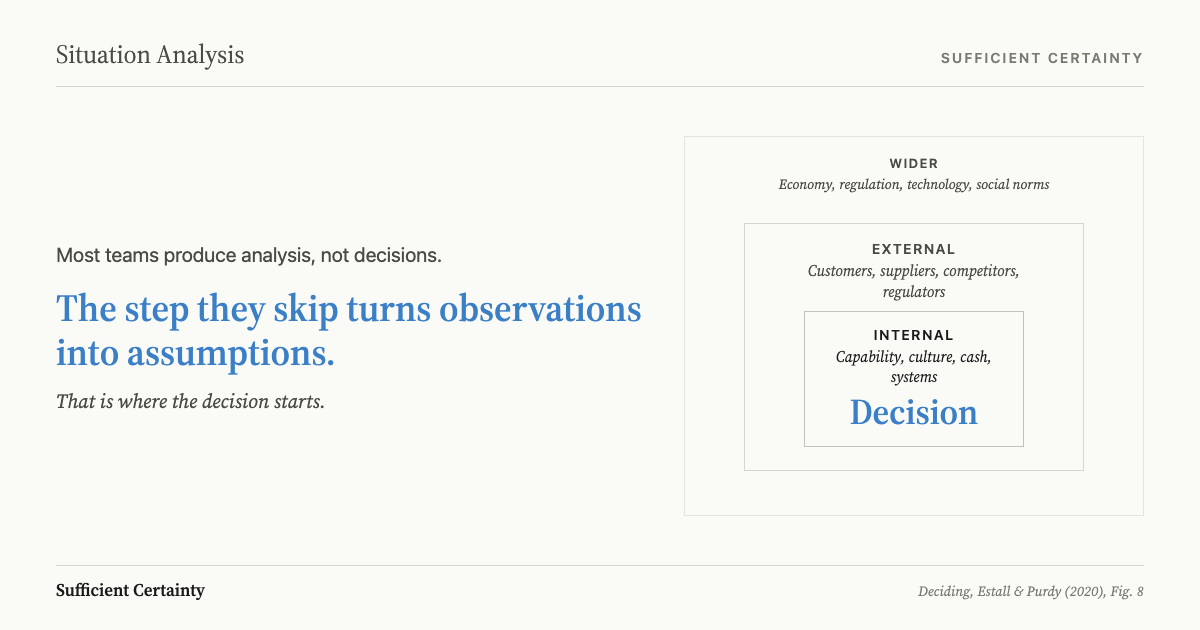
The three-band model, internal, external, wider, centres the analysis on what the decision needs, not on what the framework happens to measure.
Roger Estall and I wrote Deciding because most decision failures begin in that gap. Analysis feels serious, so people stop there. But a map of context is not a choice, and it is not a method. The method starts when we ask a harder question: what are we assuming if we take this option, and how much certainty do we need before we move?
The attraction of the exercise is easy to understand. It feels disciplined, neutral, and safely pre-decisional. No one has to take ownership yet. No one has to declare which option they favour or what assumption they are prepared to back.
But that is also why so many organisations overinvest in it. Analysis lets people look busy without confronting the risk of commitment. I am not against careful context work. I am against mistaking careful context work for decision-making. The two overlap, but they are not the same act.
What situation analysis actually means
Situation analysis means context analysis around a decision, not a general description of the organisation. Context is the background characteristics relevant to or assumed in the decision. That line does most of the work. Relevant to what decision? Assumed by whom? If those questions are not answered, the analysis drifts into a broad situational analysis of the enterprise and stops being useful.
The purpose is not to describe everything that is true. The purpose is to identify the background conditions that matter to this choice, now, for this Decider. Before funding a service, the follow-up to a needs assessment connects the proposed response to the assessed users and the difficulty they face. An equity impact assessment needs a further check that the proposed action reduces the identified disadvantage for the affected group.
That is why I use the three-band model. The internal band covers characteristics inside the organisation that bear on the decision: capability, cash, culture, systems, incentives, capacity. The external band covers the immediate environment around the decision: customers, suppliers, competitors, counterparties, regulators, partners. The wider band covers slower or broader forces that can still shape the outcome: political settings, demographic change, technological shifts, social behaviour, environmental conditions. Internal, External, Wider. Three bands, centred on the decision. Not a museum catalogue of the organisation.
A current state analysis can contribute to this, but only if it is subordinated to the decision. If we are deciding whether to enter a market, I do not need a lovingly detailed account of every function in the business. I need to know which characteristics of the current state bear on entry, which external conditions could help or hurt, and which wider forces may change the fit of the move over time.
The centre of gravity is always the decision. Once you remember that, situation analysis becomes sharp instead of sprawling. That clarity is also why governance structures work better when they are built around decisions rather than around reporting lines.
This is the point most organisations miss. They speak as if there were one permanent picture called "the situation", waiting to be documented once and reused everywhere. There is not. The relevant context changes with the decision. For service commitments, the ITIL service review follow-up compares reported targets with user incident records before assigning provider and business action.
A board considering an acquisition needs one map. The same board considering a leadership restructure needs another. Some internal facts stay important across both, but many do not. A proper situation analysis narrows the field to what this decision needs. That discipline is not a reduction in rigour. It is the beginning of rigour.
Why most situation analyses end where the decision starts
Most situation analyses fail at the exact point where the real work begins. They produce a competent description of the present and then stop, as if the act of analysing had somehow reduced uncertainty by itself. It has not. It has only named conditions.
The decision still rests on assumptions about how those conditions will behave, how they might change, and which features of the context actually matter. Most frameworks are good at cataloguing what you already know. They are poor at surfacing what you are assuming. For a circular economy assessment, test the proposed return route against the receiving processor's material specification.
The old boiling frog story captures the problem well. A frog dropped into boiling water jumps out; placed in tepid water brought slowly to a boil it doesn't perceive the danger and is cooked. Whether or not the biology is tidy, the decision lesson is sound. The most dangerous changes are the least dramatic. Your analysis expires while you're admiring it. The conditions looked stable when the deck was printed. Meanwhile the temperature kept rising in some corner nobody thought important enough to watch.
I have seen the same failure dressed up as due diligence, market review, and textbook context exercise. Teams produce binders full of facts, tables, and neat categories. Everyone feels safer because the document is thick. Property redevelopment makes this concrete: follow-up after an environmental site assessment connects each finding to the next site activity and its conditions for starting.
Yet the decisive assumptions remain unstated: that a key customer will stay, that a regulator will not intervene, that a competitor will respond slowly, that the integration will be easier than the last one. None of those appear as facts because they are not facts. They are bets. The document feels complete precisely because it never forces anyone to name the bet. The same dynamic plays out whenever organisations try to build stakeholder alignment on shared facts alone, without testing whether those facts still hold.
For operating findings, the follow-up to an environmental audit connects the next action to an owner and evidence required for closure.
The false comfort comes from the grammar of analysis. Facts sound settled. Categories sound exhaustive. Sign-off sounds final. Once the pack says "situation analysis complete", the room behaves as if uncertainty has been processed and reduced. It has not.
Uncertainty has merely been organised. Unless someone asks what we are assuming about the parts most likely to move, the decision gap remains untouched. That is why so many reviews feel solid in the meeting and flimsy in the first month of implementation. They ended where the decision started.
The same gap opens in formal transaction work, where the question of how much due diligence is enough gets answered by a completed checklist rather than by whether the assumptions carrying the deal have been tested. Follow-up after technical due diligence sets the evidence needed to resolve technical findings before commitment.
Signing off the review does not end the question. The step that decides whether the work paid off is what to do after a due diligence review: which findings get carried forward as assumptions to test, and which get filed and forgotten. The financial workstream has its own version of the gap: the adjustments restate past earnings while the price rests on forecasts nobody tested, which is why the step after financial due diligence has to be settled before the price mechanism is agreed. Culture findings usually reach the integration team only after the price is set; the step after cultural due diligence is to test them against the synergy case before the final bid.
If you want named cases rather than another neat framework, the situation analysis examples show how tidy analysis still missed the assumption carrying the recommendation.
Turn the situation summary you have been circulating into a decision with a named stopping condition. Start the Walk →
The three layers of context that matter to the decision
The three-band model matters because it keeps the analysis decision-centred. The decision sits at the centre, not the organisation. Context relates to the decision, not to the organisation in general. That is the correction most frameworks need. Boards and executive teams tend to make the organisation the subject, then gather information about it.
But a decision does not need all information. It needs the right information, arranged by relevance to the choice being made.
When Roger and I lay out the template, we do not stop at naming contextual dimensions. We ask for nine fields because the purpose is judgment, not filing.
The columns are Dimension, Characteristics, Probability of change, Speed of change, Timing of change, Detectability of change, Assumption, Significance, and Volatility. That structure forces a harder conversation. What in this band could move? How fast? Would we see it coming? Which assumption in our decision depends on it? How significant is it if it changes? Good environmental scanning becomes useful only when it is translated into those terms. For emissions-reduction spending, the follow-up to a carbon footprint audit traces a proposed reduction to the activity record, emission factor and inventory boundary.
That is also why this is inseparable from strategic thinking. Strategic thinking is not grand language about the future. It is the discipline of deciding which context matters, at what distance, and with what potential to move the result. If we are choosing whether to build, buy, enter, withdraw, or wait, the internal, external, and wider bands will not matter equally. A decision-centred approach shows the asymmetry. An organisation-centred one blurs it.
Notice what the three bands prevent. They stop us giving the same weight to every item just because it appears on the page.
A slow-moving wider force may matter more than an immediate external annoyance if it can alter the decision's fit entirely. An internal capability weakness may be decisive in one option and irrelevant in another. The bands do not answer the decision for us. They help us see where the decision is exposed. That is the real job of context work: not to be exhaustive in the abstract, but to make exposure visible.
Before funding a higher rating, the follow-up to a capability maturity assessment states the operating result the proposed improvement must achieve.
Situation analysis compared to SWOT, PESTEL, and 5C
The work is not one framework on a shelf beside SWOT or PESTEL. It is the broader activity of establishing decision-relevant context. SWOT, PESTEL, 5C, and Porter's Five Forces can all contribute, but each sorts reality in its own way and each leaves something out. That matters because people often confuse a well-known lens with a complete method. They run the framework, fill the boxes, and assume the work of decision-making has been done.
SWOT sorts by valence: strengths and opportunities look good, weaknesses and threats look bad. PESTEL, which extends the four-factor PEST original, sorts by category: political, economic, social, technological, environmental, legal. 5C sorts by stakeholder: company, customers, competitors, collaborators, climate. Porter's model sorts by structural pressure in an industry.
Useful lenses, all of them. But none sorts context by proximity to the decision, and none forces the Decider to name the assumptions on which the choice rests. A marketing team doing situational analysis may produce a respectable strategic analysis and still miss the only assumption that matters. If you want to understand why this matters, look at how most decision-making frameworks stop at categorisation and never reach the assumption layer.
That is the gap. Frameworks are lenses, not methods. A lens shows you part of the picture. A method tells you what to do with it. If the lens helps you see something important, use it. If it makes you think the categorisation itself is the answer, stop. The answer lies in translating observations into assumptions, judging their significance, and deciding whether you have sufficient certainty to proceed. Decision quality depends on that translation. That is why frameworks can support the work but cannot replace it.
Used properly, these frameworks become feeders into the method. A SWOT item should trigger the question, what assumption does this imply for the option we are considering? The workshop version in how to do a SWOT analysis shows what that sounds like once the matrix is full. A PESTEL observation should trigger, how quickly could this change and would we detect it? A 5C note about customers or collaborators should trigger, how dependent is our plan on this actor behaving as expected? Once you use the frameworks that way, they stop being posters on the wall and start becoming inputs to judgment.
The question most teams ask at this point is whether they should use a SWOT or a full situation analysis. That question is a distraction. The real question is whether either framework tests the assumptions the decision depends on.
Once the grid is full, the step most teams skip is converting each PESTEL factor into a testable assumption and rating it by significance. The guide to what to do after PESTEL analysis walks through that conversion.
The 5C model is a case in point. It gives marketing teams five categories to fill and no mechanism for testing what any entry assumes. A marketing situation analysis that adds two columns changes the exercise from a sorting task to a decision input.
The Holmes problem: analysis that misses what matters
The risk in analysis is not merely that it may be shallow. The deeper risk is that it may be brilliantly irrelevant. The Holmes and Watson tent story is funny because it captures that failure exactly. Holmes wakes Watson and asks what the night sky tells him. Watson offers a parade of insights: astronomical, theological, meteorological. Holmes replies, "Watson, you idiot. Someone has stolen our tent!" Watson's observations were not false. They were simply at the wrong level. The sky was irrelevant. The missing tent was the fact that mattered.
I have sat through more than one board paper that reminded me of Watson under the stars. The charts were polished. The language was careful. The analysts had read everything. Then the decisive fact appeared only in passing, or not at all: the one supplier nobody had locked in, the one executive whose departure would cripple delivery, the one legal interpretation on which the timetable depended, the one community reaction that could stop the programme cold. The analysis was impressive, which made it more dangerous, because people mistook sophistication for relevance.
More analysis is not better analysis. The question is whether you are analysing the right thing. The analysis earns its keep only when it helps the Decider distinguish background from signal and identify the fact that the decision truly turns on. When people tell me they need more data, I usually ask a simpler question first: what would have to be true for this option to work? That is problem framing at its sharpest. The answer often reveals the missing tent.
That question is a brutal filter, and it should be. It forces the room away from recital and back toward decision. If the option works only if a contract is renewed, then the renewal assumption deserves attention. If it works only if the public will tolerate disruption for twelve months, that assumption deserves attention. If it works only if management can execute a programme they have never executed before, that assumption deserves attention. Holmes was not asking for less thinking. He was demanding thinking directed at the deciding fact.
Litigation puts the same filter under pressure. A settlement analysis compresses a case into one expected value, and the call holds only if someone checks what that number rests on. The step that decides it is what to do after a settlement analysis: testing the win probability, damages range and procedural path behind the figure before the offer is accepted or refused.
What happens when the situation changes
A decision can be sound when made and still fail later because the context moves. That is not a paradox. It is ordinary life. Imagine a building decision that was sensible at the time: the site suitable, the design competent, the foundations adequate. Years later, excavation on the neighbouring property changes the water table and destabilises the foundations. The building begins to fail. That is not necessarily proof of a bad original analysis. It is proof that the post-decision context changed.
There are four broad reasons outcomes diverge from what the Decider expected: defective decision-making, faulty primary implementation, secondary-element malfunction, and post-decision context change. Those categories are useful because they stop organisations from blaming the first stage every time something goes wrong. Sometimes the decision was poor. Sometimes implementation was weak. Sometimes a supporting element failed. Sometimes the world moved underneath the choice.
The neighbouring excavation case belongs in the fourth category, and the remedy is not retrospective blame. It is monitoring.
We say it plainly: "Over the life of the decision, changes in context occur that were not contemplated: outcomes change or the decision no longer fits the opportunity." That is why monitoring is part of the decision, not a clerical add-on after the fact. If the context can move, the decision needs monitoring tied to its key assumptions. That is also where scenario planning becomes useful, not as prediction, but as preparation for plausible context drift and the thresholds that should trigger review.
Good monitoring is specific. It names what will be watched, who will watch it, how often it will be reviewed, and what kind of movement should trigger reconsideration.
That discipline also makes change management easier, because the triggers are already defined before the context shifts. Most organisations do not monitor assumptions. They monitor activity. They count meetings held, milestones ticked off, budget consumed. Those may matter, but they do not tell the Decider whether the context that justified the decision still holds. Monitoring earns its place only when it gives early warning that the basis of the decision is weakening.
Once the plan is signed off, the analysis expires unless someone names what would reopen it. The guide to keeping situation analysis useful after approval walks through the trigger mechanism.
Before a purchase, what to do after commercial due diligence checks whether the proposed commercial benefit follows from buyer behavior.
How to turn the analysis into a decision
Transaction reviews also need explicit alternatives. The step after legal due diligence connects legal findings to conditions on the deal and choices about its scope.
You turn a situation analysis into a decision by treating it as Step 1, not as the whole method. The five steps are: Frame the decision, Develop options, Recognise assumptions, Sufficient certainty, and Design monitoring. Situation analysis lives inside the first step, where context is established around the decision. That is necessary. It is not sufficient. Nothing has been decided until the context observations are converted into assumptions that can be judged.
The bridge matters because every framework is tempted to stop early. Step 1 tells us what sort of world the decision sits inside. Step 2 forces us to develop real options rather than decorate a favourite. Step 3 asks what each option assumes must be true. Step 4 asks whether we have enough basis, given the consequences, to proceed. Step 5 asks what we will watch after commitment in case those assumptions begin to fail.
The movement from Step 1 to Step 3 is the decisive movement. That is where analysis stops being descriptive and becomes useful.
That translation step sounds simple and is usually neglected. Teams will say, "customer demand looks strong", "the regulator seems comfortable", or "we have the internal capability". Those are not conclusions. They are assumptions wearing business clothes. Strong enough for which option? Comfortable for how long? Capability proven where?
Once you rewrite the observation as an assumption, you can test it, rank it, and decide what level of certainty you need. Until then, the analysis remains a pile of impressions, however polished the language may be. That is why so many gap analyses and context reviews feel diligent yet fail to improve the actual choice.
The guide to what to do after a gap analysis walks through that conversion: rewriting the gap as a testable assumption before the committee signs off. The same applies after a skills gap analysis, where the required-skills list and the proficiency ratings are both judgements that need testing before the training budget is set.
So by all means do the context work. Scan the environment. Review the current state. Run a gap analysis if it helps expose what capability or condition is missing. Then keep going. Situation analysis is Step 1. The method is five steps. Don't stop at one. If you want the full bridge from mapping context to making a defensible call, start with how to do a situation analysis that produces a decision, then use a situation analysis template that exposes assumptions, and work forward from there.
Your situation analysis mapped the terrain. Now test whether the assumptions behind it can carry the decision.
Work through your decisionNo sign-up. Just pick your decision and start.
Grant Purdy is the co-author, with Roger Estall, of Deciding (2020), and the architect of the Universal Decision-Making Method.