
A situation analysis template is worth using only if it includes the column that most templates leave out: which assumptions does each observation carry, and how significant is each assumption to this particular decision. Without that column, the template helps you sort information, not test it.
A situation analysis template is useful only if it forces you to state the decision it serves and the assumption it depends on. Most templates skip both steps. They hand you a grid for sorting observations, which produces a tidy document that changes nothing about the choice. The template that works starts with the decision, not the categories.
A product director once brought me a completed situation analysis template for a market-entry decision. The grid looked respectable: customers unhappy with incumbents, competitors slow to respond, regulators quiet, sales team eager. The recommendation was to enter in Q3. I asked one question: "What are you assuming about unhappy customers actually switching?" The room went quiet.
They had interviewed customers who liked complaining. They had not tested whether those same customers would endure procurement, migration risk, and a new supplier contract. The blank grid had done its job. It gave the room something to fill in. It also let everyone avoid the only question that mattered.
Most templates stop halfway. They collect observations. They do not make the user say what those observations depend on.
A situation analysis template is a worksheet for recording the conditions around a decision, the evidence for each condition, and the assumptions behind it.
What Most Situation Analysis Templates Miss
The template libraries all make a similar promise. Atlassian offers pages of collaborative templates for teams that need a shared document. Miro sells visual canvases that help people work together in a room. Lucidchart and FigJam do the same with diagrams and boards. These tools are not useless. A shared template can stop a meeting dissolving into free talk. A visual canvas can help quiet people contribute. A diagram template can make a messy situation visible.
But visibility is not judgment. The usual situation analysis template gives you headings such as internal factors, external factors, customers, competitors, strengths, weaknesses, opportunities, threats. The room fills them in and feels dutiful. Then someone carries the completed sheet into the decision meeting as though a populated grid is evidence.
I have seen this performance too often. The most confident person in the room points to a box and calls it a fact. Nobody asks what had to be true for that box to be true. Nobody asks how much the decision depends on it. Nobody asks how quickly it could stop being true next month. The grid did its job. The decision did not.
Start With the Decision, Not the Organisation
The first field in the template should not be "company background" or "current state." It should be the decision. Write it plainly. Should we enter this market this year? Should we keep funding this product? Should we change supplier before the next contract period? If the template cannot name the choice, it is not a decision tool. It is a filing exercise.
Roger Estall and I put the decision at the centre of the Universal Decision-Making Method because context belongs to a decision, not to the organisation in general. A factor that matters for one decision may be irrelevant to another. Your staff capability may be decisive for a rollout decision and almost irrelevant for a licensing decision. Your regulator may be central to a product approval and distant from an internal restructure.
That is why I prefer the three bands used in Deciding: internal, external, and wider context. Internal means the conditions inside the organisation that affect implementation. External means the people and dependencies close enough to interact with the decision: customers, suppliers, regulators, neighbours, partners. Wider means the conditions that change whether you watch them or not: law, technology, economics, social expectations, scientific knowledge.
This is the first improvement a useful situation analysis template makes. It sorts context by proximity to the decision, not by whatever acronym happens to be fashionable this quarter. Acronyms are comfortable. Decisions are not.
Use the missing assumption column on your live recommendation and separate the claims that matter from meeting noise. Start the Walk →
Add the Missing Assumption Column
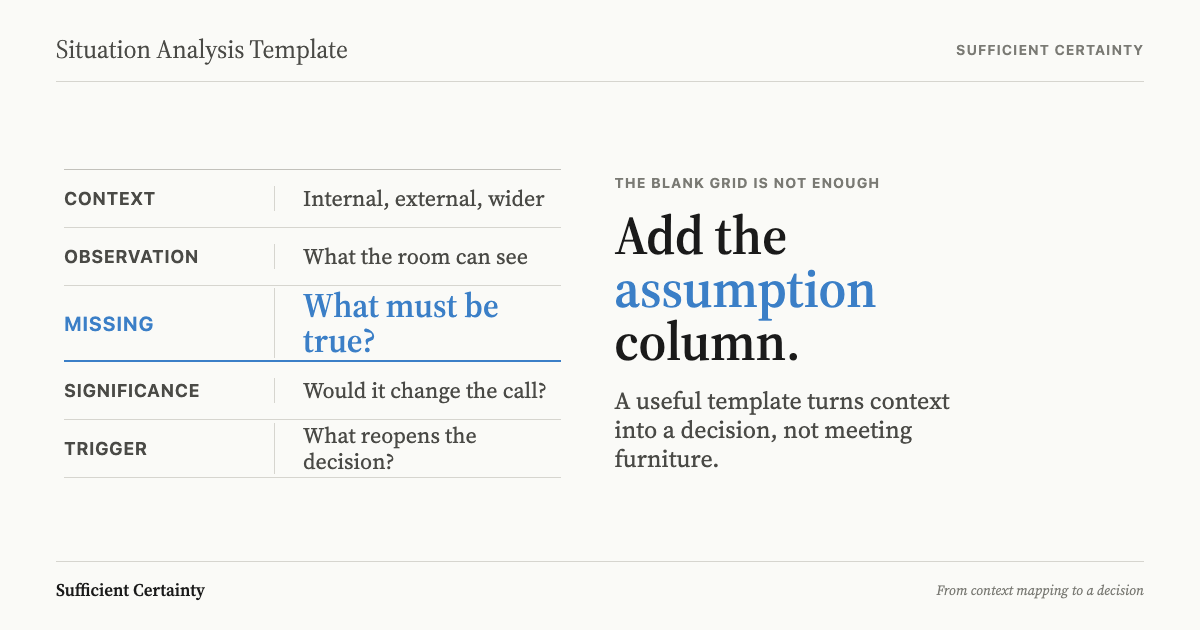
The next column is the one most templates leave out. For every observation, write the assumption behind it. If the observation says "customers are dissatisfied with current providers," the assumption might be that dissatisfaction is strong enough to make them switch. If the observation says "the regulatory environment is stable," the assumption might be that no policy change will land before implementation. If the observation says "we have enough capacity," the assumption might be that the same team can carry the new work without degrading existing service.
This column makes people uncomfortable. That is what happens when an assumption is finally stated plainly.
SWOT has suffered from this weakness for years. Hill and Westbrook's paper, "SWOT Analysis: It's Time for a Product Recall", criticised the way SWOT exercises generated lists without translating them into strategy. The same disease appears in situation analysis templates. A long list of factors is not a decision. It is a list. Committees are very good at mistaking one for the other, especially when the list is in a handsome table.
The template should force a plain sentence for each assumption, not jargon and not a category label, but a sentence that can be challenged. "We assume switching costs are low enough for unhappy customers to move within six months." "We assume the supplier can absorb a 30 percent increase in volume without quality loss." "We assume the policy review will not alter the licence conditions before launch." Now the room has something useful to argue about.
Separate Important Assumptions From Meeting Noise
Once the assumptions are visible, the next mistake is to test all of them. That is how analysis becomes delay. Some assumptions have little influence on the decision. Some are already well supported. Testing them may feel prudent, but it usually protects the room from the harder admission that one or two assumptions are carrying the whole recommendation.
Add two columns: influence and confidence. Influence asks how much the decision would change if the assumption proved wrong. Confidence asks how good the evidence is. High influence and low confidence is the danger zone. Those assumptions need work before the recommendation goes forward. High influence and high confidence may need monitoring, but they do not usually need another research project. Low influence assumptions can be recorded and left alone unless someone is looking for a way to avoid deciding.
This is also where the template connects naturally to how to do a situation analysis, and the situation analysis example shows what that handoff looks like in real cases. The process gathers the context. The template turns that context into a short list of assumptions worth testing. If the worksheet produces twenty open questions and no ranking, it has failed. You have not clarified the decision. You have created a new queue.
I would also add a volatility column. A condition may be true today and fragile tomorrow. Record the probability of change, the likely speed of change, the timing, and whether you would detect the change soon enough to act. This is where the usual blank grid becomes dangerous. It freezes the room's current view and gives it the dignity of a document. A dated context statement is useful. An undated template is a fossil pretending to be a plan.
The Situation Analysis Template I Would Use
Keep the worksheet plain. One row per contextual condition. This is the situation analysis template I would take into the meeting:
| Field | What to write | Example |
|---|---|---|
| Decision | The choice this analysis must support | Enter the market in Q3 |
| Context band | Internal, external, or wider context | External |
| Condition observed | What the team has noticed | Customers complain about current providers |
| Evidence | What supports the observation | Six interviews, sales team notes |
| Assumption | What must be true for the observation to matter | Frustration is strong enough to make buyers switch |
| Influence | How much this could change the recommendation | High |
| Confidence | How well the assumption is supported | Low |
| Volatility | How likely the condition is to change | Medium |
| Test required | The next check before relying on the assumption | Interview three lost buyers and test switching cost |
| Owner | Who must complete the test or monitor the signal | Product lead |
| Review trigger | What would reopen the decision | Fewer than two buyers say they would switch this year |
That is not elegant, which may disappoint the people who enjoy templates as stationery. It is useful.
The "test required" column is where the meeting changes character. If an assumption is high influence and low confidence, write the next action. Interview three customers. Check contract capacity with the supplier. Ask counsel for the specific regulatory trigger. Run a small pilot. If no test is needed, write that too. A blank cell is how doubt survives without ownership.
The owner column matters because assumptions without owners become folklore. Everyone remembers that "we thought the supplier was fine." Nobody remembers who was meant to check. The review trigger matters because a situation analysis belongs to a date. If customer churn rises above a threshold, if a bill enters parliament, if a competitor drops price by 15 percent, the decision may need reopening. Record that before the room congratulates itself and moves on.
Use SWOT, PEST, 5C or any other framework if it helps the room see the context. I do not object to boxes. I object to the way boxes become a substitute for thought. A proper situation analysis template should make the Decider face the assumptions underneath the boxes, judge which assumptions matter, and decide what evidence is enough to act.
The test is simple. If the completed worksheet cannot tell you what recommendation it supports, which assumption could break that recommendation, and what would reopen the decision later, it is not a situation analysis template. It is meeting furniture.
You could fill the template and still leave the recommendation unsupported.
Work through your decisionNo sign-up. Just pick your decision and start.
Grant Purdy is the co-author, with Roger Estall, of Deciding (2020), and the architect of the Universal Decision-Making Method.