
Most SWOT opportunities look attractive inside the grid because nobody checks what each entry assumes. The question is not which opportunities score highest. The question is which claim underneath the opportunity can carry capital if it turns out to be wrong.
By May 2024, AT&T had passed more than 27 million locations with fibre and said the returns were above its initial assumptions. It was considering another 10 to 15 million locations, but only if the build parameters and regulatory setting held. When a board asks which SWOT opportunities are worth betting on, it needs evidence that permits the next release of capital, rather than a prettier ranking.
I have sat in SWOT workshops where the chief executive wanted two opportunities circled before lunch and the sponsor wanted a shortlist for the board paper. The facilitator got a completed workshop, the sponsor got a shortlist, and nobody had to put evidence behind either choice. The room then started scoring impact. A high score merely describes the prize if the claim is true. It says nothing about the claim itself.
SWOT opportunities worth betting on are external conditions whose decision-critical assumptions have reached sufficient certainty for a bounded commitment.
Which SWOT opportunities are worth betting on after the workshop?
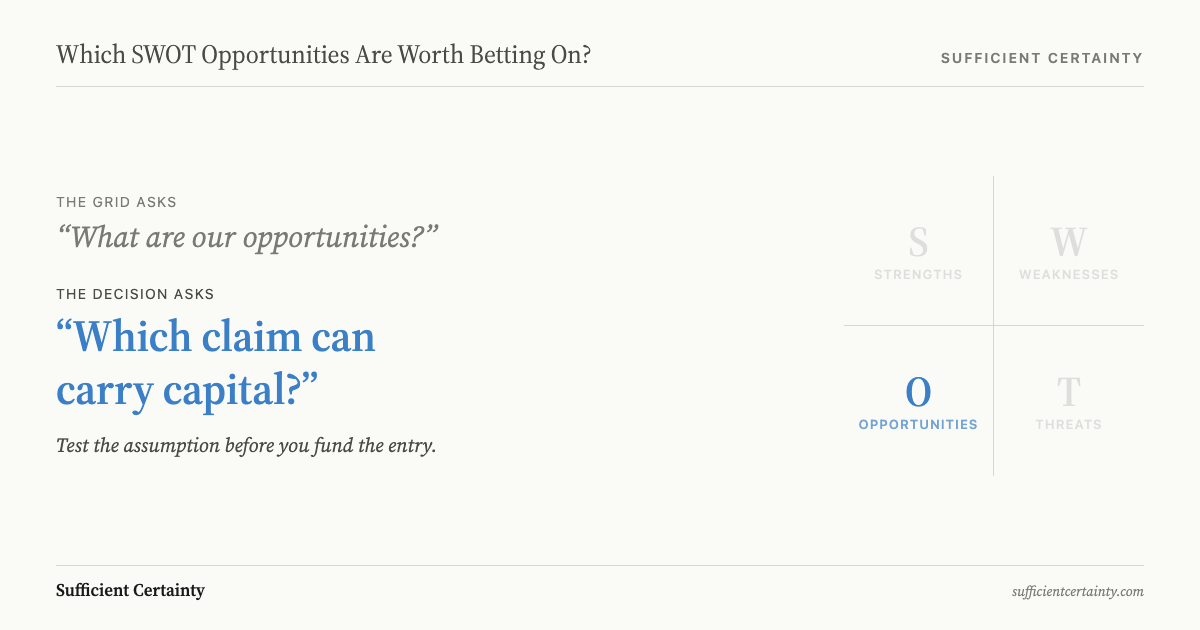
A typical O quadrant after a workshop might read:
| O-quadrant entry | The claim that must hold |
|---|---|
| Fibre broadband expansion | Build economics and regulatory setting hold at scale |
| Primary care through pharmacy network | Clinic model attracts patients at the required density |
| Renewable energy demand | Turbine platform survives field conditions |
| Adjacent market expansion | Plant has spare capacity at the required service standard |
Every entry looked attractive in the grid. The second column is the work the grid did not do.
An opportunity deserves a capital decision only after its claim has been written as a test and its first commitment has a limit. When I am asked which SWOT opportunities are worth betting on, I start by asking what capital is actually required. I have watched planning teams leave a growth strategy review calling an adjacent-market expansion a decision when all they had decided was to keep discussing it. The question changes when the commitment is written down: six months in two customer segments, with a stated sum of money, then a decision on a wider launch. The first test is whether anyone can say what they are actually being asked to fund.
In my experience, the significant assumption appears when the commitment acquires a boundary. A regional manager may be confident that existing customers will buy, while the operations manager knows the plant has no spare capacity at the required service standard. I have seen both views left unrecorded because the O quadrant was treated as a collection of attractive observations rather than a proposal to spend money. The workshop produced a page; the Deciders still had no decision.
The four boxes put an untested market claim beside a settled operating fact and make both look ready for investment. "A competitor will exit the market" can sit beside "strong brand" with no indication of which is evidence and which is hope. That is why I use the SWOT analysis guide only as the starting point. After a completed SWOT analysis, the work is to turn an entry such as "demand for adjacent markets is growing" into a claim about demand and our ability to capture it at an acceptable return.
I have watched a sponsor use a high impact score to protect an expansion from examination because the number made the choice look settled. For a board deciding which SWOT opportunities are worth betting on, that is the first filter: evidence for the claim that would release capital. The more capital an entry draws, the harder its claim needs to be tested.
Take the opportunity your team circled and write the assumption it depends on before the next release of capital goes through. Start the Walk →
Test the claim before funding an O-quadrant entry
The second test concerns the claim that must make the investment pay. A broad market claim becomes dangerous when it hides the clinic economics that must make it pay. Walgreens Boots Alliance had a large primary-care opportunity through VillageMD, yet its 2024 annual report records a USD 12.4 billion goodwill impairment after its long-term forecast was revised down. It also records the closure of about 160 clinics.
The report identifies slower patient-panel growth and weaker multi-specialty productivity as inputs to that revised forecast. Changes to Medicare reimbursement were another premise. "Primary care is a large opportunity" therefore did no useful work for a Decider. The decision depended on whether a particular clinic model could attract patients at the required density and produce the required return. A market can be large while the business trying to serve it loses money.
| Broad O-quadrant claim | The claim that actually carried the decision |
|---|---|
| "Primary care is a large opportunity" | Each clinic attracts patients at the density needed to cover its costs |
| "Demand for adjacent markets is growing" | Plant can produce to specification without breaching existing service commitments |
I have seen a division president arrive at a board meeting with a demand forecast and no answer to the question that mattered, which was whether each new site could make money before the rollout consumed the cash generated elsewhere. The annual report does not tell us how Walgreens made the original commitment. It does show the claims that mattered once the forecast was revised. Patient growth had to support the clinic model, and the clinic model had to generate enough productivity for the return to remain credible. Those claims needed to be visible before the footprint expanded.
I do not need every assumption proven; that demand lets a committee postpone a decision forever. I need the claim that can reverse the decision and the evidence behind it. The first commitment must be small enough to survive being wrong. In meetings with production managers, I have watched a favourable customer survey lose its force once the cost of producing the promised service was put on the table. A survey can show demand and still say nothing about acquisition cost or what happens when volume rises. The Universal Decision-Making Method begins by requiring the Deciders to Frame the decision before they try to decide it.
Roger Estall and I wrote Deciding from the same practical requirement: test the claim that could change the commitment before the organisation becomes committed to a story.
Which SWOT opportunities are worth betting on? Name the gate
The third test is a condition for further funding. I put the opportunity in one sentence, then ask what must be true for the next commitment to remain sensible. I have watched a finance director approve a pilot with a figure for the first spend but no figure for the result that would justify the second spend. That arrangement protects the original proposal, because every outcome can later be described as a reason to continue.
The evidence does not need to be extensive; it needs to bear on the assumption that matters. I have been in plant meetings where directors spent weeks buying market reports while the unanswered question was whether their own line could deliver the product to specification. The report seller had delivered what was ordered. The board still had no evidence on its production constraint. An outside report cannot settle an inside operating constraint. A short production run might.
The gate needs an observable condition. In the adjacent-market example, a Decider might approve the pilot if a defined number of qualified customers sign contracts at an acceptable margin. I have seen teams wait until results were poor before deciding what that number should have been; the sales sponsor then had a reason to ask for more time, rather than explain why the original case failed. Record the number before the pilot begins. If the condition is missed, reconsider the wider launch rather than carry it forward because money has already been spent.
| O-quadrant entry | Gate condition (recorded before pilot) |
|---|---|
| Adjacent market expansion | 15 qualified contracts at acceptable margin within 6 months |
| Fibre broadband (next tranche) | Build economics and regulatory setting hold across initial 27 million locations |
The named Decider records that test before releasing the pilot budget. The practical work of turning a SWOT into a decision begins there.
Release capital in stages and watch the condition
The fourth test is what happens after the first release. AT&T's fibre expansion is useful because the possible next tranche remained conditional. The company had evidence from its initial build, while the further 10 to 15 million locations depended on similar economics and a supportive regulatory environment. That is a capital-release gate; a circled matrix entry says nothing about the next release of capital. It answers which SWOT opportunities are worth betting on when the team considers more capital.
Siemens Energy shows the other side of the problem. Its technical review found rotor-blade and main-bearing issues in the 4.X and 5.X Siemens Gamesa turbine platforms. The company then recorded expected future-quality costs of EUR 1.6 billion, which contributed to an expected fiscal 2023 net loss of about EUR 4.5 billion. That is what renewable-energy demand means in a turbine business: nothing until the machines survive the field.
I have sat through project reviews where a team had named a customer-conversion target but had not decided who would act when it was missed. The commercial manager could report the shortfall, the project sponsor could ask for another month, and the original decision simply remained in force by default. Monitoring tells the Deciders whether the condition behind a commitment still holds. Name the signal before the commitment is made and set the date at which it will be reviewed. In a turbine business, field-failure rate may be the signal that matters.
| O-quadrant entry | Signal to watch | Response if missed |
|---|---|---|
| Renewable energy demand | Field-failure rate within warranty assumptions | Pause rollout; isolate affected platforms |
| Adjacent market pilot | Contract conversion rate at month 6 | Reconsider wider launch; one extension or stop |
I have watched a pilot miss its contract target and become a request for more spending because nobody had recorded the response in advance. The answer may be one extension to find out why, or it may be to stop because the proposition has failed. Decide that response before the signal moves. Otherwise the people who proposed the opportunity become the people explaining why the failed test should not count, which is an arrangement that serves them rather better than it serves the organisation.
Before more capital is released, test the weaknesses that can make the release pointless. Design monitoring makes the condition visible after the first commitment; it does not make an untested claim true.
At this point, Sufficient certainty has a practical meaning: the proposition that could overturn the decision has been tested well enough for a bounded commitment, and the next piece of evidence that would reopen it is already known. A ranked O quadrant does not meet that standard, yet a board may still have to explain its decision later.
You could approve the next opportunity and still leave the assumption behind it untested.
Work through your decisionNo sign-up. Just pick your decision and start.
Grant Purdy is the co-author, with Roger Estall, of Deciding (2020), and the architect of the Universal Decision-Making Method.