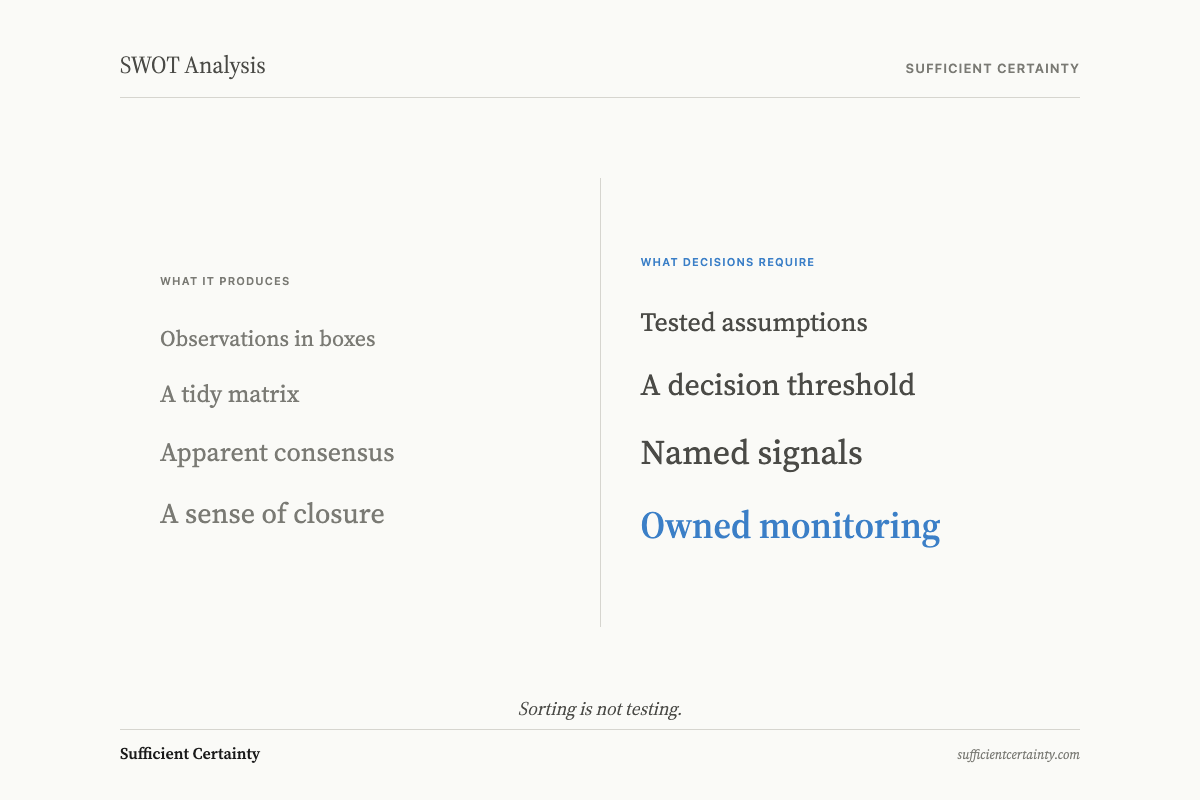
SWOT analysis sorts observations into four boxes and stops. The grid cannot tell a team whether any entry is a fact or a belief, and it has no mechanism for deciding when the room knows enough to commit. That gap between sorting and testing is where most strategic planning workshops quietly fail.
In 1997, Terry Hill and Roy Westbrook studied how 50 UK manufacturing companies used SWOT analysis in practice. Twenty of them generated more than 40 items in a single workshop. Not one used the output in later strategy formulation.
That finding captures the central weakness I see in SWOT analysis. The grid can create activity, volume, and a sense of rigour, but it rarely creates a decision unless another discipline takes over.
SWOT analysis is a strategic planning exercise that categorises observations into strengths, weaknesses, opportunities, and threats. Strengths and weaknesses describe internal conditions; opportunities and threats describe external conditions that may affect the organisation.
What SWOT analysis does not do, and what most teams never notice, is test whether those observations are facts or assumptions. I call this gap assumption debt: the accumulation of untested beliefs that a framework makes look settled.
What SWOT Analysis Actually Does (and Stops Doing)
Used fairly, SWOT analysis is a sorting tool. It helps a group collect internal observations under strengths and weaknesses, and external observations under opportunities and threats. That can be useful when people are working from different fragments of the same problem and need a shared picture before they argue about action.
In that narrow role, SWOT analysis earns its place. It gives a room a way to name what it thinks it knows, and just as importantly, what it has not yet reconciled. What it does not do is compare options, test timing, or tell the room which observations are merely descriptive and which are decision critical.
The ceiling arrives quickly. The list can look busy enough to suggest rigour, but it may not carry enough judgement to survive contact with real strategy. More items do not create a better decision.
Nor does a fuller grid create ownership, sequencing, or a clear statement of what should happen next. That is why I would keep SWOT analysis in its place.
As one input inside a broader situation analysis, it can help surface observations worth examining. Treated as the strategy itself, it becomes a piece of theatre. The team leaves with categories, not commitments, and with the dangerous feeling that the difficult thinking has already been done.
The format is tidy enough to travel upward through an organisation. That makes the illusion more dangerous because senior people may mistake presentation quality for decision quality. If you want the workshop version done properly, start with how to do a SWOT analysis without mistaking the completed grid for the decision. Three SWOT analysis examples show what happens when teams treat finished entries as facts.
The Assumption Problem: Why Four Boxes Hide More Than They Reveal
The most serious flaw in SWOT analysis is not that it is simplistic. It is that it gives every entry the same visual status, whether the entry is a measured fact, a loose inference, or a hope dressed up as insight. Once the item is in the box, it looks real.
The grid offers no mechanism to separate evidence from belief. That matters because facts can decay into assumptions. What was solid six months ago may now depend on conditions that no longer hold.
SWOT analysis also has no built-in test for significance. A trivial observation can sit beside a decisive one with equal weight and identical typography. Teams sometimes try to repair this with voting dots, colour coding, or extended debate, but that is improvised triage where a structured significance test belongs.
The framework itself does not ask two questions that should sit at the centre of strategy work: how much influence does this matter have on the decision, and how confident are we that it is true. Without that, the matrix hides its weakest thinking in plain sight, including which SWOT weaknesses could kill the decision if the team keeps treating them as background noise.
The boiling frog metaphor captures the problem. A postal service lists "established delivery network" as a strength. That was factual a decade ago, but it rests on assumptions about parcel volume, route density, and customer willingness to wait that email and e-commerce have been quietly eroding.
What was a measured strength has become a hope, and the SWOT box cannot show the difference. Facts decay into assumptions when conditions shift, and the grid offers no mechanism to notice. The alternative that fits depends on the kind of uncertainty in front of the team.
I have seen this pattern far beyond one postal service. Supplier contracts expire, regulators alter compliance costs, customer buying behaviour shifts, and markets reprice what looked secure. A cost advantage can vanish with one procurement cycle.
A recognised distribution edge can weaken when channel partners change incentives. A product feature that once signalled quality can become the minimum expected standard. Internal data decays as well.
Last year's margin, satisfaction score, or churn rate may still be accurate as history while being useless as a guide to the next decision. The drift is systemic. SWOT analysis records an observation at one point in time, but it does not ask what keeps that observation true, how fast those conditions move, or who is watching for decay.
SWOT Has No Decision Threshold
The hardest question in a SWOT workshop arrives after the matrix is full: now what. The framework does not answer it. It does not tell the team whether it knows enough to act, what uncertainty still matters, or what additional work would change the decision rather than merely delay it.
That absence creates two familiar pathologies. Some teams stall because there is always one more item to add or refine. Others leap to action because the completed grid looks like closure.
Good decisions do not require maximum certainty. They require sufficient certainty, enough understanding to act with a defensible grasp of purpose, assumptions, consequences, and exposure to change. SWOT analysis has no such threshold.
It provides no stopping rule and no test of readiness. A team can spend hours enriching the boxes and still remain unable to say whether the decision is fit to proceed. That is one reason the exercise so often feels like work while producing very little movement.
In practice, sufficient certainty is not zero risk and not complete consensus. It is the point at which the organisation understands the purpose of the decision, the assumptions it is relying on, the consequences if those assumptions fail, and the parts of the environment most likely to change after approval. That threshold is demanding, but it is usable.
It tells a team what it still needs to know and, just as important, what extra analysis will not improve the call. A practical test is blunt: what missing fact, if we had it tomorrow, would change the decision rather than simply make us feel calmer. Without that threshold, caution turns into drift and speed turns into guesswork.
Enron's board had volumes of data, audit reports, and analyst coverage. A SWOT analysis could have listed "innovative financial instruments" under strengths and "regulatory scrutiny" under threats. Neither entry would have prompted the question that mattered: at what point do we have enough evidence that these instruments rest on assumptions we cannot verify?
Without a decision threshold, confidence compounded unchecked. More data arrived, but no mechanism existed to ask whether the data was testing the right assumptions or merely confirming the comfortable ones.
Rewrite the SWOT entry your strategy depends on as a testable assumption and check whether it holds. Start the Walk →
What Changes After the Meeting?
SWOT analysis is static. It captures a moment, then assumes the moment will stay put long enough for the decision to remain sound. Real decisions do not fail in only one way, and they do not fail only at the moment of choice.
When outcomes diverge from intent, the problem usually sits in one of four places: a defective decision, bad implementation, a monitoring malfunction, or a context change. SWOT analysis has no architecture for distinguishing between those four after the meeting is over.
The distinction matters because the remedy depends on the failure mode. A product launch can miss its target because the choice was wrong, because sales execution was poor, because the team failed to notice an early warning signal, or because a competitor changed the market after launch. Those are different problems.
One calls for revisiting the judgement, another for fixing delivery, another for repairing oversight, and another for adapting to a changed environment. A SWOT grid cannot tell you which one happened because it was never designed to connect the original judgement to later evidence.
This is why I would not stop at the workshop wall. Someone has to know what signals would show the decision is drifting, which assumptions are most likely to move, who will monitor them, and what response is pre-authorised if they do. The monitoring cadence matters as much as the signal.
A monthly review may be adequate for one decision and absurdly slow for another. A matrix on a wall answers none of that. At best it becomes a historical artefact.
At worst it creates false reassurance because people assume the thinking has been captured somewhere, when in fact nothing has been designed for the moment conditions shift.
Taxi incumbents could easily have written regulation under strengths and technology under threats. That would have missed the mechanism of disruption: smartphones, GPS, and digital payments arriving inside a looser labour market and changing customer expectations together. Uber did not win because one threat sat in one box.
It won because several context changes interacted at the same time, and the incumbents were not watching the combination. Knowing which opportunities are worth betting on requires testing the claim behind each one before releasing capital.
When SWOT Is Worth Running (and When It Isn't)
SWOT is worth running when the conversation is genuinely early, the room is fragmented, and the immediate aim is to surface what people think they know. In that setting, the four boxes are a prompt, not a verdict. They can expose disagreement, reveal blind spots, and give a mixed group a common starting page.
I would rather see a team use SWOT this way than pretend it already has a complete view of the situation. The problem is not the prompt. The problem is mistaking the prompt for the strategy.
SWOT is not worth treating as the endpoint. If the issue is wide environmental scanning, a PESTEL analysis is at least honest about being an external scan rather than a decision process. If the issue is choosing between options under uncertainty, SWOT analysis is usually too loose where the work needs to be tight.
For an entry decision, the question of whether to use SWOT or PESTEL for a market entry depends on whether the uncertainty sits in the new market or in the organisation's ability to operate within it.
It does not frame the decision precisely, it does not test the assumptions behind the entries, and it does not design monitoring. Used beyond its natural range, it gives weak thinking a polished container. The warning signs are clear: timing matters, downside is material, assumptions are unstable, and a bad call will be expensive to reverse.
An Alternative That Tests What SWOT Assumes
The alternative is not another template, a weighted matrix, or a more elaborate workshop. It is a decision method that forces the team to do the work SWOT analysis leaves undone. I am not suggesting the four boxes must be banned.
I am suggesting they need a follow-on process that turns categorised observations into tested judgement. Otherwise the organisation is still relying on a list, and lists are poor substitutes for decisions.
Where SWOT leaves the decision unframed, the method begins by stating the actual choice, so the team stops filling boxes before it knows what it is deciding. Where SWOT revolves around one favoured answer, the method requires real options. Where SWOT gives every entry equal visual weight, the method drags out the hidden dependencies and asks how confident we are in each one. Where the matrix offers no stopping rule, the method supplies a threshold: sufficient certainty to act. And where SWOT ends at the workshop wall, the method designs monitoring so the decision is not abandoned to luck once approved.
Make that concrete. If someone writes strong brand under strengths, I would not let the item sit there untested. Strong with whom, for which offer, at what price, and against which alternatives.
The claim usually rests on assumptions about customer recall, trust, switching costs, or the organisation's ability to charge a premium without losing volume. Then I would ask how confident we are in each assumption and what signal would show the claim has stopped holding.
Falling repeat purchase, weaker price realisation, lower conversion in a once loyal segment, or rising acquisition cost can all show that the brand is not as strong as the box suggests. That turns a flattering label into a monitored claim, which is far more useful than leaving it in a green square.
That is why the method is more than a critique of SWOT analysis. It is a practical replacement for the thinking SWOT leaves unfinished. When each assumption is rated for influence and confidence, and then watched for likely change, the plan stops pretending to know what it only hopes.
That small change creates a live picture of what the organisation actually knows, what it merely believes, and what would have to move before the strategy should be questioned, which is the point of the five steps that turn a filled SWOT grid into a funded commitment.
From Categories to Commitments
The point is not to abandon SWOT analysis in disgust. The point is to stop treating a sorted list as a strategy. Every item in the matrix is a hypothesis until someone asks what evidence supports it, what assumption sits beneath it, how much it matters, and what would show it has stopped being true.
Until then, the neatness of the four boxes is cosmetic. It makes the discussion easier to display, not safer to trust.
This is the difference between a useful framework exercise and strategic theatre. In the useful version, the output moves quickly into the method, where the assumptions are tested, the threshold for action is stated, and the monitoring is designed before the decision is locked in.
In the theatrical version, the matrix is circulated, filed, and cited later as evidence that due diligence occurred. That is how organisations accumulate paper confidence and operational surprise at the same time. Documentation is not discipline. A board that runs PESTEL and SWOT before a market entry can still approve the bet without naming the assumption that carries it.
A slide deck that records untested assumptions is still a record of untested assumptions.
I would keep SWOT analysis on the table, but only as a first pass. Used that way, it can help a team notice what deserves scrutiny. Left on its own, it leaves the hardest work untouched.
Sorting observations is easy. Turning them into commitments that can survive contact with reality is the real job. If you run one, add four notes beside every item before you trust it: evidence, assumption, consequence, and monitoring owner.
Your SWOT sorted the observations. Now test whether the assumptions behind them can carry the decision.
Work through your decisionNo sign-up. Just pick your decision and start.
Grant Purdy is the co-author, with Roger Estall, of Deciding (2020), and the architect of the Universal Decision-Making Method.