
Teams fill the SWOT grid and go quiet because the matrix has no mechanism for telling them when they know enough to act. To turn SWOT into a decision, test the one assumption the commitment depends on. The grid sorts what a room thinks. It cannot check whether the room is right.
You filled the grid. Four quadrants, twenty or thirty entries, every one of them defensible. Now you want to turn the SWOT into a decision, and the grid has nothing to say about how. SWOT does not distinguish evidence from assumption, and it has no mechanism for telling a group when it knows enough to commit.
Most teams I have worked with over fifty years reach the same point. The matrix is full, the session felt productive, and nobody can name the next commitment. They sorted everything the room collectively knew into four labelled boxes. Sorting felt like progress. It was not.
The standard advice at that point is to append action items or a prioritisation layer to the matrix. That advice misses the structural problem. SWOT collects and categorises observations but has no mechanism for testing them against evidence or telling the group when it has enough information to commit. The gap is architectural, built into the framework's design. The work that follows a completed SWOT must supply what the grid never can: a mechanism for testing claims and a threshold for action.
Turning a SWOT into a decision is the process of testing each grid entry against evidence and setting a threshold for when the team knows enough to commit.
Why Your SWOT Did Not Turn Into a Decision
SWOT is a sorting tool built for a single job: taking the scattered observations of a group and distributing them into four labelled boxes. That job is useful, but sorting is not deciding, and the two operations require fundamentally different cognitive work, a distinction Henry Mintzberg identified in 1994. Strategic planning had failed, he argued in his Harvard Business Review article, because it confused analysis with synthesis: planning decomposes problems into parts and arranges them, while strategy requires choosing between alternatives under uncertainty, which is a different operation entirely. Mintzberg observed that formal planning systems had "never amounted to strategic thinking" and had "in fact, often impeded it."
SWOT inherits this confusion, performing analysis and stopping where synthesis should begin. The framework provides no mechanism for testing whether an entry rests on evidence or assumption, and no threshold for saying "we have examined enough, it is time to commit." Consequently, teams fall into one of two patterns after completing the grid. They stall, adding entries indefinitely because nothing in the framework signals that analysis is complete. Or they leap, treating the filled matrix as permission to act on assumptions they never examined.
I have seen both patterns across nearly fifty years of working with boards and management teams. The people are fine. The tool stops where it should start. SWOT analysis sorts the room's thinking. It does not test a single claim in the grid. Planning-software vendors give the four-box template away and charge for the project-management tools that follow. They have no interest in the grid producing a decision either.
What Untested Assumptions Cost Toys R Us
In 2005, KKR and Bain Capital bought Toys R Us for $6.6 billion, funding the deal almost entirely with debt and saddling the company with $5 billion and annual interest payments exceeding $400 million. A SWOT at the time of the deal would have shown a dominant brand with more than 600 stores and roughly 40 per cent of annual revenue concentrated in the fourth quarter, giving the company a seasonal moat. It would also have listed Amazon's retail expansion and the growth of e-commerce in the threats quadrant, both visible to anyone reading a trade publication.
The entries were accurate, but what mattered was what sat beneath them: the sponsors assumed the retail marketplace would remain stable long enough to service the debt, and they assumed operating costs could be cut far enough to generate surplus cash without degrading the brand. Neither assumption was tested against evidence or assigned to an owner responsible for monitoring whether conditions changed. Each occupied the strategy deck as settled fact when it was, in reality, a hypothesis that would determine whether the company survived.
Between 2005 and 2015, Toys R Us made no meaningful investment in e-commerce while the competitive ground shifted beneath it. The SWOT entry "e-commerce threat" had been visible to every analyst covering the sector, but visibility is not testing, and a category label in the threats quadrant carries no obligation to act. In September 2017, the company filed for Chapter 11 bankruptcy. The matrix had not turned the SWOT into a decision about which assumptions needed testing or who would test them.
Pick the SWOT entry your plan depends on, rewrite it as a dated bet, and name who owns the answer. Start the Walk →
Turning SWOT Into a Decision Requires a Threshold
The structural gap in SWOT is the absence of what Roger Estall and I call sufficient certainty: the point at which the cost of further analysis exceeds the expected value of what that analysis would reveal. Every decision involves uncertainty; the question is not whether you have complete information, because you never will, but whether you know enough, on the matters that could actually change your choice, to commit and move forward.
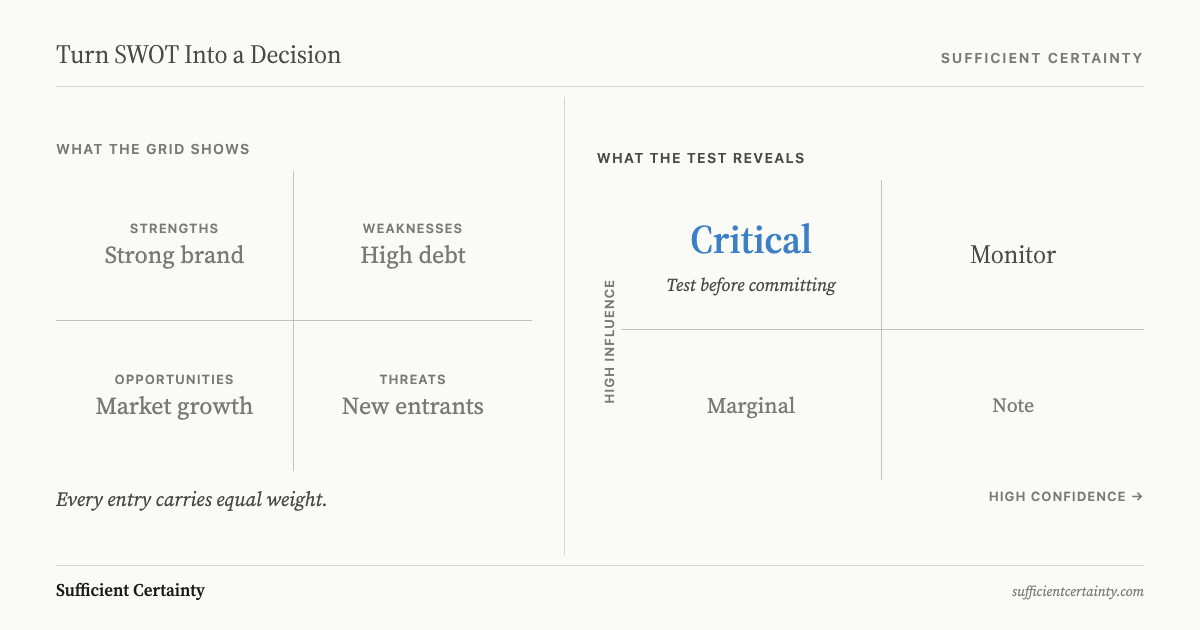
The test we use asks two questions about every claim the plan depends on. First: how much influence would this matter have on the decision if the claim turned out to be wrong? Second: how confident is the team in the evidence behind it? A claim with high influence and low confidence sits in the Critical zone and must be investigated before anyone commits. A claim with low influence and high confidence can be noted and monitored but should not delay the decision. This sorting replaces the flat visual equality of the SWOT grid with a prioritised, testable set of claims about the world.
Consider a typical SWOT entry: "strong brand recognition in the domestic market," placed in the strengths quadrant. You will find it in nearly every set of real SWOT analyses. The grid gives this entry the same visual weight as every other strength, regardless of the evidence behind it. In most cases, nobody has checked whether the brand carries the same weight with younger customers as with existing ones, or with customers in a new country, which is the test behind using SWOT or PESTEL for market entry. The confidence is inherited from an older survey and has not been re-examined. That is how you turn a SWOT into a decision: not by adding action items to the grid, but by testing what it assumes.
Mintzberg called for a mechanism that would bridge the gap between analysis and synthesis in strategic work. The method we developed provides that mechanism as its third stage, where assumptions are tested and assigned to owners before the team decides.
What Changes When Every Assumption Has an Owner
ClearPoint Strategy analysed over 20,000 real strategic plans between 2017 and 2024 and found that 84.5 per cent of strategic projects never reached completion. The most revealing finding was not the failure rate itself but the ownership data behind it: 74 per cent of goals and 57 per cent of projects had no assigned owner. The report described these as phantom ownership situations, where names appeared on paper but no one held accountability for outcomes.
This is the predictable result of strategies that were sorted but never decided. A plan without ownership is a list of intentions, and a list of intentions is what SWOT produces by default. The grid distributes observations into boxes but assigns no one the responsibility of testing whether those observations rest on evidence or belief. The PMI Pulse of the Profession (2025) documented the same pattern: only half of projects met a modern definition of success, and PMI attributed the gap to a skills deficit. I would frame it as a decision deficit instead. Organisations formulate extensively and execute poorly not because their people lack competence, but because no tool in the standard planning sequence tells them when to stop analysing and start committing.
The sequence from grid to commitment does not start at the whiteboard. Every entry must be rewritten as an assumption and tested for what matters and how well it is known, then assigned an owner if it falls in the Critical zone.
This is the monitoring discipline set out in Deciding and built into the Universal Decision-Making Method. Each significant assumption gets a person responsible for watching it and acting if conditions change.
Without that discipline, no amount of strategic analysis will turn the SWOT into a decision. The grid joins the 84.5 per cent of projects ClearPoint documented: sorted and never executed.
You could type up the matrix and still owe the room a decision by Thursday.
Work through your decisionNo sign-up. Just pick your decision and start.
Grant Purdy is the co-author, with Roger Estall, of Deciding (2020), and the architect of the Universal Decision-Making Method.