
An AI decision maker processes data and produces a recommendation or a weighted score. It does not make a decision. A decision requires someone to judge what matters and to commit to a course of action when certainty is incomplete.
Every tool in this category operates on the same structural flaw: it processes inputs according to assumptions that receive no scrutiny. When an organisation treats the tool's output as the decision, the assumptions embedded in the model go untested, and the person who should be deciding has been quietly replaced by a calculation.
An AI decision maker is a tool that processes data and produces a recommendation or score, but cannot judge what matters to the person who must act.
What an AI Decision Maker Actually Does
Search for "AI decision maker" and you will find tools across a wide range of complexity and price. They fall into distinct categories, and understanding what each one actually does matters because the marketing language obscures a shared limitation.
The simplest are consumer apps. You describe your dilemma and the app returns an answer. Some generate pros and cons. Others ask a series of questions and produce a weighted recommendation. A few present the output as a verdict, complete with confidence percentages. The interface varies but the function is identical: the tool takes your description of the problem at face value and produces output that looks like a resolved decision.
More structured tools ask you to define your options, list your criteria, and assign weights to each criterion. The tool builds a decision matrix, scores each option against your weighted criteria, and ranks them. Some use large language models to generate the criteria themselves or to argue both sides of each option. These tools are popular in procurement, vendor selection, and technology evaluation where the criteria feel objective.
At the enterprise level, the tools add scenario modelling, sensitivity analysis, and Monte Carlo simulations. They generate board-ready reports with trade-off matrices, option trees, and visual summaries. The promise is that senior leadership can feed in strategic options and receive a data-driven recommendation. The output carries the appearance of rigour because it is quantified, structured, and presented with precision.
The newest category treats the AI itself as the decision maker. You describe your situation in natural language and the model responds with a recommendation, sometimes structured, sometimes conversational. The interface feels like consulting an adviser, which makes the output feel more authoritative than a spreadsheet ever did.
I have spent nearly fifty years working with organisations on how they decide. Every one of these tools, from the consumer app that tells you where to eat to the enterprise platform that models a capital allocation, performs the same function a spreadsheet performs. They organise information. That is useful. What none of them do is examine whether the information you provided captures what actually matters, or whether the assumptions embedded in your criteria, your weights, or your framing of the problem are sound. The tool takes your inputs at face value because it has no capacity to question them.
The hardest part of any consequential decision is identifying the assumptions the decision rests on and judging whether you have sufficient certainty about each one. The tool skips that step entirely. It starts after the thinking should already be done, and it produces output that looks authoritative enough to pass for a finished judgment.
The Model Is Not the Decision
In 2007, credit rating agencies ran sophisticated models on mortgage-backed securities. The models processed vast quantities of data: default rates, housing prices, geographic diversification. They produced ratings. Triple-A. The output looked like a decision, and the entire financial system treated it as one. Banks bought the securities because the model said they were safe; regulators accepted the ratings in place of independent judgment; investors relied on the output without examining the assumptions embedded in it.
The assumptions were wrong. The models assumed that housing prices would continue to rise, that defaults in different regions were uncorrelated, and that historical performance predicted future risk. A handful of analysts did question those assumptions, but they were working against a system that had outsourced judgment to a model. The rating carried more institutional weight than any individual's doubt. Nobody with the authority to act tested these assumptions because testing would have required someone to actually decide: to say "I think this is wrong despite what the model says." The model's authority made that act of individual judgment feel unnecessary, and the cost of that unnecessary feeling was measured in trillions.
The same pattern plays out whenever someone treats a tool's output as a finished judgment.
Name the assumption underneath your next AI recommendation and ask who tested it before the output became the decision. Start the Walk →
88 Per Cent Adoption, 40 Per Cent Impact
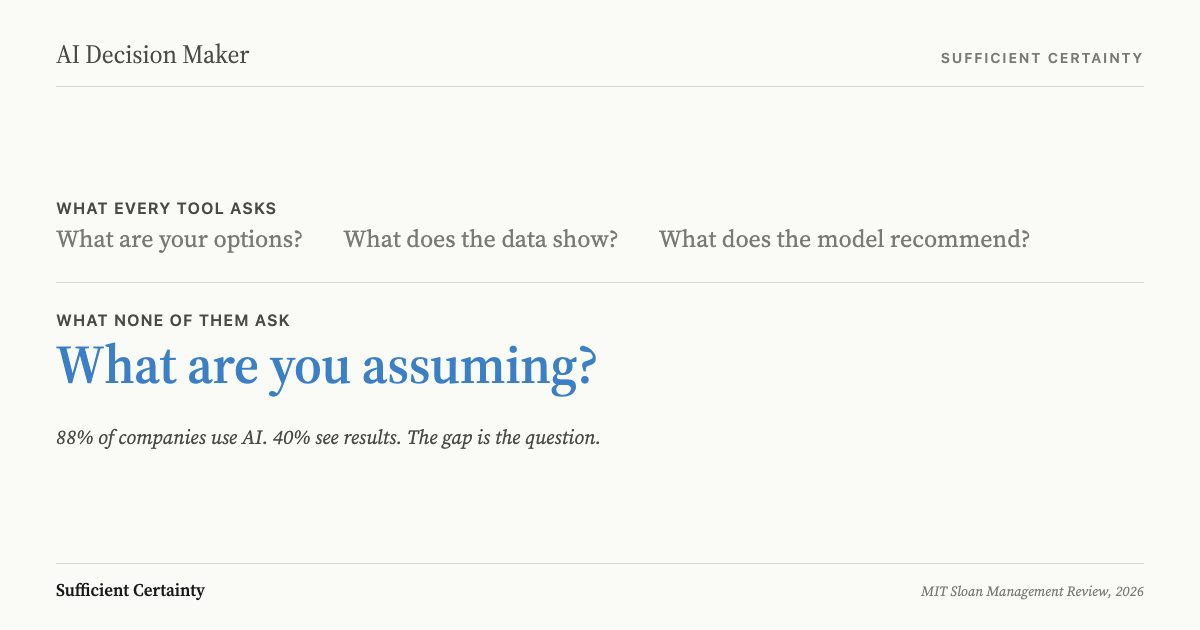
Research from MIT Sloan Management Review (Amorim, Saleh, and Cederskog Sundling, May 2026) found that 88 per cent of companies now use AI in at least one function, but only 40 per cent report positive bottom-line impact. That gap, nearly half of all AI-adopting organisations seeing no measurable return, is a deployment problem. The researchers identified the core failure: organisations systematically apply AI to decisions the technology is not suited for.
The MIT Sloan team distinguishes between what they call "narrow decisions" and "wide decisions." Narrow decisions have clear objectives, available data, and quickly measurable outcomes; predictive and analytical AI handles these well. Wide decisions involve contested goals, incomplete information, and the need for alignment among people who disagree about what matters. Most of the decisions that keep a VP Operations awake are wide decisions. No tool in the category addresses them because wide decisions require a human being to determine what matters before any data processing begins.
That distinction maps directly onto a principle Roger Estall and I established in Deciding: a model is not a decision. Models handle narrow problems efficiently. They optimise logistics and predict demand. They fail when the problem requires someone to ask "what are we actually trying to achieve, and what are we uncertain about?" The Universal Decision-Making Method begins where these tools stop: with the question of what the decision actually is.
A Harvard Business School study (Koning and Ammerman, September 2025) tested this directly. Researchers gave 640 small business owners in Kenya access to an AI business advisor. The expectation was that AI would close the performance gap between high and low performers by giving everyone access to the same quality of advice.
The opposite happened. Business owners who already had strong judgment, those who could evaluate which advice fit their specific situation, saw profits and revenues increase by 10 to 15 per cent. Business owners who lacked that judgment and relied on the AI as an oracle saw an 8 per cent decline. The gap between high and low performers widened.
The tool provides information and recommendations; it does not provide the capacity to judge which recommendation fits your situation. That capacity is what I call sufficient certainty, and it is personal. No algorithm can calculate your threshold because only you know what you are deciding about and what you can accept getting wrong. The Kenyan entrepreneurs who benefited already knew what to look for; the AI helped them refine decisions they were already capable of making.
The ones who were harmed expected the tool to supply the judgment they felt uncertain about, and the tool obliged by giving them confident recommendations that did not account for their specific circumstances. That is what happens when a tool that cannot judge context makes business decisions: it amplifies existing capability and punishes its absence.
Automation Bias: Why People Stop Thinking
There is a cognitive mechanism that explains why these tools are actively dangerous for consequential decisions. An empirical study published on ResearchGate in 2024 found that professionals using AI decision support systems routinely accepted incorrect outputs without critical evaluation. The researchers term this "automation bias": the tendency to defer to an automated recommendation even when it conflicts with the user's own judgment or the available evidence.
The mechanism is straightforward. When a tool presents a recommendation with confidence that bears no relation to its accuracy, ranked options, and weighted matrices, the output acquires the appearance of authority. Users treat it as a decision rather than as an input to one.
In a related clinical review, only 6 out of 5,987 citations met the criteria for clinically validated AI decision support. The gap between what is promised and what is validated is enormous, and automation bias ensures that users do not notice the gap because noticing would require them to question the tool's authority. The ethical questions this raises are substantial: the tool's selling point, that it does the hard thinking for you, is precisely the condition that triggers automation bias. The user stops thinking because the tool appears to have done it already.
What a Decision Partner Looks Like Instead
Gartner's 2025 Hype Cycle for Artificial Intelligence rated "Decision Intelligence" as having transformational potential. That category exists because enterprises spent heavily on AI without improving decision outcomes. If the tools worked as advertised, an analyst category dedicated to bridging the gap between AI output and actual decisions would not need to exist. The industry is selling a second layer of technology to fix what the first layer failed to deliver.
The process that works begins with the question the technology skips: what are you actually deciding, and what are you uncertain about?
The Universal Decision-Making Method starts where these tools leave off. You frame the decision: what is its purpose, who are the Deciders, what is the Context. You develop options. You recognise the assumptions each option rests on. You judge whether you have sufficient certainty about each assumption, and that judgment is yours alone because only you know what is at stake and what you can accept. Then you act, with monitoring designed to catch the assumptions that prove wrong.
AI can surface patterns in data and generate options you had not considered. However, those are decision support functions, not decision-making functions. The distinction matters because conflating the two is exactly how the GFC happened, how 60 per cent of AI-adopting organisations see no return, and how business owners in Kenya lost 8 per cent of their revenue by trusting a tool that could not tell them what mattered.
The pattern repeats because the failure is structural, not technological. An AI can surface data and generate options. It cannot judge whether you know enough to act on them. The broader relationship between AI and decision making begins with that distinction.
You could run the model and still leave the assumption it rests on unexamined.
Work through your decisionNo sign-up. Just pick your decision and start.
Grant Purdy is the co-author, with Roger Estall, of Deciding (2020), and the architect of the Universal Decision-Making Method.