
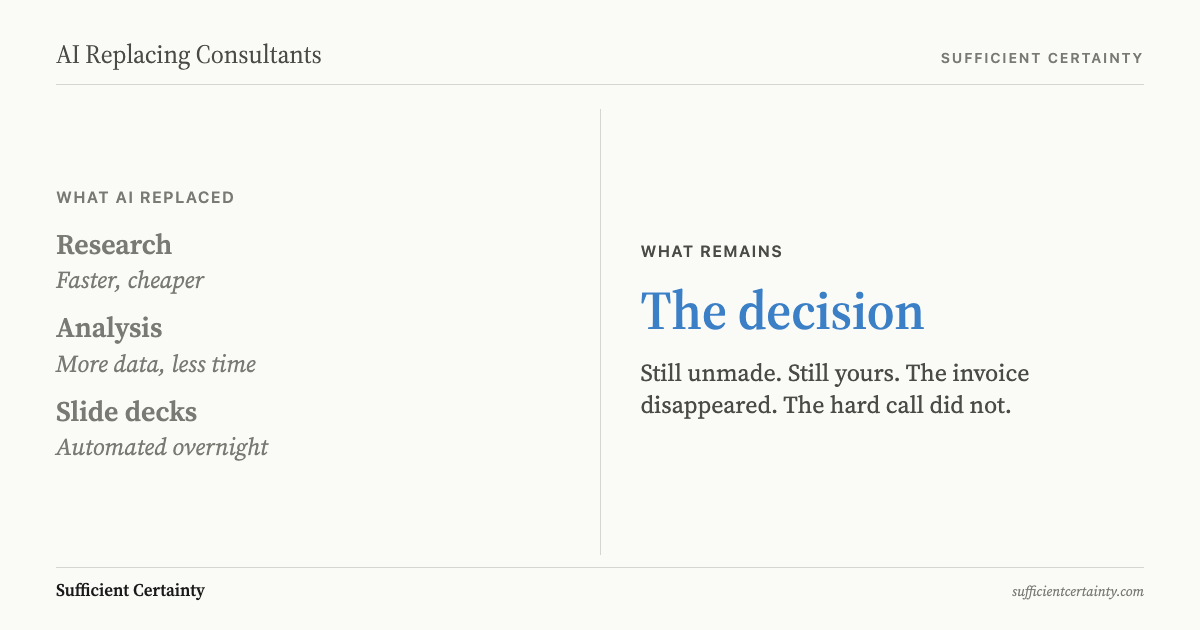
AI replacing consultants is the wrong framing. Consultants sold research and frameworks; AI replicates that product faster and cheaper. But the decision those deliverables were supposed to inform was never in the consultant's scope, and it is not in the AI's scope either. The gap between analysis and action remains where it was.
AI replacing consultants is the shift from buying research and analysis from external advisors to generating it with AI, while the consequential decision remains with whoever owns the outcome.
What Kevin O'Leary Actually Said
In June 2026, Kevin O'Leary told the Founder's Mindset podcast that companies he backs now use AI as their "first stop before engaging external advisors". He tears up resumes from anyone who spent more than seven years in consulting and frames this as AI replacing consultants.
Listen to what he actually describes. The AI evaluates distribution strategies, assesses operational structures, and analyses growth initiatives; every one of those is research, not a decision. O'Leary has not replaced the judgment; he has replaced the invoice for pre-decision research, and the founder still decides. What he describes is AI-assisted decision making in its proper sense: the tool researches, the human owns the call.
BCG's counter-claim is revealing: AI and technology services now account for more than 40% of BCG revenue. The consulting firms are not being disrupted; they are selling the disruption, and the invoice moves rather than vanishing.
AI Replacing Consultants Collapsed the Pyramid
The management consulting business model is a pyramid: cheap junior analysts do the research and build the slides, while expensive partners bill for judgment and client relationships. AI collapsed the base.
McKinsey cut 3,000 to 4,000 positions in 2025, concentrated in junior research roles, and PwC made similar reductions, with comparable cuts across the other major firms. Industry-wide, graduate job postings in consulting dropped 44% by 2024. McKinsey's own AI platform now does what the junior analysts used to do, and an estimated 80% of that research and synthesis work is automatable.
Notice what was not cut: partners and relationship managers, the people who sit in the room and help the client think through the hard call. The analysis layer is gone; the judgment layer persists because it was never what AI, or the junior analysts, were doing in the first place. The question of whether AI can make decisions answers itself when you look at what the cuts did and did not touch.
A $337 Billion Industry Where Most Buyers Say It Fails
Global management consulting was estimated at US$337 billion in 2024 by Source Global Research. The US market alone reached $420 billion in 2026; despite every headline about AI replacing consultants, consulting spend increased.
At the same time, a survey of 1,002 senior executives by HFS Research found that 65% said consulting engagements "often fail to deliver real value." Two thirds of buyers, dissatisfied, before AI entered the conversation.
That contradiction tells you what AI can replace in consulting and what it cannot. If the product were decisions and 65% of buyers said it failed, the industry would shrink; it grew because the real product is not a decision but the appearance of due diligence. "We hired McKinsey" is a defence against future blame. AI threatens the research deliverable but not the blame-absorption product. The $337 billion figure is the price tag on institutional reluctance to decide. The ethical problem with outsourcing judgment is the same one that plagued consulting: abdication dressed as delegation.
Write down what the last consulting engagement was supposed to decide, and ask whether anything has addressed that decision since the deck went into the drawer. Start the Walk →
The Jagged Frontier
In 2023, researchers at Harvard Business School ran a randomised controlled trial with 758 BCG consultants. Those using GPT-4 completed 12.2% more tasks, 25.1% faster, and produced results rated 40% higher in quality. Inside the capability frontier of the AI, the tool was unambiguously better than the consultant working alone.
Outside that frontier, the results reversed: consultants using AI were 19% less likely to reach the correct answer than those working without it. The researchers called this the "jagged technological frontier": AI capability is uneven, not graduated. Pattern-matching tasks sit inside the frontier; decisions under genuine uncertainty sit outside it, which is why AI makes wrong business decisions when applied beyond that boundary.
AI replacing the research layer follows a pattern I have watched for nearly fifty years. Roger Estall and I traced it across industries in Deciding, and the sequence never varies: a tool enters an organisation as an aid, gets treated as a substitute for the thinking it was supposed to support, and the thinking disappears.
The Enron board had Arthur Andersen billing a million dollars a week for auditing and consulting, and Andersen praised Enron's risk management practices. The board approved more than three thousand special-purpose entities on that assurance. The framework, the compliance checks, the risk reports: all produced the appearance of rigour while the actual thinking was absent.
Enron was simple fraud at the most senior level, aided by auditors whose consulting fees depended on not looking too closely. The apparatus did not detect the fraud because detection was never its function; it existed to provide the appearance of oversight.
AI Replacing Consultants Is the Wrong Question
If AI is replacing your consultant, the question is: what was your consultant doing? If the answer is "research and a slide deck," then yes, AI does that now, faster and cheaper. Contract analysis work that once took consultant teams weeks now takes minutes, often with greater accuracy.
If the answer is "helping us make the hard call," you were the rare buyer. Most consulting engagements never reach that point. The 60-slide deck arrives, the executive team nods, and it goes into a drawer. The decision that prompted the engagement remains unmade, or gets made on instinct the following Tuesday despite the consultant's framework recommending otherwise.
The Universal Decision-Making Method starts where both consultants and AI stop: with the decision itself, not with more research or another framework. Its five steps exist to move you from analysis to action; they surface the assumptions your decision rests on, rather than producing more analysis about the situation surrounding it.
That distinction matters because the assumptions are where decisions fail, not because the research was inadequate, but because nobody tested whether what they took for granted was true. A consultant will not do that for you, and neither will an AI; both will give you more information about the world, but neither will ask: given what you now know, what are you actually going to do?
AI replaced the research product, and that is overdue: it was overpriced and, by the buyers' own admission, underperforming. What remains is the gap that consulting was supposed to fill and never did, the structured process of converting analysis into a decision you can defend and act on.
If you have a decision in front of you and you are wondering whether to hire a consultant or use AI, you are asking the wrong question; neither one makes the decision. The question is whether you have a method for making it yourself, using whatever information you already have.
You could replace every consultant with AI and still leave the decision they were hired to inform unmade.
Work through your decisionNo sign-up. Just pick your decision and start.
Grant Purdy is the co-author, with Roger Estall, of Deciding (2020), and the architect of the Universal Decision-Making Method.