
A planning team I worked with last year completed their annual SWOT in forty-five minutes. Strengths filled one column; threats filled another. The board wanted a decision about where to invest; the grid gave them categories, so the strategy lead searched for an alternative to SWOT analysis.
Every result offered a different acronym. SOAR, PESTLE, and a half-dozen others each promised a better set of boxes to fill in. None addressed what had actually gone wrong in the meeting, which was not the quality of the categories but the distance between filling them in and committing to a course of action. The consulting firms and framework vendors who sell these replacements have the same incentive the original SWOT promoters had: the tool generates billable workshops whether or not it produces a decision.
The search for an alternative to SWOT assumes the framework was the problem. In my experience, the framework is rarely the problem. The problem is that the team used a categorisation tool where it needed a decision process, and no replacement framework closes that gap on its own.
An alternative to SWOT analysis is any strategic planning tool or process used in place of the strengths, weaknesses, opportunities, and threats framework when that framework has not produced a basis for action.
The failure every alternative to SWOT inherits
SOAR replaces weaknesses with aspirations; PESTLE widens the scan to six external domains; VRIO ranks internal resources by rarity and imitability. Each restructures the inputs without changing what happens with the output.
The first failure is the absence of a named decision. The team never stated what they were choosing between. Without a framed decision, any environmental scan produces observations that feel strategic but commit to nothing. I have watched teams spend entire days populating frameworks that were never connected to a specific choice; the output looked like strategy work and functioned as theatre.
The second failure is untested assumptions. Every entry in the original grid was an assertion that nobody checked. "Strong brand reputation" and "growing Asian market" sat in their respective quadrants as though someone had verified them. In 1997, Terry Hill and Roy Westbrook reviewed SWOT use across fifty UK manufacturing companies and found that the framework had no mechanism for distinguishing a fact from a guess; entries accumulated until the grid was full, and nobody went back to test them. That is what a categorisation exercise produces when no one asks whether the entries are true.
The third failure is the absence of a threshold for commitment. A completed grid creates a sense of closure: the meeting produced output, so the difficult thinking must be done. In practice, the team left with categories and no commitment. That is the most dangerous outcome, because it looks like progress while deferring the actual decision indefinitely.
Name the decision your team actually faces and test the assumption it rests on before reaching for a different grid. Start the Walk →
When the decision is a finite choice
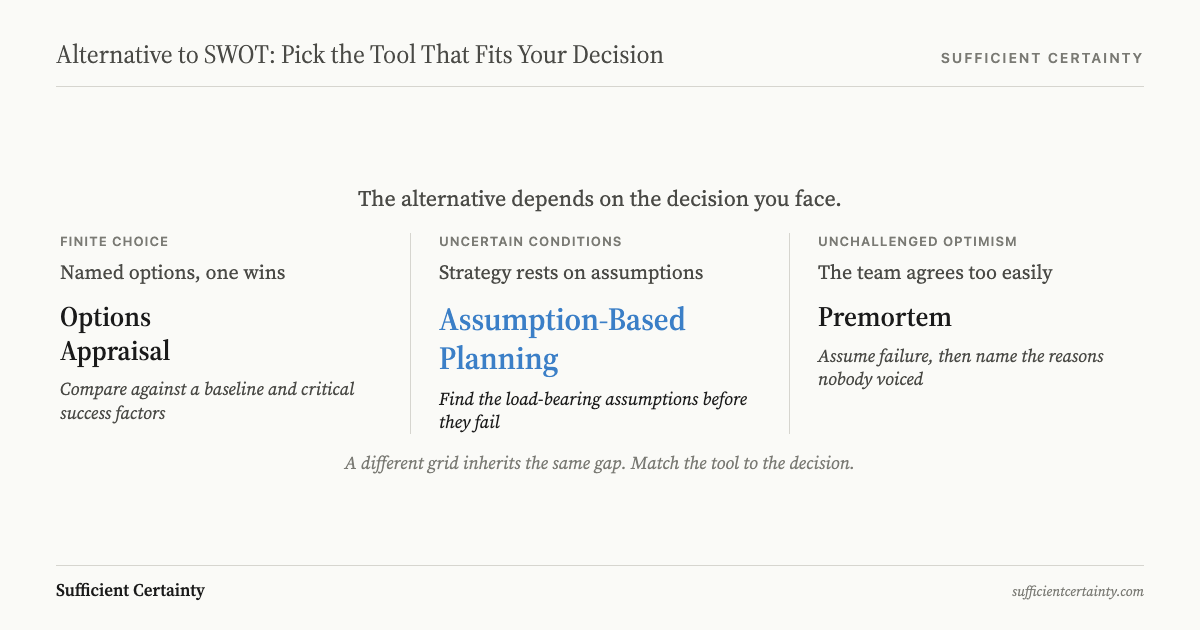
If the team is choosing between real options, say investing in one market over another or keeping a plant open versus closing it, the alternative is options appraisal: name the objective, generate options including the status quo, and appraise the shortlist on costs, benefits, and residual uncertainty. I have sat on appraisal panels where this structure forced a board to compare three named alternatives against the same criteria; the conversation shifted from preferences to evidence within the first hour.
The UK Government's Green Book, updated in February 2026, makes options appraisal mandatory for significant spending proposals. It requires a case for change and named objectives before shortlisting about five options for comparative appraisal; the preferred way forward can change after detailed analysis. Most corporate boards still settle for a brainstorm and a two-by-two grid.
The planning team from the opening had a finite choice: invest in a new market, invest in operational efficiency, or continue as they were. That is the real alternative to SWOT for a finite choice: not a different scan, but a structured comparison where each option earns its place by surviving the same test. The SWOT analysis they completed could not do that, because it was a categorisation exercise applied to a problem that required a comparative one.
When the strategy rests on uncertain conditions
Some decisions can be made now, but their success depends on conditions that may change after the commitment. A market will grow or it will not; a regulation will pass or stall; a competitor will enter or stay out. The team cannot resolve these conditions in advance. What it can do is identify the assumptions that make the chosen strategy work and prepare for the possibility that those assumptions fail.
In 1993, RAND developed Assumption-Based Planning for exactly this problem. The method surfaces the assumptions behind a plan, identifies which would break the strategy if wrong, and prepares hedging actions before those assumptions fail. It was built for US Army long-range planning; the logic applies wherever a strategy rests on conditions the team cannot verify at the time of commitment. I introduced assumption-based planning to a board that had been relying on annual scenario exercises; within two sessions they had named the three assumptions their expansion strategy depended on and assigned an owner to each.
Where the concern is not external uncertainty but unchallenged optimism inside the team, Gary Klein's premortem addresses a different failure mode. After the team has agreed on a course of action, each member independently assumes the project has already failed and writes down the reasons. Klein reports that the underlying prospective-hindsight research increased participants' ability to identify reasons for future outcomes by 30 per cent. The exercise surfaces reservations that normal planning meetings make socially difficult to voice, and it runs before launch, when the team can still modify the proposal.
Both tools test what must be true for the chosen direction to work, rather than producing a different arrangement of categories. The Universal Decision-Making Method places this step (recognise assumptions) before any commitment, because a strategy built on untested inputs is not a strategy regardless of how structured the analysis that preceded it.
Why every alternative to SWOT needs monitoring
A completed analysis, whether SWOT or any replacement, is a snapshot. In my experience, this is where the replacements stop: a new arrangement of inputs, and then silence. An alternative to SWOT that does not include monitoring after the decision is no improvement at all.
The Texas City refinery explosion in March 2005 is the severe version of that failure. The site had safety frameworks, risk registers, and management systems. The US Chemical Safety Board's investigation found that the assumptions behind a safe restart were never named as assumptions, never given an owner, and never connected to a monitoring trigger. Fifteen workers were killed and 180 were injured. A list of risks is not a control system. That is what happens when analysis is treated as a substitute for ongoing accountability.
That is the test I apply to any tool that claims to improve on what comes after a SWOT analysis: does it require the team to name the assumptions they are accepting, assign ownership of each, and define a signal that triggers a prepared response? If not, it is a different set of categories with the same missing discipline.
The planning team from the opening eventually named their decision, tested the assumptions behind their preferred option, and committed with sufficient confidence that the remaining uncertainties would not change the choice. They needed a decision process that connected their analysis to a commitment and kept the critical assumptions visible after the meeting ended, not a new framework.
You could swap the framework and still leave the room without a decision anyone owns.
Work through your decisionNo sign-up. Just pick your decision and start.
Grant Purdy is the co-author, with Roger Estall, of Deciding (2020), and the architect of the Universal Decision-Making Method.