
What to do after SWOT analysis is not cross the quadrants into a TOWS matrix. It is test whether the entries in each quadrant are facts or assumptions. Most teams skip this step, which is why SWOT outputs look confident on paper and collapse under the first question a board member asks.
I watched a planning team at a mid-size manufacturer complete a SWOT and then run a TOWS analysis on it. The SO quadrant said: use spare manufacturing capacity to enter an adjacent market. Twelve strategies came out of the matrix. The team picked the most confident-looking one and committed resources.
Twelve months later, the spare capacity turned out to be a scheduling artefact, and the adjacent market had three incumbents nobody had investigated. Both inputs were untested. The crossing gave them the appearance of a considered strategy, but neither input had been verified.
The tool is taught as the natural next step after SWOT: you have your four lists, now cross them. What follows is a grid of strategy options that feels rigorous because it has rows, columns, and labels. The problem is that rigour in the crossing step cannot compensate for guesswork in the inputs.
- Rewrite each SWOT entry as a testable claim. "Strong brand reputation" becomes "We believe our brand is strong enough to support entry into this market."
- Score each claim on influence and confidence. High influence + low confidence = the entry that needs investigation before it crosses anything.
- Investigate the high-risk entries. One phone call or one data check per claim. Do not commission a study.
- Cross only verified entries into strategies. Use a TOWS matrix (SO, WO, ST, WT) on the entries that survived testing.
- Assign ownership and a review trigger. Each strategy gets a named owner and the condition under which the strategy should be reconsidered.
After a SWOT analysis, the standard next step is a TOWS matrix. The step worth taking first is to test whether each entry rests on evidence or assumption.
The standard next step: cross your lists
Weihrich's original paper described TOWS as “systematically identifying relationships between these factors and basing strategies on them.” The acronym reverses SWOT to emphasise starting with external factors: Threats and Opportunities first, then Weaknesses and Strengths.
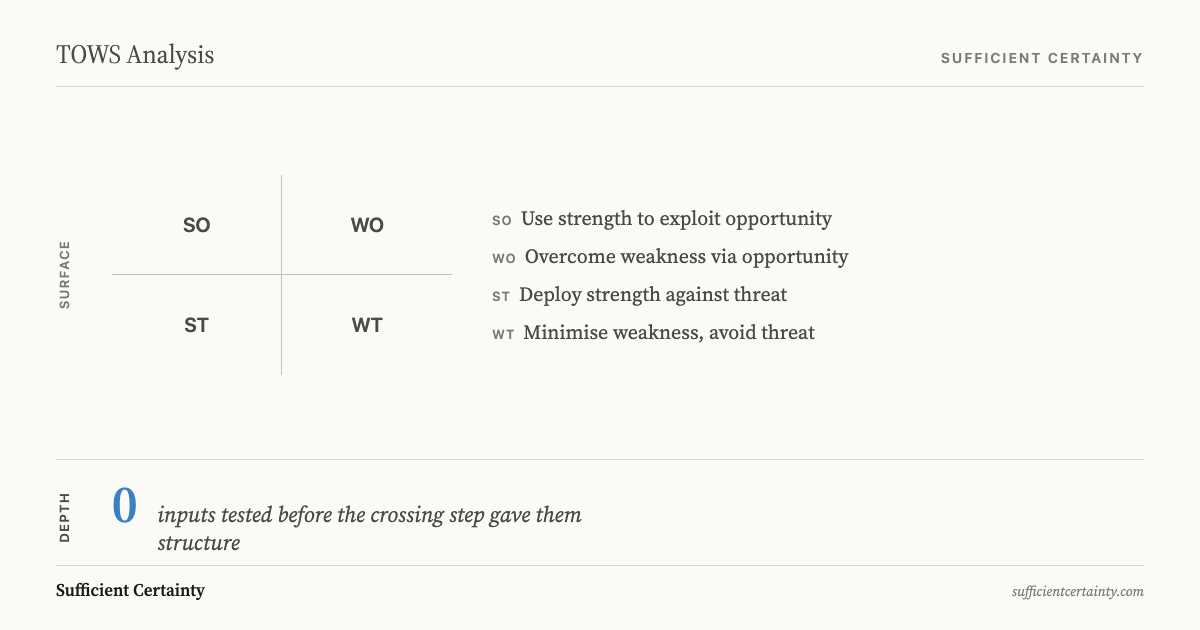
The matrix produces four strategy types. SO strategies use a strength to exploit an opportunity; WO strategies overcome a weakness by riding one. ST strategies deploy a strength to counter a threat, while WT strategies minimise a weakness while avoiding a threat. A team with four strengths, four weaknesses, four opportunities, and four threats can generate up to sixteen strategy cells. Presented in a board paper, the completed matrix reads as analytical rigour.
What the crossing step adds
SWOT is an identification tool: it asks what your strengths, weaknesses, opportunities, and threats are. The output is four lists. TOWS is a formulation tool: it asks what strategies emerge when you cross those lists. The output is a grid of options. If you have completed a SWOT analysis and want to move beyond the lists, TOWS is what most planning guides recommend.
The crossing step is the contribution. It forces the team to connect internal factors with external ones, which SWOT alone does not require. A strength crossed with an opportunity becomes a strategy candidate, which is a genuine improvement over leaving the four lists in a slide deck.
Rewrite the SWOT entry your strategy rests on as a claim and test it before the matrix crosses it into a commitment.
Rewrite the SWOT entry your strategy rests on as a claim and test it before the matrix crosses it into a commitment. Start the Walk →
Where the standard playbook breaks down
But the crossing step introduces a problem of its own. It treats every entry in the original SWOT as settled. “Strong brand reputation” crosses with “growing Asian market” to produce a strategy. If the brand reputation is an assumption rather than a measured fact, the strategy inherits the assumption without marking it.
In 1997, Terry Hill and Roy Westbrook reviewed strategic planning practice across fifty UK manufacturing companies. Among the twenty-odd that used SWOT, outputs averaged more than forty items, described as “general (often meaningless) descriptions, a failure to prioritize and no attempt to verify any points.” None of those companies used the outputs in later strategy formulation. A TOWS analysis applied to exactly these outputs can generate hundreds of strategy cells, each carrying the same unverified inputs forward under a more structured label.
The most instructive failure sits in Weihrich’s own showcase. He applied TOWS to Volkswagen’s strategic position in the early 1970s. The matrix crossed VW’s production strengths with the opportunity to access the US market, producing a strategy to build cars in the United States. VW adopted that strategy. It failed. As Robert Dyson later noted, VW “never overcame a key weakness, their lack of US production experience.” The TOWS matrix had crossed a real strength (German engineering capability) with a real opportunity (US demand) and produced a strategy that looked sound. The missing test was the assumption behind the crossing: that VW could transfer its production competence to an unfamiliar manufacturing culture, but nobody had checked whether that assumption was true.
I have seen this pattern across nearly fifty years of working with planning teams. The tool produces a structure that looks analytical, and the structure itself becomes the justification. Teams stop asking whether the inputs are right because the matrix has already crossed them into strategies.
Dyson’s own case at the University of Warwick showed a different version of the same problem. The Warwick steering committee generated eighty-one SWOT items in a strategic awayday. When scored, the internet appeared as both a leading opportunity (4.09 out of 5) and a leading threat (3.45). Complacency appeared as both a strength and a weakness. If the same factor sits in opposite quadrants, a TOWS analysis generates contradictory strategies from a single input. The tool has no mechanism for resolving that contradiction.
Marilyn Helms and Judy Nixon surveyed a decade of academic literature on SWOT and found that “past research continues to lack quantifiable findings on the success of the SWOT analysis.” The tool is dominant because it is simple, not because it produces measurably better outcomes. TOWS inherits that evidentiary gap and adds a crossing step that makes the output look more analytical than the input warrants. As long as SWOT feeds strategic planning without verification, every downstream tool carries the same unexamined inputs forward. The alternative that fits depends on whether the decision involves a finite choice, uncertain conditions, or unchallenged optimism.
The step to take first
The crossing step is not the problem. The problem is crossing before testing. Before a SWOT entry enters the TOWS matrix, it needs to survive a simple question: what are we assuming here?
Take each entry and rewrite it as a claim. “Strong brand reputation” becomes “We believe our brand reputation is strong enough to support entry into this market.” Then ask two things about that claim: how much influence does it have on the decision, and how confident are we that it is true? An entry with high influence and low confidence is the one that needs investigation before it gets crossed with anything.
A strength you are confident about and that matters to the decision can enter the matrix. A strength you are guessing at and that carries the whole strategy should not. The same test applies to opportunities, threats, and weaknesses. An entry earns the right to generate a strategy only after someone tests whether it is true.
The planning team from the opening would have listed “spare manufacturing capacity” as a strength. Rewritten as a claim: “We believe our manufacturing lines have enough unused capacity to support a new product line without capital expenditure.” Influence on the decision: high, because the entire SO strategy rests on it. Confidence: low, because nobody had checked the production schedule against actual demand patterns. That entry needed verification before it crossed the matrix, not after.
When I work with teams after a SWOT analysis, the first thing I do is separate entries they have evidence for from entries they are assuming. The separation takes ten minutes, and it changes which strategies survive the crossing step. Most teams have never been asked to make that distinction, because the matrix does not require it. Three documented cases show what happens when the distinction is left unmade.
This is the step that sits between completing a SWOT analysis and committing resources to the strategies it generates. Identify which entries are assumptions rather than facts. Determine which assumptions matter most to the decision. Investigate those before the crossing step lends them structure they have not earned. The Universal Decision-Making Method calls this step “recognise assumptions” and places it before any commitment, because a strategy built on an untested input is not a strategy, no matter how structured the matrix that produced it.
You could cross every quadrant and still commit resources to an input nobody checked.
Work through your decisionNo sign-up. Just pick your decision and start.
Grant Purdy is the co-author, with Roger Estall, of Deciding (2020), and the architect of the Universal Decision-Making Method.