
Availability bias replaces evidence with memory. Whatever comes to mind fastest feels most likely, and the substitution is invisible. A vivid plant failure outweighs a quiet decade of data. The fix is not better recall. It is a process that requires the evidence to be written down before judgment runs.
Availability bias is the shortcut that turns the vivid case into the likely case. I have heard versions of the same sentence for decades: "After what happened last time, we would be mad to..." A storm hits, and by the next week a firm that was willing to invest is suddenly hoarding cash. Nothing material in its exposure has changed enough to justify the lurch. The storm is simply easier to remember than the quieter cost of freezing the business. That is availability bias in decision making.
Availability bias is the tendency to judge frequency, probability, or importance by ease of recall rather than by evidence.
Availability bias in decision making is an assumption problem
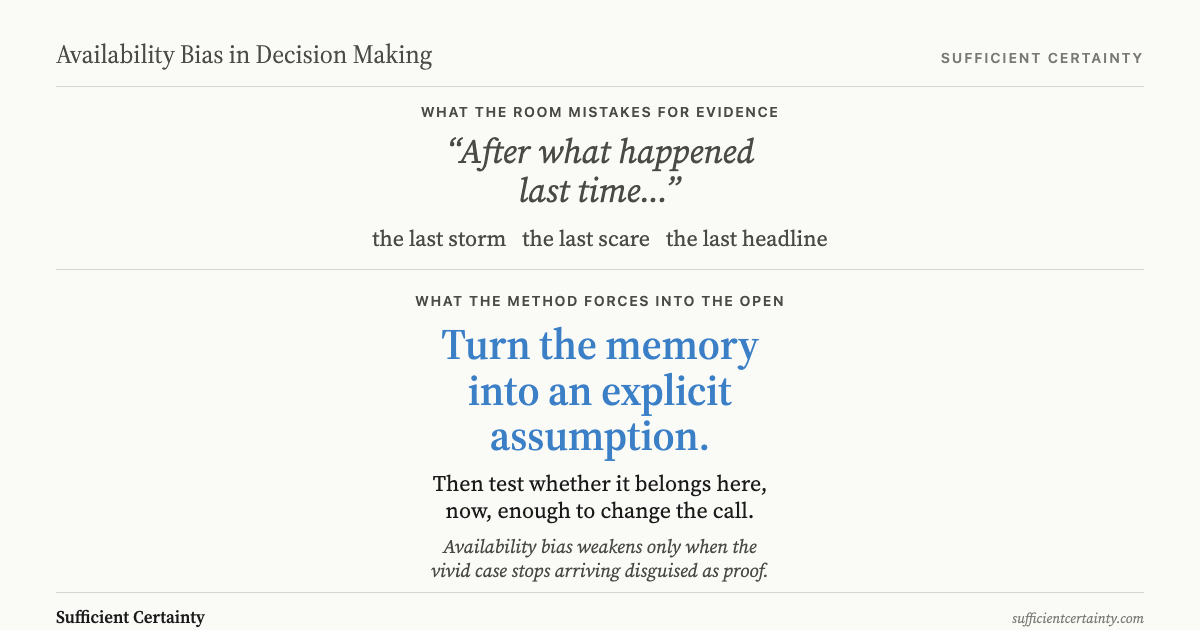
Amos Tversky and Daniel Kahneman gave this shortcut its name in 1973 in their paper on the availability heuristic. Their point was simple: people judge frequency or probability partly by how easily examples come to mind. In a boardroom, that means the last flood or ugly headline enters with more authority than it deserves, because nobody has to prove a memory. They only have to sound responsible while repeating it.
I am not trying to repair human memory. I want the room to state what it is now relying on because that case is easy to recall. Once the belief is written down, the Universal Decision-Making Method makes the room test it instead of admiring its vividness. That is the wider problem with cognitive biases in decision making: the bias survives because the carrying assumption never has to introduce itself. People say "lesson learned" with great dignity, as if the phrase itself had done the analysis. It has not. The biases and heuristics label only helps if the shortcut is forced to say what it assumed.
Availability bias in decision making moves money and policy
The corporate version is not subtle. Olivier Dessaint and Adrien Matray studied firms near hurricane strikes and found that managers raised cash holdings after local storms even when the firm's objective exposure did not justify much change. I have seen the same move in smaller rooms. One local scare occurs and a cautious posture suddenly acquires moral weight. The cautious executive looks wise and the finance team gets a larger buffer. The adviser who urged delay is rarely asked to price the growth that never arrived. Nobody ever brings a spreadsheet showing the return on the project they suffocated.
The public-policy version can be uglier. Availability bias was not the whole German nuclear decision; politics and energy constraints were in the room too. After Fukushima, Germany accelerated its nuclear phase-out. In a study of the aftermath, Stephen Jarvis, Olivier Deschenes and Akshaya Jha estimate extra electricity costs of about EUR3 billion to EUR8 billion a year, along with more than 1,100 extra deaths from the pollution created by replacement fossil generation. The memorable danger was a nuclear disaster. The quieter damage arrived as pollution and higher cost. If the Purpose is to reduce total harm, the memorable disaster has no right to occupy the whole table. Treating it as the entire case is not caution. It is theatre with casualties, which is the broader trap inside decision-making under uncertainty.
Write down the last vivid case driving your judgement, then work the decision until memory stops posing as evidence. Start the Walk →
The cost nobody puts on the table
In my experience, this is where committees get solemn and still get the decision wrong. They ask how to stop the last catastrophe, then ignore the price of the protection they are buying. That price may be lower investment or a weaker operating position next year. Saying "we must never let that happen again" sounds respectable, which is why the quieter damage is usually left to arrive unannounced.
How to reduce availability bias before the vote
The cure is not telling people to be less biased. I ask for three checks before the room votes, because a memorable case should not get a free pass just because everyone can picture it.
| Check | Question | Why it matters |
|---|---|---|
| Base rate | How often does this happen, not how clearly do we remember it? | Separates frequency from recall. |
| Displaced harm | What damage becomes more likely if we overcorrect for the vivid case? | Stops safety theatre from hiding the bill. |
| Trigger | What evidence would make us reopen the decision later? | Makes the next memory answerable to evidence. |
The bias weakens when the process forces reflection
Silvia Mamede and colleagues showed the useful distinction in a JAMA study on medical diagnosis: residents who had recently seen a similar case could be pulled toward the available diagnosis, yet deliberate reflection improved accuracy. Accuracy improved when the procedure forced reflection, not when people were merely warned to be sensible.
That is why bias training is mostly a comfort blanket for organisations that do not want to change their meetings. Posters and training slides do nothing if the meeting still lets the freshest anecdote overrule the harder facts. I set out the practical version of that fix in making decisions with uncertainty.
What I ask when the last vivid case is running the room
When one memorable event is dominating a decision, I do not argue with the memory itself. I ask what the room is now assuming because that event is fresh. Then I ask what harm has disappeared from view as a result. Gerd Gigerenzer made that second question hard to ignore after September 11. In his analysis of post-attack travel behaviour, he estimated about 1,500 additional road deaths in the United States in the following year as people switched from flying to driving. The vivid danger was terrorism. The larger travel danger became the road, because fear changed the transport mode and arithmetic did not. That is the substitution I want a room to face: the cinematic risk got the speech, while the statistical one got the bodies.
Roger Estall and I wrote Deciding against that sort of substitution. A Decider does not need perfect neutrality, which does not exist. A Decider needs the discipline to say, in plain English, what has to be true for the choice to work and whether that leaves Sufficient certainty. I set out harder case material in decision-making under uncertainty examples, but the rule is the same: the memory may still matter after the assumption has been tested, yet it no longer gets to occupy the chair marked evidence for the executive who wants cover or the adviser who wants his caution applauded.
You could let last time decide and freeze the investment your business still needs.
Work through your decisionNo sign-up. Just pick your decision and start.
Grant Purdy is the co-author, with Roger Estall, of Deciding (2020), and the architect of the Universal Decision-Making Method.