
Business problem solving starts after the business case is written, which is exactly the wrong sequence. A business case with perfect numbers still solves the wrong problem when four executives read the same document and cannot agree on the question it answers.
I once sat with an executive team that had spent eight months on a 52-page business case. Market forecasts, three revenue scenarios, a competitor analysis borrowed from the consultants' last engagement. After an hour I asked what decision the executive committee was being asked to make. The CFO said market entry. The operations director said plant closure. The CEO said margin protection. The company secretary just looked at me. Four people, one document, no shared question. That is business problem solving in a great many organisations.
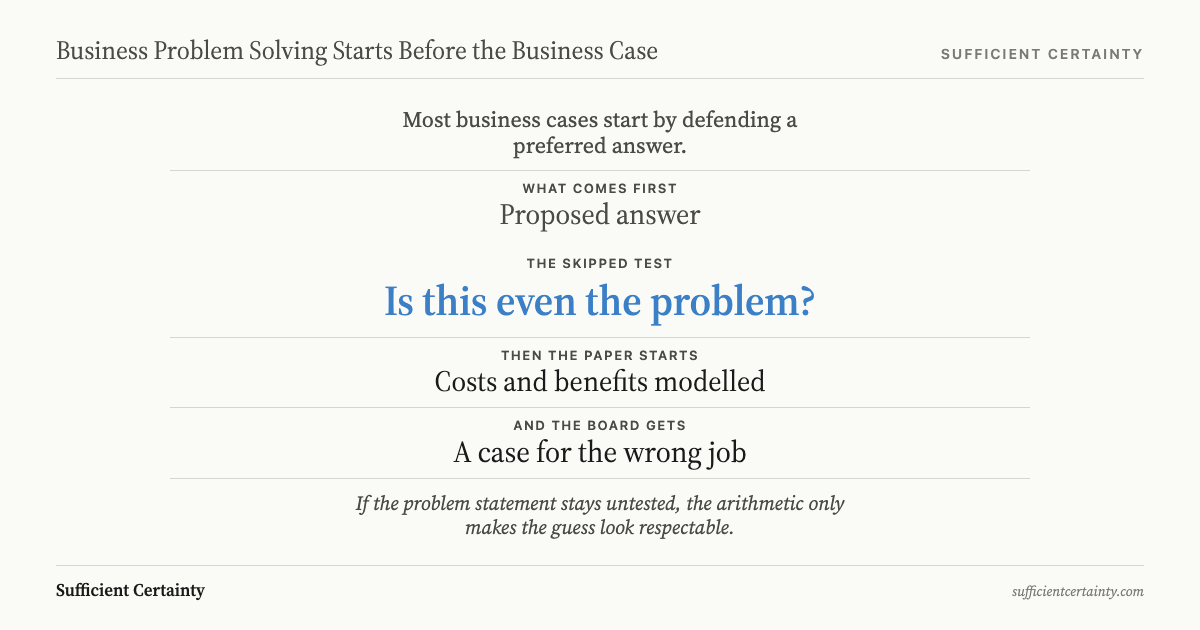
That 52-page document had every number a governance committee could want except a sentence saying what the committee was being asked to decide. A business case is often a permission slip with arithmetic attached. Once the opening line says what must be built or bought, the paper exists to make that sentence look respectable. In the Universal Decision-Making Method we Frame the decision and Recognise assumptions before the paper starts pretending nobody has picked a favourite.
Business problem solving is the discipline of defining the decision and exposing its assumptions before an organisation spends money defending an answer.
Why business problem solving usually starts after the mistake
The usual corporate method treats problem definition as a courtesy paragraph, not the work. McKinsey's much-circulated seven-step problem-solving process gives a nod to defining the problem, then hurries into analysis. If the famous advice piece barely pauses at the opening question, internal teams were never going to linger there either. They have deadlines to hit and slides to fill. (Consultants bill either way.)
I have sat through this more times than I care to remember. Someone says margins are falling or a competitor has moved, and the room treats that sentence as settled fact. Then the board gets a polished paper, graphs included, while nobody has named the wager underneath it. That is why so many problem solving techniques in business look busy and still miss the live question.
Start with the board decision itself and test whether your business case is answering the right problem. Start the Walk →
Business problem solving failed at Kodak and Nokia for the same reason
Kodak did not lack evidence. It invented the digital camera in 1975, and as Forbes recounted, its own research later warned that digital would replace film. Yet Kodak kept treating the question as how to move from film to digital cameras without surrendering the print business.
That was the wrong job. The real shift was from printing to sharing. Once you see that, a handsome business case for camera hardware looks like a school essay dressed for the board.
Nokia repeated the trick from the other side. The INSEAD account of the company's collapse shows engineers knew Symbian was too weak for a serious app ecosystem, while senior management kept framing the fight as a hardware contest. Better screens and sturdier handsets were answers to the wrong problem.
The market had become a software platform war, and fear inside the company helped keep that fact away from the people signing off the story.
People talk about these companies as if they died from slow execution. I do not buy that. They died earlier, when they accepted a flattering problem statement, one that protected the old profit pool and the people living off it. Once you call the matter a product upgrade or a handset race, the spreadsheets can be immaculate and the decision can still be absurd.
Business cases usually defend answers that nobody tested
Most business cases are defence briefs wearing numbers. Bent Flyvbjerg's megaproject research makes the point brutally: across 16,000 projects, only 0.5% met budget and delivered the promised benefits. Boards call this rigour because the tables are tidy. I call it theatre for frightened governors who want numbers to bless a guess.
When Flyvbjerg says business cases cannot generally be trusted, he is describing a governance problem more than a clerical mishap.
The NHS national IT program made the same failure public at industrial scale. The Public Accounts Committee called it one of the worst contracting fiascos in public-sector history because the program treated the NHS as one neat machine needing one neat database, a fantasy that suited ministers who wanted one announceable program and contractors who wanted one giant contract.
That is how business problem solving gets counterfeited, by making a messy institution look simple enough to sell from a podium.
I see smaller versions of the same defect in ordinary commercial work. A pricing team can model margin pressure and channel costs for weeks, yet nobody says aloud that willingness to pay is still an assumption. Roger Estall and I called that a belief system in Deciding. The numbers are being asked to launder a preference into a fact.
Once a board pack hardens around that kind of fiction, people ask for more analysis and drift into analysis paralysis in business instead of reopening the frame.
How I handle business problem solving before the board pack hardens
Before anyone is allowed to defend a model, I force the matter into one decision sentence. Then I ask which unproved claim is carrying the model and what the board is being asked to fund on trust. If the case depends on customers staying put or a business unit suddenly delivering to a standard it has never met, that claim belongs on the table in ink, not buried in an appendix.
The next question is the one most papers are built to avoid: what would have to be false for this case to collapse? People dislike it because it demotes the document. Documents should not outrank the decision. If the paper survives that question, fine. If it does not, the board has just been spared an expensive alibi.
Real business problem solving starts there, with the claim carrying the case, not with the spreadsheet carrying the room. That is how I handle difficult business decisions. I would rather have an ugly argument about the real choice than a beautiful model about the wrong one.
That is the only kind of strategic problem solving I trust. Treat the problem statement as a claim that must survive challenge. If it cannot survive that, the analysis belongs in the bin.
You could polish the next business case and still never define the decision.
Work through your decisionNo sign-up. Just pick your decision and start.
Grant Purdy is the co-author, with Roger Estall, of Deciding (2020), and the architect of the Universal Decision-Making Method.