Strategic problem solving is the discipline of testing what the real problem is before spending time and money on the wrong one. Most organisations reach for analytical tools before checking whether the question itself is correct. The hardest step is the one before analysis begins.
When an organisation faces a strategic problem, the instinct is to reach for a technique: root-cause analysis, SWOT, brainstorming, or Five Whys. Each promises structure. Each assumes the problem has already been correctly identified.
Strategic problem solving is the discipline of defining a problem before attempting to solve it. Most approaches treat the problem as given and move straight to generating solutions. The problem is rarely given. It is constructed from assumptions about what matters, what is changing, and what success looks like. Strategic problem solving starts by surfacing those assumptions and testing them before any solution is considered.
I have spent nearly fifty years watching organisations solve the wrong problem with great confidence. The ones that got the outcome right shared a habit: naming their assumptions before committing to a solution. That is what the Universal Decision-Making Method is for, and it is the question Roger Estall and I spent our careers working through across boards, regulators, and public bodies.
Strategic problem solving is the discipline of testing what the real problem is before you spend time and money solving the wrong one.
What strategic problem solving actually means
The phrase gets used loosely. In most organisations it means applying a structured technique to a big problem. Bigger problems get bigger tools. What they actually need is better problem definition. The two jobs are not the same: problem solving and decision making look alike from the outside and fail in different ways.
The difference determines where effort goes. If strategic problem solving means "better analysis," effort goes into spreadsheets, models, and consultant reports. If it means "better problem definition," effort goes into a harder question: what are we actually trying to achieve, and what are we assuming about why we are not achieving it?
That second question is where most organisations stop too early. Revenue is declining, so the problem must be revenue. A competitor has launched, so the problem must be the competitor. A regulator has issued a finding, so the problem must be compliance. Each reads as obvious. Each is a symptom described as a problem, and the distinction has real consequences. An organisation that treats declining revenue as the problem will cut costs or chase sales. An organisation that treats it as a symptom will ask what changed, what assumptions about customer behaviour stopped holding, and whether the original Purpose still makes sense.
This applies at every level. A factory manager who frames a quality problem as "our workers need more training" will not discover that the tooling specification was wrong. A team that books the gains from a kaizen event as delivered will not discover that the new standard only held while the facilitator was on the floor. A CEO who frames a strategic problem as "we need to grow faster" will not discover that the growth target rests on an untested assumption about market size. The scale changes. The error is the same.
The reason this keeps happening is not complexity. It is urgency. People allow themselves to be swept along by the pressure for a result, or by the confidence of someone who claims to already know the answer. This is harder than it sounds because the discipline is not analytical. It is the willingness to slow down at the moment when everyone else is reaching for a solution.
Why most problem-solving frameworks skip the hardest step
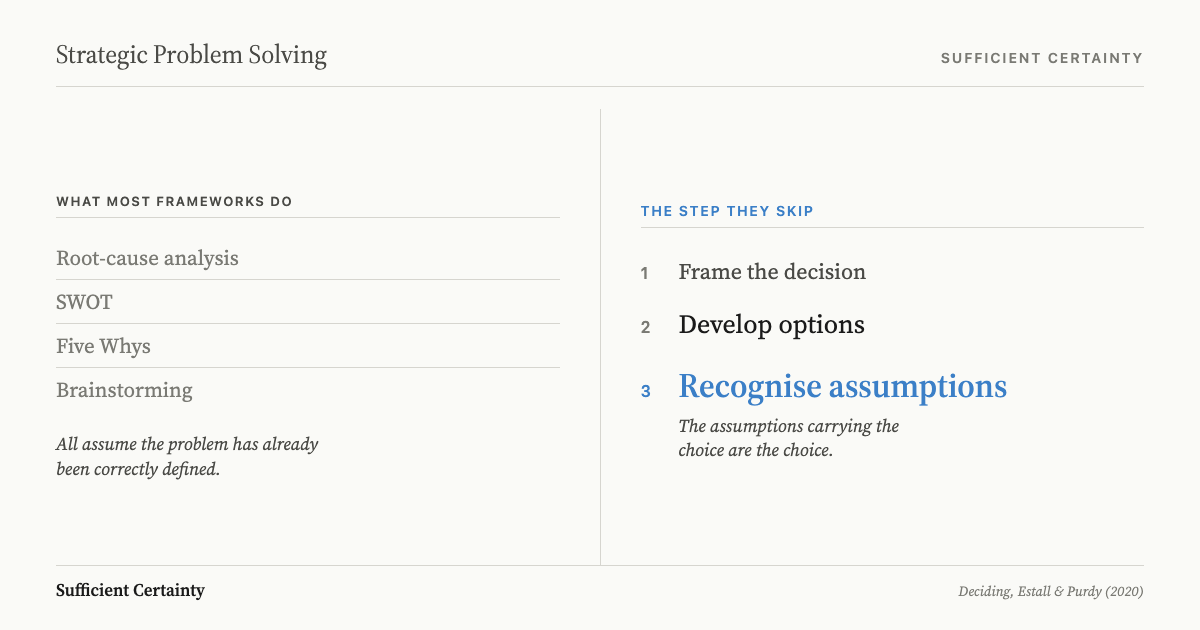
The popular techniques share a structural gap. Root-cause analysis drills into the assumed problem without asking whether it is the right one. The same flaw runs through the fishbone diagram: it organises causes neatly without testing whether the effect at the head of the fish was the right problem to begin with. SWOT produces lists of assertions without verifying any of them. Five Whys pushes deeper into whatever framing the first question imposed, never questioning the frame itself. The tools are analytical. None is diagnostic about whether the framing is sound.
If you have already completed the analysis, the next question is what to decide. The guide to what to do after a fishbone diagram, the companion piece on what to do after root cause analysis, and the piece on what to do after an A3 report walk through the step most teams skip: converting the diagram into a testable assumption before committing resources. The clinical version of that step, between an RCA action plan and the ward, is covered in what to do after a root cause analysis in healthcare.
I call this pattern got-to-get-there-itis. Pilots are susceptible to it. The flight plan says land at the destination airport. Weather closes in. A pilot who has already committed mentally to arriving keeps pushing because the destination has become more important than the overriding Purpose: living to fly another day. The same pattern plays out in boardrooms. A team that has already decided the problem is "how to cut costs" will not naturally revisit whether cost is actually the constraint.
The danger is not limited to emergencies. In corporate settings, the problem is often stated as a project brief or a board paper title. Once it has a name and a budget, it becomes the destination. People who fill executive positions tend to be goal-orientated and confident. That combination of personality and sunk commitment makes reframing feel like failure rather than discipline. The organisation does not re-examine the problem. It doubles down.
Every popular decision-making framework shares this blind spot. They begin after the problem has been defined. The hardest step in strategic problem solving is the one before analysis: stating clearly what the problem is, then asking what would need to be true for that statement to be correct.
That is why the most popular problem-solving techniques in business start too late. They formalise the analysis without questioning whether the frame deserves it.
The same flaw runs through creative problem solving workshops. A room full of post-it notes built on a false premise is expensive theatre, not strategic work.
Define what you are actually deciding before the team starts solving the wrong problem. Start the Walk →
The problem behind the problem
When email began replacing letters, postal services around the world faced a decision. Most framed it as: how do we compete with email? That framing led to efficiency drives, cost-cutting, and efforts to make letter delivery faster or cheaper. None of it worked. The real problem was not "how to compete with email." It was "what is our Purpose now?" The organisations that asked that question redirected into parcel logistics and financial services as e-commerce created new demand. The ones that stayed with the original framing shrank.
This is not unusual. It is the standard pattern. The first framing of a strategic problem feels obvious and is usually wrong. What makes it dangerous is that the wrong framing still produces actionable-looking plans. You can build a perfectly coherent strategy around "competing with email." It will have milestones, budgets, and performance indicators. It will fail because the premise is wrong, and no amount of execution quality compensates for a mistaken premise.
As Roger Estall and I wrote in Deciding, belief systems inevitably start with the answer rather than with careful and objective definition of the problem. The postal services started with the answer: our business is delivering letters, so the threat is anything that replaces letters. The answer prevented the question. It prevented anyone from asking whether letter delivery was still the Purpose.
Every stated problem rests on assumptions about what matters, what is changing, and what the organisation exists to do. Those assumptions are the real object of this discipline. If they are wrong, the problem is wrong, and the solution is irrelevant. Where the problem itself spans multiple moving parts, the discipline is identical: name the next decision rather than reaching for a grander framework. That is what complex problem solving actually requires.
A polished business case can have every number a governance committee could want and still solve the wrong problem because nobody tested the question underneath. That is the defect business problem solving exists to fix.How to define a problem before you solve it
The Universal Decision-Making Method begins with three steps that address this directly. Frame the decision. Develop options. Recognise assumptions.
Framing forces the Decider to state what decision is actually being made. The decision itself, not the topic or the project. "We need a digital transformation strategy" is not a decision. "Should we redirect 40% of capital investment from letter-sorting infrastructure to parcel-handling capacity over the next three years?" is a decision. The framing step compresses vague concerns into statements that can be tested.
Developing options prevents premature closure. If only one option is on the table, the process is not deciding; it is justifying. A genuine decision requires at least two options, including doing nothing. Each option changes which assumptions need examining.
Recognising assumptions is the step that separates this from every conventional approach. The question is plain: what are we assuming here? What needs to be true for this option to work? Usually the assumptions are invisible until someone asks. They sit inside the business case, inside the revenue forecast, inside the assertion that "our customers will accept this." Making them visible is not additional work on top of the decision. It is the decision. The assumptions carrying the choice are the choice.
What follows is judgment, not formula. How significant is each assumption? How confident are we that it will hold? An assumption with high influence and low confidence is critical. One with high influence and high confidence is important but not urgent. This sorting takes minutes when the assumptions have been stated clearly. It takes forever when they are still buried inside a business case that presents them as facts. I call this the practical heart of the method: not the analysis but the act of naming what you do not know.
This is also where the skills conversation belongs. Most lists of problem-solving skills grade personality; the workable skill is naming the assumption before the commitment.
What strategic problem solving looks like in practice
In January 1986, engineers at Morton Thiokol told NASA that the O-ring seals on the Challenger's solid rocket boosters had never been tested below 53 degrees Fahrenheit. The launch-day temperature at Kennedy Space Center was 36 degrees. The engineers recommended delay. NASA management shifted the question. Instead of asking "is there evidence this is unsafe?" they told the engineers to "prove it will fail." The assumption that O-ring performance would hold at lower temperatures was never surfaced as an assumption. It was treated as a fact because it had not yet been contradicted.
Seven crew members died. The analytical tools existed. The data existed. What was missing was a process that would have forced one question: what are we assuming about how these components behave at this temperature, and how confident are we? The problem had been framed as "is the shuttle ready to launch?" not "what are we assuming about component behaviour in conditions we have never tested?"
Compare this to what happens when someone asks the right question before committing. A decision-maker facing unfamiliar conditions states the assumptions explicitly. If we launch at this temperature, we are assuming the seal material will behave as it does at higher temperatures. We have no data supporting that assumption. Confidence is low. Influence on the outcome is total. That assessment takes minutes. It does not require a new model or a larger committee. It requires someone willing to say "that is an assumption, not a fact" before the room commits.
Assumptions that are named can be examined. The ones that remain hidden decide the outcome by default. That is what makes difficult business decisions difficult: not the complexity of the options, but the assumptions no one has stated.
The problem solving examples in the workplace that teach anything useful expose those assumptions before the first meeting locks the frame.
When strategic thinking and problem solving diverge
Strategic thinking is about direction: where should we be? What market should we enter? What kind of organisation do we want to become? These are important questions. They are not decisions. They become decisions when they are reduced to a specific choice with identifiable options, stated assumptions, and a standard for when you know enough to act.
Strategic problem solving is the bridge between direction and decision. It takes a broad question and compresses it into something that can be made, tested, and monitored. Process redesign needs the same connection: what to do after value stream mapping ties the future-state map to a service measure, an owner and a response when performance changes. The distinction matters because organisations that confuse the two either spend years thinking without deciding, or decide without testing whether the problem they are solving is the right one.
The postal services could think strategically about the future of communication for years. That thinking became useful only when someone framed the actual decision: do we invest in competing with electronic communication, or do we redefine what we exist to do? Strategic thinking described the broader question. The method named the decision and surfaced the assumptions it rested on.
That is where this connects to decision-making under uncertainty. Uncertainty is not a reason to delay a decision. It is the material the decision is made from. The discipline is not to remove uncertainty but to name it, judge it, and act when the certainty is sufficient for what is at stake.
You could tackle the fire in front of you and leave the pattern untouched.
Work through your decisionNo sign-up. Just pick your decision and start.
Grant Purdy is the co-author, with Roger Estall, of Deciding (2020), and the architect of the Universal Decision-Making Method.