
Problem solving techniques in business start too late. They begin with analysis and skip the step before it: testing whether the problem itself has been framed correctly. A study of 100 diagnostic errors found that the single most common failure was accepting the wrong question.
Most problem solving techniques in business start too late. I once sat with a management team that had already spent 90 minutes on a fishbone diagram. The strategy director was still defending a SWOT grid nobody believed. By lunch nobody could tell me what decision they were trying to make. All that effort had merely decorated a guess.
That should be obvious. It plainly is not. Roger Estall taught me never to compromise on logic, and logic is exactly what goes missing when a room opens with “the problem is declining sales” or “the problem is poor execution”. Someone has already hidden a conclusion inside the opening line. The technique then gives that conclusion a worksheet and a little authority, which is marvellous if you sell workshops.
Problem solving techniques in business work better when the first step is testing whether the problem has been framed correctly, because most failures start with the question, not the answer.
Why problem solving techniques in business miss the real problem
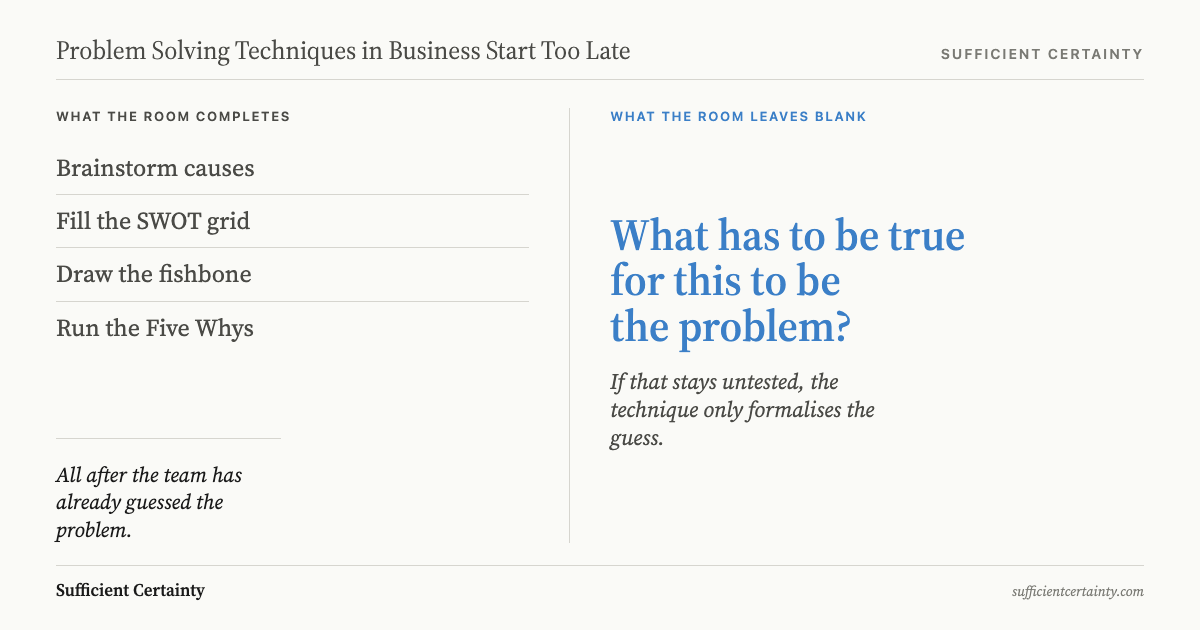
Mitroff and Featheringham gave this failure a proper name in their paper on the Error of the Third Kind. It means solving the wrong problem with great precision. I have seen boards do exactly that when a paper asked how to accelerate a program that should first have been questioned, or how to reduce complaints when the live decision was whether the service itself needed redesign.
I do not say that as a theorist. Roger Estall and I wrote Deciding after watching committees arrive armed with analysis and still leave the real decision untouched. The techniques were never the weak link. The weak link was the moment somebody accepted a problem statement without asking what belief it carried. That is a deficit in problem solving skills in the workplace, not in the toolkit. I have watched that moment pass unchallenged in boardrooms that could afford better, and the apparatus simply gave it a professional finish. That is the narrower discipline behind strategic problem solving: test the premise before you resource the method.
Frame your business problem through the five steps before you reach for brainstorming, SWOT, or root-cause tools. Start the Walk →
Brainstorming and SWOT make a bad frame look busy
Brainstorming survives because it flatters the room. People talk for an hour and everyone gets to feel helpful. The evidence is less flattering. Mullen, Johnson and Salas reviewed 38 controlled experiments and found that face-to-face brainstorming groups produced about 83% fewer ideas than individuals working alone and then pooling the result. People wait for a turn and censor themselves, then mistake the noise for output, a defect that deepens when the exercise is called creative problem solving.
The larger defect sits upstream. A group that brainstorms before challenging the frame does not merely produce fewer ideas. It produces agreement around the wrong question. That pattern repeats across most discussions of problem solving in the workplace: in my experience that is the dangerous moment, because confidence rises just as the room moves further from the live decision.
SWOT wears a tidier costume, but the defect is the same. Hill and Westbrook studied more than 20 companies and found outputs bloated with vague factors, averaging more than 40 items, with not one company using the result in later strategy work. That finding does not surprise me. The quadrants assume you already know what matters. If the frame is wrong, the boxes simply arrange your confusion so it can be circulated.
Root-cause tools make premature closure look rigorous
The medical world uses a blunter phrase for the same failure: premature closure. Graber, Franklin and Gordon examined 100 cases of diagnostic error in internal medicine and found cognitive factors in 74% of them, with premature closure the most common single mistake. A clinician lands on the first plausible diagnosis and starts defending it instead of testing alternatives.
Business teams do this every day. The most respected problem solving techniques in business begin by accepting a problem statement. Once that happens, the method does what it was built to do, it drills deeper. Drill into a false frame and you do not get truth. You get a thicker file. That is how business problem solving fails before the first spreadsheet opens.
Samsung’s first response to the Galaxy Note 7 fires is a cleaner business example, and a less forgiving one for managers. The company framed the problem as a battery-supplier defect. It recalled the phones, switched suppliers, and still saw replacement units catch fire. Its later own findings showed faults in both the original and replacement batteries. The first question should have been wider: what are we assuming about the device design itself? Instead the investigation went deeper into the first explanation that sounded actionable. That is how a bad frame survives long enough to become a second recall.
That is where people muddle diagnosis with commitment. A diagnosis can be interesting and still leave the live choice untouched. The decision begins when somebody names the belief they want others to live with. That harder distinction sits underneath problem solving and decision making, and it is the point most technique manuals slide past because manuals prefer tidy steps to human accountability.
How I use problem solving techniques in business after the frame is clean
Here is what I do in the room. I force the decision into one sentence a Decider would recognise. Then I ask what has to be true for the preferred answer to hold. I keep at that until slogans give way to assumptions. Only then do we agree what would make us reopen the call, because a decision with no trigger for review is only hope with stationery.
If the frame is clean, problem solving techniques in business can help. I will use a fishbone once the event is properly defined and the decision around it is plain. What I will not do is let the room hide inside the method. That is how the paperwork becomes concealment, and then the meeting slides into analysis paralysis while everyone pretends the trouble is complexity rather than cowardice.
If the problem is strategic, the discipline is simple: clean the frame before anybody starts solving. Once the key assumption is visible, you can judge whether the technique helps or merely gives the room something to do. The market for decorative technique has had a comfortable run. It does not need protection from me.
You could open another framework and still solve the wrong business problem by lunch.
Work through your decisionNo sign-up. Just pick your decision and start.
Grant Purdy is the co-author, with Roger Estall, of Deciding (2020), and the architect of the Universal Decision-Making Method.