
Problem definition vs problem solving is not a sequence. It is an argument about which comes first. Most teams start solving before anyone has named the choice the situation actually requires. The first sentence of the brief already picked the winner, and nobody noticed because the work felt productive.
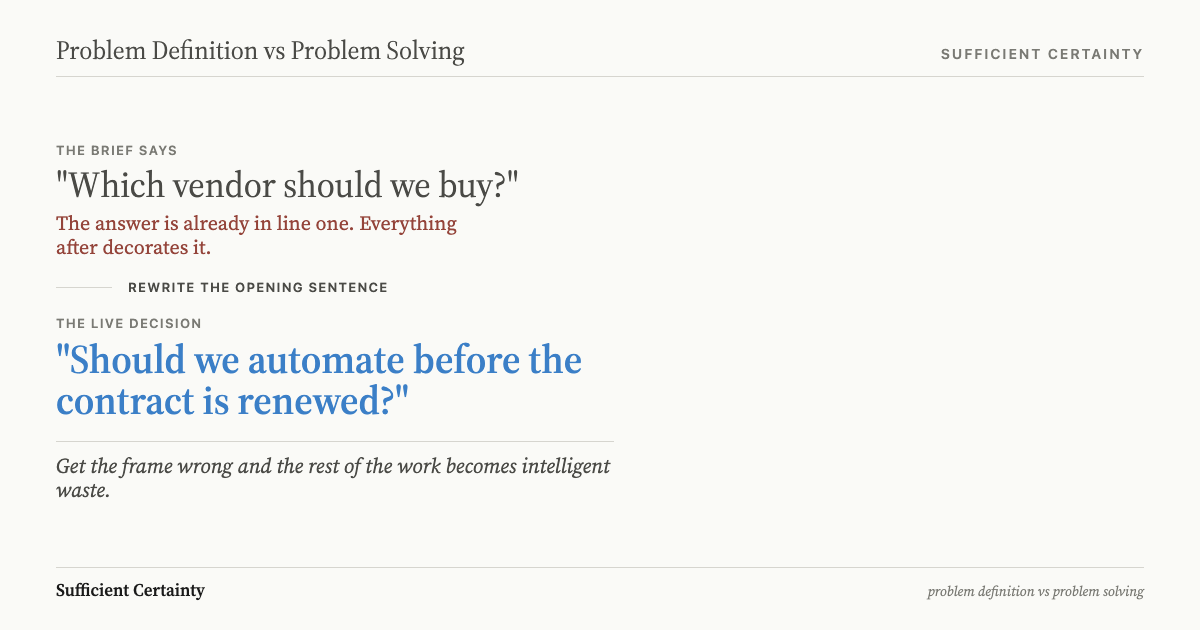
A logistics chief once handed me a 41-page warehouse automation paper. The vendor shortlist was on top, and the contract deadline was 4 p.m. The paper claimed the decision was which system to buy. It was not. The real decision was whether to automate that site before the customer contract had even been renewed. That is problem definition vs problem solving in the wild.
In the Universal Decision-Making Method, Frame the decision comes first, because get the frame wrong and the rest of the work becomes intelligent waste. People love the Einstein line about spending 55 minutes on the problem and 5 on the solution. Then they walk into the meeting with the solution already typed into the paper. That is how the paper turns into a permission slip.
Problem definition vs problem solving is the difference between naming the decision and then working on answers.
Why problem definition vs problem solving collapses in most organisations
In my experience, it collapses because open questions are bad for status. If the real question is still live, the politics are visible and the sponsor loses control of the room. So the brief arrives loaded, perhaps to choose a vendor or cut headcount. The room is told it is discussing options, but line one has already fenced off the answer.
I have asked clients the same question for years: if risk management is the answer, what was your question? The blank look is usually the useful moment. Whole organisations adopt problem framing techniques or risk machinery after the answer has been picked, then wonder why the paperwork multiplies while the decision stays foggy. Belief systems behave like that. They start with the answer and then hire language to defend it.
Most hard problems move the moment somebody rewrites the question. Dwayne Spradlin reported that at InnoCentive: roughly 85 per cent of posted problems were eventually solved, and many only moved after the problem statement was rewritten. I believe that instantly. Outsiders often look clever simply because they have been handed a question that has finally been cleaned.
Reframe the choice your team is racing to solve and see which option the first sentence already picked. Start the Walk →
What Nutt found in 356 real decisions
Paul Nutt studied 356 decisions over 19 years and found that half failed. The worst pattern was idea-imposition: someone senior backs a solution early, everyone else works backwards, and the paper gets praised for being decisive. Discovery-style decisions, where the problem was worked before the alternatives were pushed, did much better. That is where problem definition vs problem solving stops being a seminar distinction and becomes a governance failure.
Once the wrong definition gets approved, the later work becomes decoration. Better models do not rescue the opening sentence. They just make the mistake look expensive, which suits the people who commissioned it.
I have sat in rooms where the paper said cost reduction when the live question was continuity of capability. I have seen safety decisions dressed up as budget discipline. By then people think they are debating solutions. They are still muddling problem definition vs problem solving, and later problem solving and decision making gets muddled for the same reason: nobody stopped to name the choice properly.
Why problem definition vs problem solving gets flattened into one box
Most methods flatten the distinction by putting define the problem in one polite box at the top of a flowchart and then rushing the room toward ideas. That suits workshop sellers because speed sells better than awkwardness. It suits consultants because the brief survives untouched. It suits the sponsor most of all, because the opening sentence gets treated as fact and the process can be called neutral, which is a charming word in a political room.
People accept the presented problem far too easily. That is not my hunch. Roni Reiter-Palmon and Erica Robinson reviewed the research on problem identification and found that training people to redefine the problem improves the quality of what follows. Leave the opening statement alone and intelligence gets spent inside a bad boundary. Conveniently, the one-box version lets everyone say the problem was defined, which keeps the workshop honest on paper and useless in practice.
This is why I distrust advice that says spend more time on the problem. A team can spend a month discussing the wrong question. I have seen that done with enormous professionalism. If the first sentence is rotten, you do not need more energy around it. You need to reopen the question.
How I force the room back to Frame the decision
I use the front end of the Universal Decision-Making Method for one reason: it makes people say what they are trying to decide before they start admiring options. When Roger Estall and I wrote Deciding, we separated Frame the decision from Develop options because power rushes into the gap the moment those steps blur.
In practice I write one hard sentence and try to break it. I test it against Purpose and the outcome the Decider will be judged on. Then I test how long the choice has to hold, and what has to stay true in the surrounding Context for the sentence to survive. If the wording collapses, good. Proper framing is supposed to strip cover from the sponsor who wanted approval hidden in line one. It also strips cover from the consultant selling problem solving before there is a problem, and from the executive hoping vague language will save them from a clear trade-off. When teams blur problem definition vs problem solving, they mistake motion for progress and call the delay analysis.
I lay out the wider discipline in problem framing. In my experience, once the question is honest, most of the heroic process suddenly looks smaller and cheaper than advertised.
Once the room can state the live decision plainly, the work usually speeds up. Until then, people are mostly rehearsing a preference and calling it analysis.
You could start solving today and discover tomorrow you framed the wrong problem.
Work through your decisionNo sign-up. Just pick your decision and start.
Grant Purdy is the co-author, with Roger Estall, of Deciding (2020), and the architect of the Universal Decision-Making Method.