
A collaborative decision making definition that means something starts with ownership. One person decides. The group contributes knowledge that tests what the decision rests on. If nobody can say who owns the outcome, the definition is describing a meeting, not a method for arriving at a decision.
Collaborative decision making is not a technique for getting people to agree. It is a structure that makes one person accountable for the decision while ensuring every person whose knowledge matters has contributed before the commitment is made. Without that structure, collaboration becomes compromise, and compromise is what organisations mistake for a decision.
A chief executive I worked with once walked into a shutdown meeting carrying a 34-page board paper, minutes from two steering committees, and a risk register that claimed every red item had an owner. Eight people had spent three weeks on the issue, and an outside facilitator had already billed for two workshops. She still could not tell me who was actually deciding whether the line would close. That failure is why my collaborative decision making definition starts with ownership, not with a roomful of people "working together".
Most page-one definitions make it sound respectable. A representative version from Krisp says a group works together and shares responsibility. In my experience, that definition is too vague to be useful, because once responsibility is declared "shared", awkward facts start disappearing into the upholstery.
Collaborative decision making is a structured process in which one person owns the choice while others test the assumptions behind it and agree what would force the decision back open.
What collaborative decision making usually means
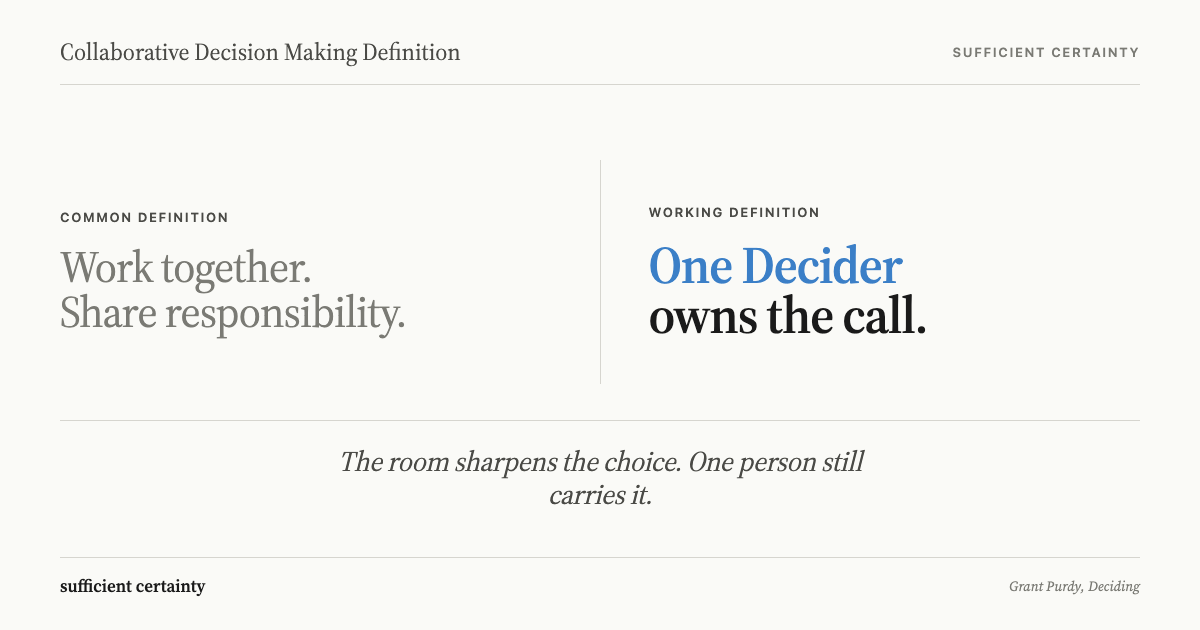
It usually means broader input and some form of consensus. Those definitions survive because they make everyone look sensible. The sponsor gets comfort from a room behind the choice, everyone else gets the relief of having been consulted, and the paperwork can later be waved around as evidence that due care was taken.
I do not object to contribution. I object to the fiction that contribution equals judgment. Much advice on a team decision making process stops at who should speak, how options should be discussed, and when the meeting should close. It says little about the only question that matters: what does this decision depend on being true?
I have watched boards call themselves collaborative when all they had done was make the sponsor's preference sound unanimous. The vote looked tidy. The minutes looked tidy. The buried assumption stayed buried. A smoother meeting is often a worse meeting, because it strips out the friction that tells you something material has not been settled.
This language also keeps a few trades comfortably employed. Consultants get another workshop to invoice. Governance staff get prudent-looking papers for the board pack. Meanwhile the decision stays ownerless, which is convenient for everyone except the person who will live with the consequence. That is why I prefer the one decider idea: collaboration is there to expose weak thinking, not to bleach responsibility out of the room.
Define collaboration on one real decision by naming the decider, the challenge, and the trigger to reopen. Start the Walk →
Why the usual collaborative decision making definition fails
Groups are far better at repeating what everyone already knows than surfacing the one fact that could change the call. Lu, Yuan, and McLeod's meta-analysis of 65 hidden-profile studies found that groups were eight times less likely to reach the correct answer when the best answer depended on pooling unique information. During discussion they mentioned far more shared information than unique information. I was not surprised. Shared information is socially cheap. The inconvenient fact usually belongs to one person, and that person has to spend political capital to say it.
Many teams try to fix that by appointing a devil's advocate. Carol Nemeth's work on authentic dissent versus role-played dissent shows why that often backfires. A staged contrarian tends to make people defend their first position more stubbornly. Genuine disagreement does something else. It forces the room back to the evidence.
If you want the full pathology, I cover it in groupthink in decision making. For definition purposes, the point is simpler: a collaborative decision making definition is worthless if it only describes polite participation and never asks how unshared assumptions get dragged into daylight.
Collaborative decision making definition for real decisions
Roger Estall and I make the same distinction in Deciding and in the Universal Decision-Making Method. A workable collaborative decision making definition is blunt: one owner, exposed assumptions, and a named condition that reopens the call if reality turns. The sequence is not mysterious. Frame the decision, Develop options, Recognise assumptions, Sufficient certainty, and Design monitoring.
In my experience, the room should be small and a little uncomfortable. The useful participant is not the person with the glossiest title, but the person who knows where the favourite option is weak and is prepared to say so. If the meeting cannot name the assumption that would break the decision, or cannot say who has to bring it back for review, it is not ready to approve anything.
I have sat in too many meetings where the supposedly collaborative move was to ask for one more paper, one more workshop, or one more round of comments. Asking for one more round is delay dressed as prudence, and it usually helps the people who sell process more than the people who have to live with the decision.
How a collaborative decision making definition should end
It should end by naming what would prove the room wrong. Logan et al.'s 2025 Pike River study is a brutal example of the alternative. Three senior decision-makers built a reference narrative that methane was low, coal volumes were vast, and uncertainty could be managed. A geologist who challenged the methane assumption was brushed aside. Costs blew out from $174 million to more than $340 million, and 29 men died.
Once the paper is approved, organisations love to behave as if monitoring belongs to some later tribe. I have never understood that dodge. If you cannot say, before implementation, what fact would make you stop, you have not finished deciding. You have only finished meeting.
People sometimes call that a failure of risk management. I do not. It was a failure of judgment dressed up as normal management process, which is how these things usually pass through governance without alarming the adults. The broader argument about collaborative decision making only interests me when it gets this concrete: before approval, name the tripwire and name the person who must haul the decision back onto the table when it snaps.
You could run another shutdown meeting and still not know who actually decides.
Work through your decisionNo sign-up. Just pick your decision and start.
Grant Purdy is the co-author, with Roger Estall, of Deciding (2020), and the architect of the Universal Decision-Making Method.