
A team decision making process is only as good as its stopping rule. If the process cannot tell the room when it knows enough to act, the meeting will loop until someone senior gets impatient or someone junior gets tired. Neither is a method. Both are how most team decisions actually end.
The team decision making process most organisations use has no decider, no stopping condition, and no test of the assumption the decision depends on. It has a meeting, a discussion, and a compromise. That is not a process. It is a habit. A real process names who decides, what must be true, and when the evidence is sufficient.
The team decision making process was already bent out of shape when I walked into a factory meeting with the chief executive, the operations head, and her engineering and finance chiefs. Output had missed plan three months running. Engineering wanted a $4 million line upgrade. Operations blamed scheduling and sloppy maintenance follow-through. The chief executive owned the call, but nobody wanted to say aloud that a vote would let everyone share the wording of responsibility while ducking the thing itself.
That factory room was doing what I have watched committees do for years: using the vote as a laundering device. Once the room can say "we decided", governance staff get their shared fog and committee secretariats get their lovely collective wording for the minutes. Roger Estall and I built the Universal Decision-Making Method, and wrote Deciding, because this nonsense is expensive. The facilitator, naturally, can always recommend one more workshop. It makes the paperwork look shared and the consequence look ownerless.
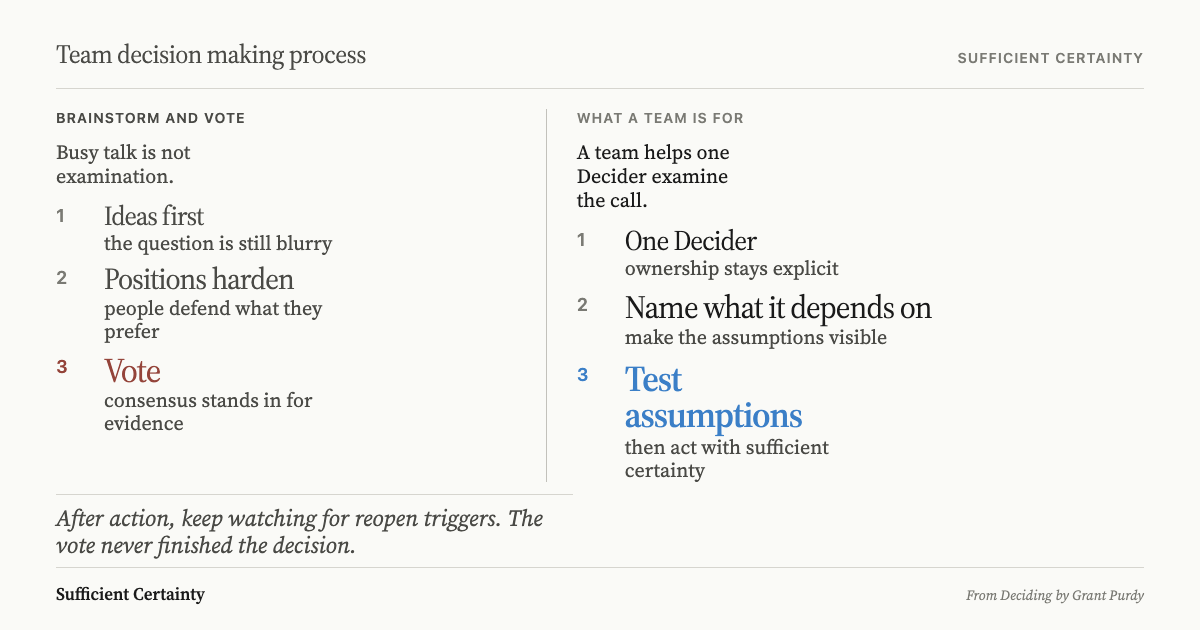
A team decision making process is a structured way for a group to test what a choice depends on before acting, then keep watching after action.
Why a team decision making process starts with Frame the decision
The first job in that factory room was to say what the decision actually was. Was the business short of capacity, or short of discipline? Nobody had separated the physical bottleneck from the planning failure. Until that sentence was clear, every opinion in the room was theatre with a spreadsheet.
I keep returning to Paul Nutt's study of organisational decisions because it confirms what I see in practice. Failure rises when people seize the first workable idea and rename it the decision. If you do not Frame the decision, you cannot Develop options that answer it. The room still feels productive, minutes get written, and some consultant can later praise the team's decisiveness, but nobody has examined what the action is supposed to solve.
I have heard people call that efficient. It is not. When I stopped the option talk and asked for two competing explanations of the missed output, the room changed shape. Engineering stopped defending spend it had not yet justified, and operations stopped pretending the sales forecast had settled the matter.
A 2024 study of four-person teams found better results when people explored before criticising and summarised before concluding. That should embarrass the meeting industry, which has built a small religion around sticky notes and clever choreography while dodging the awkward question of what decision the room is there to serve. Mechanics are useful only after the decision has been framed, which is the first thing I settle when making decisions in groups.
Frame the team's actual choice, run the assumptions in the open, and see whether consensus is hiding an ownerless call. Start the Walk →
Why the team decision making process must Recognise assumptions
Pike River is where polite talk about team process ought to stop. The mine had procedure and paperwork, plus confidence. It also carried untested assumptions about methane control and about whether a method borrowed from Australia would behave the same way in New Zealand conditions. After the event there was still plenty for regulators and compliance people to point at, which is precisely why apparatus without examination survives so long. Twenty-nine men died because the organisation kept relying on assumptions it had never forced into the open.
Most talk about groupthink is sentimental. It treats failure as a mood problem, the same substitution the decision making styles literature performs with a personality grid. In my experience the harder question is the one committees dodge: what was this decision relying on, and who kept that reliance safely unspoken? Once an assumption is visible, a team can test it. Before that, the room is only defending tribes.
In the factory case the critical assumption was banal, which is usually how the dangerous ones look. Management was assuming demand would justify the capital spend, and assuming the bottleneck sat in steel rather than in planning. Once we said that aloud, the grand debate shrank to size. The team authorised one small equipment change and four weeks of tighter evidence gathering. The full upgrade could wait until reality earned it. That is usually when committee theatre starts to collapse.
Sufficient certainty is the call, not consensus
False consensus is a favourite disguise of bad team process. By the time the vote is taken, the room is often just tired, and the minutes later make it sound nobler than it was. That is the trap I am trying to keep teams out of in collaborative decision making. Collaborative work does not cancel ownership; it exposes it.
NASA faced that test with Starliner after the June 2024 mission exposed thruster trouble and helium leaks. On 24 August 2024, it chose to bring the spacecraft back without crew. I cite NASA because it refused the soothing assumption that crew return must be safe merely because the timetable was embarrassing and the institution had already sunk too much pride into the mission. That is what Sufficient certainty looks like under pressure.
Design monitoring or the decision is still unfinished
Knight Capital is what an unfinished team decision looks like. New trading software went live in 2012 without a proper stop rule. The team had approved the deployment, signed the paperwork, ticked the governance boxes. The defect mattered, of course, but the more interesting failure sits one step earlier: nobody had clearly owned the watch once implementation started. Forty-five minutes later the firm had lost more than $460 million and the governance paperwork was worth exactly nothing.
In the factory case we named the watch owner before anyone left the room. The operations head had four weeks to track throughput and downtime. If output improved without new quality trouble, the staged fix held. If not, she reopened the capital decision with the chief executive and the engineering head, because the original owner still had to own the second call. That is how I think about effective team decisions. Committees dislike reopen triggers for an obvious reason: reopening exposes the first bluff, that the vote settled anything. The capital spend came back only if the four-week evidence failed.
You could ask the team to vote and still duck the decision yourself.
Work through your decisionNo sign-up. Just pick your decision and start.
Grant Purdy is the co-author, with Roger Estall, of Deciding (2020), and the architect of the Universal Decision-Making Method.