
Groupthink in decision making is not a flaw in the people. It is a flaw in the process. When the method asks for agreement before naming the assumption the preferred option depends on, the room will protect the comfortable answer every time. A dissent step breaks that pattern.
Groupthink in decision making is not a rare pathology that afflicts only dysfunctional teams. It is the default output of any group process that asks for agreement before anyone names the assumption the group is protecting. The fix is structural: surface assumptions before consensus forms, so the group tests claims instead of defending comfort.
Most people who use the word "groupthink" treat it as a diagnosis. A team made a bad call, so somebody invokes Irving Janis and the room nods. But Robert Baron's research in Advances in Experimental Social Psychology argues the opposite: groupthink in decision making is not a rare pathology requiring Janis's eight antecedent conditions. It shows up whenever social identity is threatened and norms discourage open challenge. Groups routinely suppress dissent and overrate their own competence. Janis made it sound exceptional. Baron says it is ordinary.
Groupthink in decision making is the collapse of independent judgment inside a group, prevented by structuring the process so that dissent surfaces before consensus forms.
What groupthink actually looks like
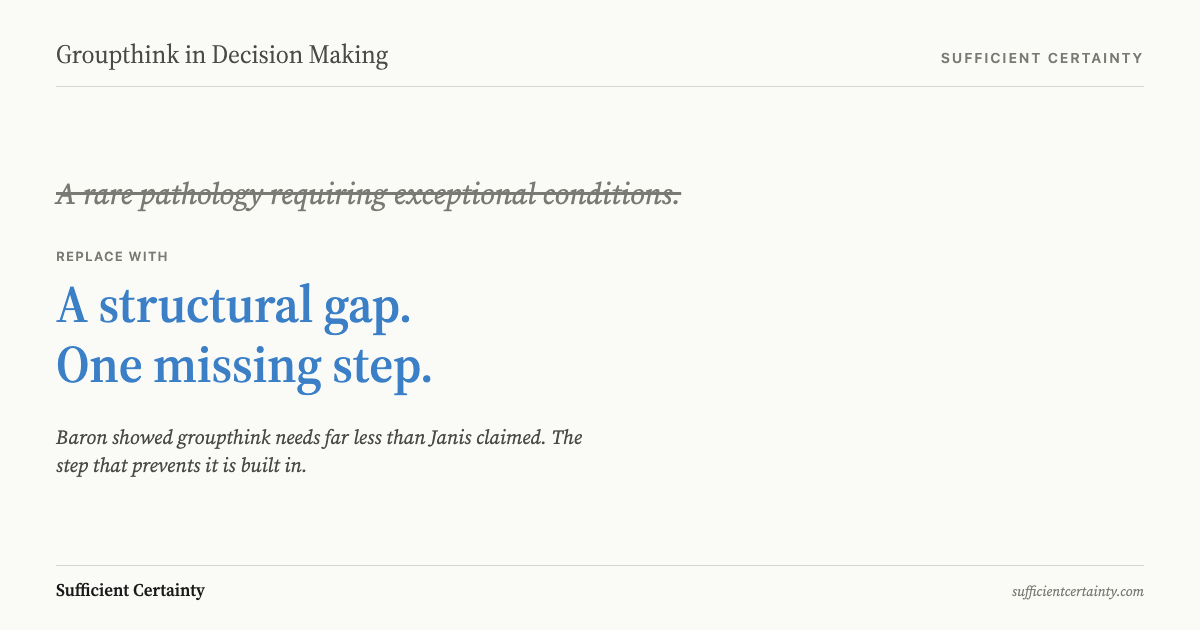
Janis studied the Bay of Pigs and Watergate. Those cases made groupthink sound like something that happens to powerful cabinets under extreme pressure. Baron's contribution was to show that the same mechanism operates in any group where social identity is threatened or where norms discourage open challenge. That covers most Monday-morning meetings. What feels like alignment is actually evasion.
I think of this whenever I hear the phrase collaborative decision making. Collaboration sounds generous. In practice, most collaborative groups collaborate on avoiding the hard question. They share information freely and still manage to agree on a course of action without anyone stating what it rests on. The hard question is always the same: what are we assuming, and have we tested it?
Three hundred and eighty-two findings, and still nobody changed course
Credit Suisse is the case I keep coming back to, because it is groupthink with full documentation. Between 2018 and 2022, the Swiss regulator FINMA conducted 108 on-site supervisory reviews and recorded 382 points requiring action, 113 of them classified as high or critical. The institution acknowledged every one. Strategic changes were proposed. Risk management deficiencies were flagged repeatedly. And then nothing changed. The bank collapsed in March 2023, not because the problems were hidden but because nobody in the room had a reason to act on what was already visible.
This was not a room full of fools. Credit Suisse had compliance teams, internal audit, external auditors, and a regulator standing in the building. The operating assumption was plain enough: we can acknowledge risk without changing behaviour. That is a testable assumption. Nobody tested it because surfacing it would have meant admitting that 382 findings had not produced a single change of course. Every layer of governance gave the board permission to believe the next layer would catch the real problem.
FTX was the mirror image, small instead of large. John J. Ray III, a restructuring specialist with forty years of experience including Enron, said he had never seen such a complete failure of corporate controls. Three people recently out of college ran the company. No independent board. Some entities never held a board meeting. The assumption was simpler than Credit Suisse's but structurally identical: the people in the room do not need to be questioned. The people who should have asked questions did not exist.
Big institution, small outfit, same result. The pattern runs through decision-making failures across every sector. Groupthink does not require Janis's cohesion or directive leadership. Baron showed it needs far less: a group identity worth protecting and norms that make challenge feel unsafe. Both Credit Suisse and FTX had those in abundance. Neither had a process for making decisions under uncertainty that required anyone to name what the decision rested on.
Bring your next team call through the five steps and expose the assumption everyone is protecting with agreement. Start the Walk →
Why devil's advocates do not fix it
The standard prescription for groupthink is to appoint someone to argue the other side. Baron's research explains why this fails. When the group knows the dissenter has been assigned the role, the dissent gets discounted. It becomes theatre. The room tolerates the performance and proceeds as planned. Insincere opposition is ritual, not scrutiny. There are techniques that make dissent genuine, and none of them involves assigning the role.
The fix is a step, not a role. In the Universal Decision-Making Method that Roger Estall and I set out in Deciding, every participant is responsible for surfacing assumptions, not just one person assigned to play devil's advocate. The third step, Recognise assumptions, is not optional and not a brainstorm where people volunteer concerns if they feel bold enough. It is a structural requirement: before the group moves forward, it must state what the decision rests on and test whether each assumption holds.
That changes the dynamic entirely. The question shifts from "does anyone object?" to "what are we assuming?" The first invites silence; the second demands content. It is the difference between genuine consensus and compromise dressed as agreement. When disagreement arrives in a team, the structure channels it toward the assumption, not away from the person.
Why psychology cannot prevent groupthink
A scoping review of groupthink in healthcare teams found 22 articles on the subject, of which only four were empirical studies. That gap tells you something. We use "groupthink" constantly as a label. We have barely studied how to prevent it. The word has become more useful to post-mortem authors than to the people still in the room.
I think the reason is that most remedies aim at psychology: encourage dissent, reward independent thinking. Those are fine sentiments. They do not survive contact with a room where the most senior person has already signalled a preference. The invite list does half the damage before anyone speaks, which is why effective decision making in teams starts with who is in the room. The facilitation industry has built a business selling courage workshops and team-building retreats, positioning the problem as personal rather than structural. If groupthink is a character flaw, it can be fixed with better characters. Nobody buys a process step, but a process step is what works.
The step that prevents groupthink in decision making
What survives is structure. That is why the choice of collaborative decision making model matters more than the facilitation. The method works because one of its five steps, Recognise assumptions, makes assumption-surfacing mandatory. A group that follows it cannot skip that step any more than a pilot can skip the pre-flight checklist. It is built in.
When I run this with leadership teams, the shift is visible within the first hour. People stop defending positions and start examining what those positions rest on. The process makes the question unavoidable. I do not ask rooms for courage; I ask them for their assumptions.
You could nod with the room and lose your last chance to surface dissent.
Work through your decisionNo sign-up. Just pick your decision and start.
Grant Purdy is the co-author, with Roger Estall, of Deciding (2020), and the architect of the Universal Decision-Making Method.