
Collaborative decision making is not a voting exercise. It is a structure where one person owns the decision and the group tests what that decision quietly depends on. Without that discipline, collaboration produces agreement that nobody is willing to be held to when the assumption underneath it breaks.
Collaborative decision making works when one person owns the commitment and the group contributes knowledge that tests the assumptions behind it. It fails when collaboration means consensus, because consensus rewards the option that offends nobody rather than the option that addresses the actual uncertainty. Structure, not harmony, is what makes group decisions reliable.
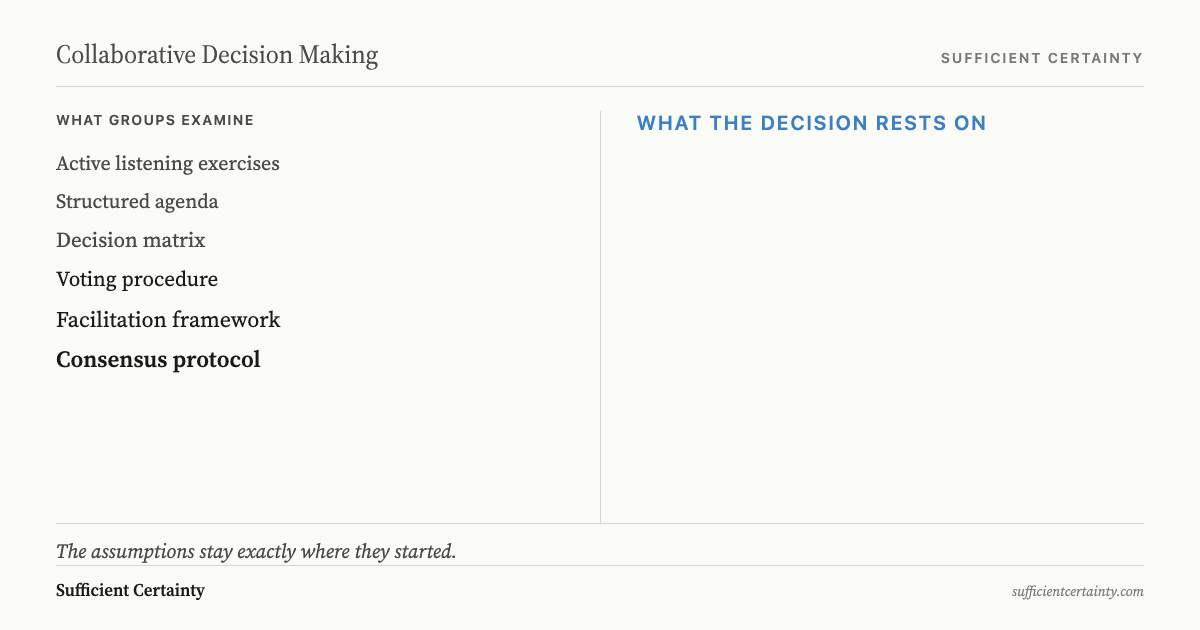
I sat through a standards committee where the group spent forty minutes on active listening exercises before anyone mentioned what the decision actually was. Sticky notes on the wall, a structured agenda on the screen. I have spent nearly fifty years watching variations of that scene play out under the banner of collaborative decision making, and it always ends the same way: the participants leave feeling respected, and the assumptions the decision rests on remain invisible.
The goal is sufficient certainty: enough confidence in those assumptions to act, with monitoring designed before the group leaves the room. The facilitators and consultants who run these sessions earn their living from process choreography, not from examining content. If your consultancy earns its fees from two-day facilitation workshops, you will sell facilitation. Content examination requires subject-matter knowledge that most facilitators do not have.
Collaborative decision making is the practice of one person working with a group to test what a choice depends on before making it.
What collaborative decision making usually means
Search the phrase and you get technique guides, matrices, and the usual consultant perfume. What they mostly share is a fixation on decision-making frameworks for managing the room rather than examining the decision. That is not collaborative decision making. That is choreography with better stationery. A working definition starts elsewhere: one person owns the call, and the group is there to test what it rests on.
I do not dismiss technique entirely. De Bono's hats can separate creative from critical thinking, which is useful when a room needs permission to disagree. But most techniques stop at process. They make people feel heard, which is pleasant, and leave the assumption the decision rests on sitting in the dark, which is less useful.
Volkswagen's board is the tidy example: it approved a diesel strategy that assumed emissions testing would stay in the lab, and the road tests later turned the strategy into a very expensive moral lecture. That is what most collaborative sessions miss. They talk about how the room will decide and never ask what the preferred option quietly depends on.
Surface the assumptions your group is carrying into the next meeting and test which ones actually matter. Start the Walk →
One person owns the decision
A group can help shape a decision, but it cannot own the outcome without turning accountability into soup. I use Decider for the person who owns the result. The group tests assumptions, challenges options, and tells that person when the attractive story is nonsense.
That is why I wrote about collective decision making separately. The promise of shared ownership sounds democratic until nobody can say who was supposed to have noticed the weak assumption. I also wrote about making decisions in groups because the room needs structure, not a vote and some hopeful nodding.
This is also why decision making for leaders matters. Someone has to own the consequences when the window closes. A Dutch study found junior-led groups outperformed senior-led groups because rank suppresses challenge; that is not magic, just a room where title makes people quieter than they should be. I built participant selection into the method to avoid that nonsense: choose for subject knowledge and the capacity to challenge, not for decorative seniority. If they are not helping implement the decision, they usually do not belong. That is the same reason effective decision making in teams depends on role clarity instead of polite participation.
Five steps for a group decision
The Universal Decision-Making Method stays at five steps because five is enough. Frame the decision. Develop options. Recognise assumptions. Ask for sufficient certainty. Design monitoring. If a group cannot remember five steps, it probably should not be making the decision in the first place.
The middle step does the heavy lifting. Options matter, but assumptions decide whether an option is worth anything. The rest of the method exists to stop people from jumping from a polished proposal to a confident mistake. I set out the longer version in the collaborative decision making model and the team decision making process, where the machinery is laid out without the furniture polish.
Role charts, consensus rounds, and a wall full of coloured stickers are not a method. They are props. The method forces a group to answer three questions: what are we deciding, what does it depend on, and do we know enough to act? Everything else is decoration.
The conversation that determines the decision
Techniques matter only when they help a group think. That means de-biasing, protected dissent, and a clear rule that the group decision making techniques are there to surface truth, not to make the room feel tidy. A licensed challenger helps because groupthink in decision making thrives wherever people mistake agreement for intelligence.
Consensus is fine when it means the strongest idea survives rigorous attack. It is dreary when it means everyone trades pieces of the answer to avoid a bruise. I wrote about consensus group decision making because organisations call compromise consensus and then act surprised when the result is mush.
A water-pipe repair crew does not need a workshop on active listening. It needs a purpose, a context, and enough room to think aloud before the road closes and the school run begins. The decision fatigue that accretes in organisations often comes from making every conversation carry the weight of a tribunal. When people can say "I am not sure, but..." without getting stared at like a suspect, the useful ideas surface. That is the whole of it. The method removes work the group was creating for itself.
What happens after the group decides
The monitoring step is the part most people skip because they want the decision to be over. It is not over. Before the room empties, agree what will be watched, who will watch it, and what change will trigger a review. If the decision depends on a six-week delivery promise, someone needs to watch the six weeks, not the optimism.
That is why I treat risk registers as records, not decision tools. During COVID, organisations did not need another matrix; they needed to know which assumptions had been invalidated and which ones still held. Aviation and medicine learned this long ago: the people who make the call also monitor the assumptions the call rests on. That is basic competence, which is why it is so uncommon.
The examples are blunt. Grenfell Tower: cladding assumptions passed through multiple hands until 72 people died, then the system responded with more regulation instead of admitting the assumption had never been tested. The Financial Crisis Inquiry Commission report: models, ratings, and institutions built on unexamined assumptions, then surprised themselves when the floor vanished. Apollo 13: Mission Control named the problem, tested options, and kept checking what the decision depended on while the crew was still in space. Deepwater Horizon: inspection resources were allocated as if all rigs carried the same risk, and the fire proved the assumption was lazy.
You could invite everyone in, then leave with polite alignment and private doubts.
Work through your decisionNo sign-up. Just pick your decision and start.
Grant Purdy is the co-author, with Roger Estall, of Deciding (2020), and the architect of the Universal Decision-Making Method.