
A collaborative decision making model must answer one question before the room opens discussion: who decides. Most models choreograph input and ignore authority. The group talks, the matrix scores, the facilitator summarises, and the decision belongs to nobody. That is not a model. That is a spectacle.
A collaborative decision making model is only as useful as the answer it gives to one question: who decides. Most models distribute responsibility so evenly that nobody can close the call. The model that works names one decider, defines who contributes knowledge, and specifies when the contribution window closes so the decision can actually be made.
I once reviewed a project pack built around a RACI chart with 17 names and a 47-item risk register. After two committee meetings and a great deal of careful nodding, nobody could tell me who would decide whether the outsourcing should proceed if service quality slipped in month three. That is a collaborative decision making model in many organisations: a picture of participation with nobody left holding the call.
That is the standard the Universal Decision-Making Method was built to meet. It names one Decider and keeps monitoring inside the call, not in the appendix nobody reads.
Most models go wrong when people treat the picture as the decision. RACI can clarify contributions after the decision is framed. Delphi can collect views when status or distance would poison a live meeting. Neither tells the room what must be true for the preferred answer to work. Boxes and rounds do not decide anything.
Roger Estall and I wrote Deciding because we were tired of watching committees turn process into shelter. Consultants sell the shelter and in-house 'risk' teams keep it standing. Board secretariats then treat the shelter as ordinary furniture. Oddly enough, the people paid to preserve it never recommend leaving it (a heartbreaking coincidence, I am sure). I wanted a method that left one person exposed to reality and forced the room to say what the decision was betting on.
A collaborative decision making model is the structure that names one Decider, draws challenge from the room, and tests the assumptions behind the choice before action starts.
Most collaborative decision making models start in the wrong place
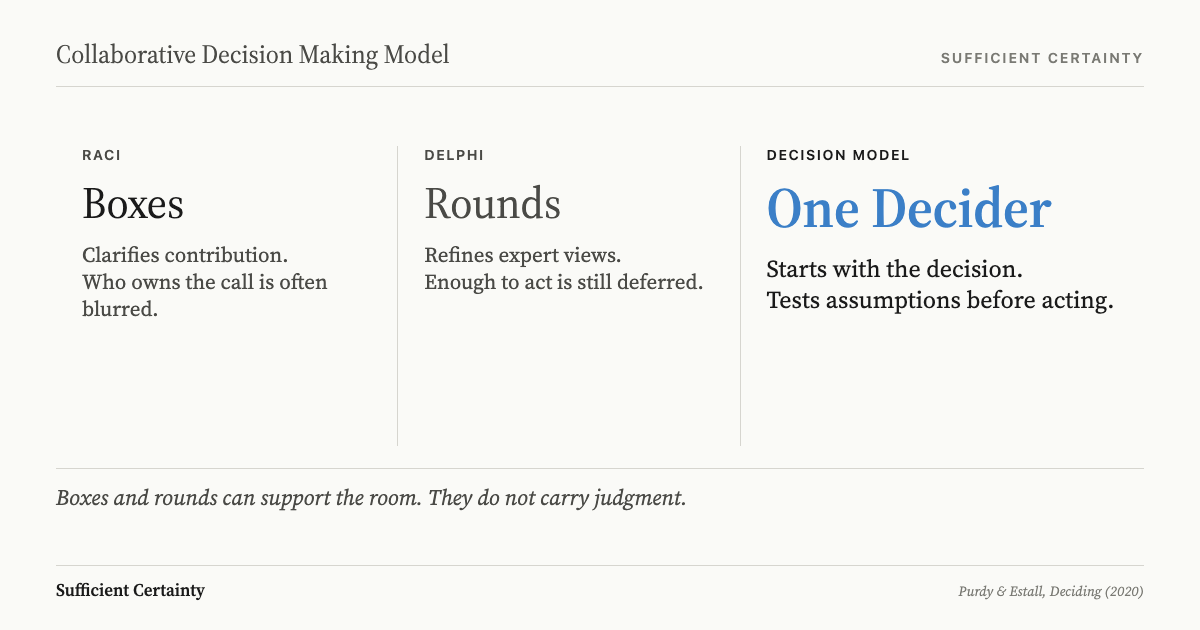
Most collaborative decision making models begin with machinery, and that flatters the people who live off the machinery. McKinsey's critique of RACI noted in 2022 that 80 per cent of organisations struggle with decision making and that bloated role charts slow the call instead of sharpening it. I do not need the survey to believe it, but the survey is correct. By the time a room has argued over the boxes, it may still not have stated the choice or the outcome it wants. The life of the decision can be settled afterwards.
| Model | Useful for | Who owns the call | What gets missed |
|---|---|---|---|
| RACI | Clarifying contribution | Often blurred | What decision is actually being made |
| Delphi | Gathering dispersed expert judgment | Usually deferred | When there is enough certainty to act |
| Universal Decision-Making Method | Running the decision itself | One Decider | The room contributes, but one person still owns the call |
I do not object to RACI as an aid to implementation. I object when it becomes the frame. If the chart arrives before the decision has been properly framed, administration has already beaten judgment.
A collaborative decision making model needs one Decider
The evidence for collaboration is useful, but it is not mystical. Rutka, Wrobel, and Wycinka looked across 598 teams and found that consultation and group discussion reduced error against autocratic calls, yet neither reliably beat the best informed individual in the room. The room can improve the input. It does not absorb accountability.
Clients have said to me, "Grant, you do bang on about one Decider." I do, because the Decider is not automatically the most senior person. It is the person who has the authority to act and who cannot disappear when the outcome turns sour. Committees dislike that arrangement because it denies them the usual refuge of "we all agreed", which is often how nobody agrees to own anything. That is the quiet fraud inside most collective decision making.
In my experience, "shared accountability" is a laundering device. It suits consultants and governance teams because it spreads exposure so thinly that the paperwork looks prudent while the decision remains homeless (though the minutes look splendid). A committee can congratulate itself on the quality of the discussion and still leave the hard exposure on nobody's desk. That is why effective decision making in teams depends on extracting challenge for one accountable call rather than preserving harmony.
RACI and Delphi are tools, not full decision models
RACI can help after the frame is set, and Delphi can help when status or geography would spoil a live meeting. I still would not call either a full decision model. Delphi is particularly attractive to institutions that want disciplined input without the inconvenience of a visible owner. It can pool views. It cannot tell me who owns the call or which signal should bring the decision back for review.
The reporting quality tells the real story. Schifano and Niederberger reviewed 287 Delphi studies in the health sciences and found that 61 per cent did not define consensus before the work began, while about half did not report a clear stopping rule. That kind of reporting is procedural camouflage dressed up as rigor. If nobody can say what counts as enough, the panel can keep polishing its agreement until the calendar finally makes the decision for them.
That is one reason groupthink in decision making survives inside respectable organisations. Once convergence becomes the goal, disagreement gets treated as bad meeting behaviour instead of evidence that an assumption is still loose.
Use the five steps on your shared decision and make clear who decides, who advises, and what assumption needs testing. Start the Walk →
The collaborative decision making model I trust tests assumptions
This is the step the fashionable models usually skip. Most groups move from options to preference without naming what the preferred answer assumes. I want the room to ask two blunt questions: what has to be true for this to work, and how much pain do we buy if it is false? Once those assumptions are on the table, the conversation gets less theatrical very quickly. People can no longer hide behind adjectives or percentages. They have to defend the bet itself.
When I run this in a room, I do not start with "thoughts?" I start with the decision itself. What exactly is being decided, who owns it, and what would count as a good outcome? Once that is plain, the room stops drifting into commentary. One person owns the call. Everyone else is there to improve it. I want the people closest to the work saying what this answer is assuming, and I want the awkward assumption said in ordinary English before somebody hides it under a chart.
The Decider then has a real job. They judge when the important assumptions have been pushed hard enough that acting is safer than waiting for another perfect memo that will never arrive. Anyone selling perfect certainty is back in the furniture business. Before anyone leaves, the room settles what will be watched, who will notice if the context shifts, and what kind of change opens the decision again. If that part is left for later, it usually means never.
I once watched a plant upgrade approved on the strength of a shutdown date buried in an appendix. The room treated the outage window as an administrative entry, not as an assumption that needed testing against contractor readiness and the state of the site preparation. Nobody asked what had to be true for that date to hold. When the window moved, the economics that justified the project collapsed with it. That was a failure to drag one critical assumption into daylight before the decision stood.
A collaborative decision making model worthy of the name does not ask whether everyone had a turn. It asks whether one accountable Decider has enough certainty to act because the room has exposed the live assumptions and settled what to watch next. That is the version of collaborative decision making I trust. The rest is committee theatre, useful mainly to the people paid to keep the theatre open.
How to make group decisions without turning every meeting into a committee
Collaborative does not mean everyone votes. It means the right people challenge the right assumptions and one person still carries the call. Once that distinction is lost, "collaborative" becomes code for "no one owns it," which suits everyone in the room except the organisation paying for the decision. The word has been stretched so far by governance teams and facilitators that it now covers everything from genuine structured challenge to a monthly meeting where 12 people share observations and leave without a conclusion.
The method works because it assigns roles that are not negotiable. One person frames the decision. Others identify what the preferred answer assumes. The Decider judges whether those assumptions have been tested hard enough to act. After the call is made, someone owns the monitoring: what signal would force the decision open again. Each role has a job. None of them is "attend and agree."
I ran this with a water utility that needed to decide whether to replace a treatment plant or retrofit the existing one. The engineering director owned the decision. The operations manager, two shift supervisors, and a contracts specialist were in the room to challenge. Finance was there to price the futures, not to approve the preference. Nobody was invited to represent a department. Everyone was invited because they knew something the decision needed.
The engineering director framed the choice in one sentence: replace or retrofit, judged against capacity for the next 15 years. The operations people named the assumption carrying the retrofit option: that the existing civil structure would tolerate the additional loading without reinforcement beyond the current budget line. The contracts specialist pointed out that the preferred contractor's availability window assumed a procurement timeline that had never been achieved on a project of this scale. Both assumptions were live. Both had been invisible in the paper that came to the meeting.
The Decider then had a real job. She judged that the structural assumption needed a geotechnical report before the retrofit could be taken seriously, and that the procurement timeline needed testing against the last three comparable tenders. The decision was not made that day. It was made two weeks later, with evidence that had been missing when the room thought it was ready.
That is what structured collaboration looks like. Not a brainstorm. Not a vote. A sequence where each person has a defined job and the Decider cannot hide behind the room's agreement. The common failure mode is exactly the opposite: a steering committee that meets regularly and decides nothing, because participation has been confused with accountability.
I have watched organisations set up cross-functional teams with 14 members and no owner. The meetings are long. The minutes are thorough. The decision drifts sideways until a deadline makes it for them. Everyone then points to the process, which is convenient because the process cannot point back. Nobody calls the arrangement what it is, which is a polite refusal to decide. A proper decision rights framework prevents this by making ownership visible before the discussion starts, not after it fails. The people who resist that visibility are usually the ones who benefit from the ambiguity.
The water utility made a better decision because the collaboration had edges. The room knew who was there to challenge, who was there to supply evidence, and who would carry the outcome. Nobody confused contributing with deciding. Roger Estall and I wrote Deciding around that principle because structured challenge is what turns a meeting into a decision, and open-ended participation is what turns it into a shelter.
You could invite seventeen names and still freeze when service slips in month three.
Work through your decisionNo sign-up. Just pick your decision and start.
Grant Purdy is the co-author, with Roger Estall, of Deciding (2020), and the architect of the Universal Decision-Making Method.