
Effective decision making in teams depends on structure, not chemistry. A named decider, clear roles, and an explicit test of the assumption the decision rests on will outperform any amount of trust and goodwill. Teams that skip that structure confuse agreement with reliability.
Effective decision making in teams fails when the team treats collaboration as consensus and consensus as the goal. Effectiveness comes from structure: a named decider, clear roles for those who contribute knowledge, and a defined point at which the evidence is sufficient to act. Teams that skip this structure convert every decision into a negotiation.
I once sat in a shutdown meeting where two vice presidents were arguing over the restart sequence while the maintenance window slipped and the permit sheet gathered more signatures than useful information. The fitter who would have to start the line again on Monday was not in the room. That is how many organisations approach effective decision making in teams.
The meeting industry will tell you to fix this with better facilitation, decision making style workshops, and nicer language. I am not a facilitator, so let me skip to what actually matters: teams usually fail before the first question is asked, because the invite list was built by rank and the awkward assumption was excluded with the people who knew it.
I do not want a room full of titles. I want people who understand the work and will wear the consequences, with enough freedom to contradict each other. Miss that, and the meeting becomes a polite alibi.
Effective decision making in teams requires naming one owner before the discussion starts, so that the group tests the choice and one person carries it forward.
Effective decision making in teams starts with who gets invited
Rank is a poor filter for truth, though it does wonders for seating plans.
Mihailis Pitesa and Stefan Thau studied more than 11,000 leaders and employees across 32 organisations and reached an awkward result for anyone who treats hierarchy as wisdom: higher rank weakened principled dissent. Senior people identified more strongly with the group and became less willing to challenge it. I have seen the same thing in boardrooms. The longer a title has occupied a chair, the more the room edits itself before speaking.
The same rank distortion shows up in effective decision making in leadership, but teams feel the damage first. Once seats are assigned by status, the room starts protecting its own story. Governance people call that organizational alignment. Consultants call it stakeholder buy-in. Both descriptions are very convenient if your income depends on crowded rooms and nobody wants a clear owner for the mistake.
Senior people may well bring a broader view. Let them bring it. Just do not confuse breadth with scrutiny. A broad view built on protected assumptions is still a bad decision, only now it arrives with a title page and a confident voice. The room applauds because the presenter is senior, not because the assumption was tested.
Bring your next team decision into the five steps and see whether the real operator and the real owner are present. Start the Walk →
Frontline people see the assumptions managers miss
They see them because they are the ones who discover whether the plan survives first contact with Monday morning.
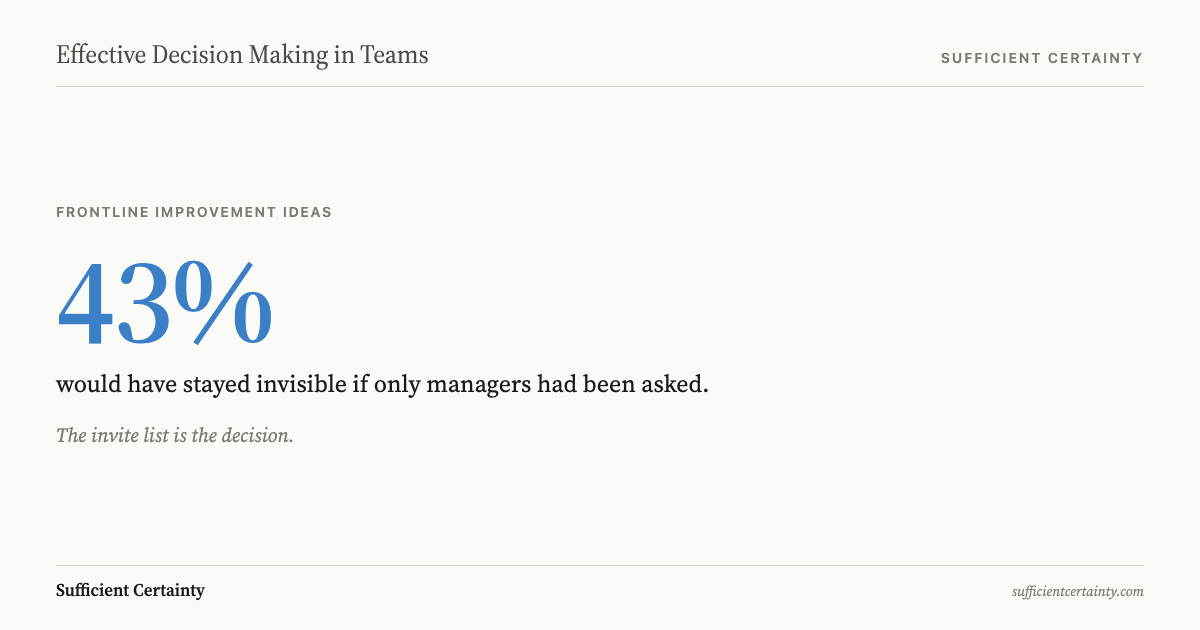
That is why I paid attention to the Milbank Quarterly study by Jung and his colleagues. Across 54 federally qualified health centres, 1,417 frontline workers submitted 2,271 improvement ideas. Forty-three per cent of those ideas would probably have stayed invisible if only executives and managers had been asked. Eighty-three per cent of respondents said the ideas they submitted were unlikely to be heard through normal channels.
I have watched factories do this to themselves. They invite finance and planning, then act surprised when the plan comes apart in week two. The operator who could have named the weak spot was back on shift, not in the meeting. I see the same gap in collaborative decision making examples at larger scale: headcount goes up and the live assumption stays untouched.
The people closest to the work notice the hidden assumptions first. They know when the maintenance window is fantasy or the spare part is not actually on site. A room without those people is not deciding together, it is briefing itself. Once the operator is missing, groupthink in decision making does not need exotic psychology. It just needs a deck and someone who wants the minutes to look tidy.
Effective decision making in teams needs one owner before action
It needs a named decider before anyone starts congratulating the team, because discussion helps and shared responsibility is usually camouflage. That is the first thing I look for in any collaborative decision making model: a person, not a matrix.
The 2010 JAMA study by Neily and colleagues makes the point cleanly. The Veterans Health Administration put structured team training into 74 surgical facilities and compared them with 34 controls. Surgical mortality fell from 17 to 14 deaths per 1,000 procedures, an 18 per cent annual reduction, while the control sites showed no significant change.
That improvement did not come from warmer feelings in theatre. It came from a sharper conversation before the work started. Roger Estall and I built the Universal Decision-Making Method to force that discipline: Frame the decision, Develop options, Recognise assumptions, reach Sufficient certainty, then Design monitoring. That sequence is the spine of Deciding. Committees dislike the last two because they expose the bet and the owner. In my experience "shared accountability" mainly helps consultants and board secretariats, with governance staff nodding along, because it smears ownership across the room. That is why making decisions with uncertainty needs a named owner, not a committee excuse.
Boeing shows what happens when managers overrule expertise
A team stops being a team when expertise is invited to speak but not permitted to change the outcome.
The U.S. House hearing record on the Boeing 737 MAX is plain on this. Lion Air Flight 610 and Ethiopian Airlines Flight 302 killed 346 people. On a 2015 FAA panel considering a key MCAS compliance decision, seven aerospace engineers and the project pilot disagreed with the approach. Four managers signed off anyway.
Boeing did not lack expertise. It turned expertise into a procedural courtesy. Once that happens, the meeting is no longer testing the choice, it is staging approval for it.
That is why the phrase "cross-functional team" does not impress me. Boeing had every function you could want and still let hierarchy plus schedule pressure turn technical objection into a nuisance, which is how a formal group becomes useless at the one moment it matters.
That failure sits inside collaborative decision making more often than people admit. Effective decision making in teams starts before the meeting, with the invite list and the owner, not with the agenda. If the vice presidents are approving the restart sequence while the fitter is still out on the floor, do not call it teamwork. Call it a blame-sharing exercise and start again.
You could enter the meeting without the real operator and leave with ownership still missing.
Work through your decisionNo sign-up. Just pick your decision and start.
Grant Purdy is the co-author, with Roger Estall, of Deciding (2020), and the architect of the Universal Decision-Making Method.