
A collaborative decision making tool should test what the group assumes before anyone votes. Most do the opposite: they tally preferences and call the result consensus. That process hides disagreement instead of resolving it, and the decision breaks on the assumption the room never examined.
A collaborative decision making tool should test what a group assumes before it commits. Most do the opposite: they tally votes and collect preferences without asking whether the people voting share the same reading of the evidence. That is the step where group decisions break, and no software feature covers it.
Fourteen people spent three hours in a conference room on a product-line decision. The facilitator had prepared well: a shared Miro board on the screen and coloured dots for priority voting. At the end of the session every participant placed a green dot on the preferred option, the facilitator photographed the board, and the group dispersed with what the meeting notes described as consensus.
Within a week the project lead called a second meeting. Two of the original fourteen had raised concerns they never voiced in the room.
The procurement director said the costing assumption behind the preferred option had changed since the original session; a regional manager pointed out that the demand forecast everybody had treated as settled was a projection she had flagged as uncertain six weeks earlier in a different meeting.
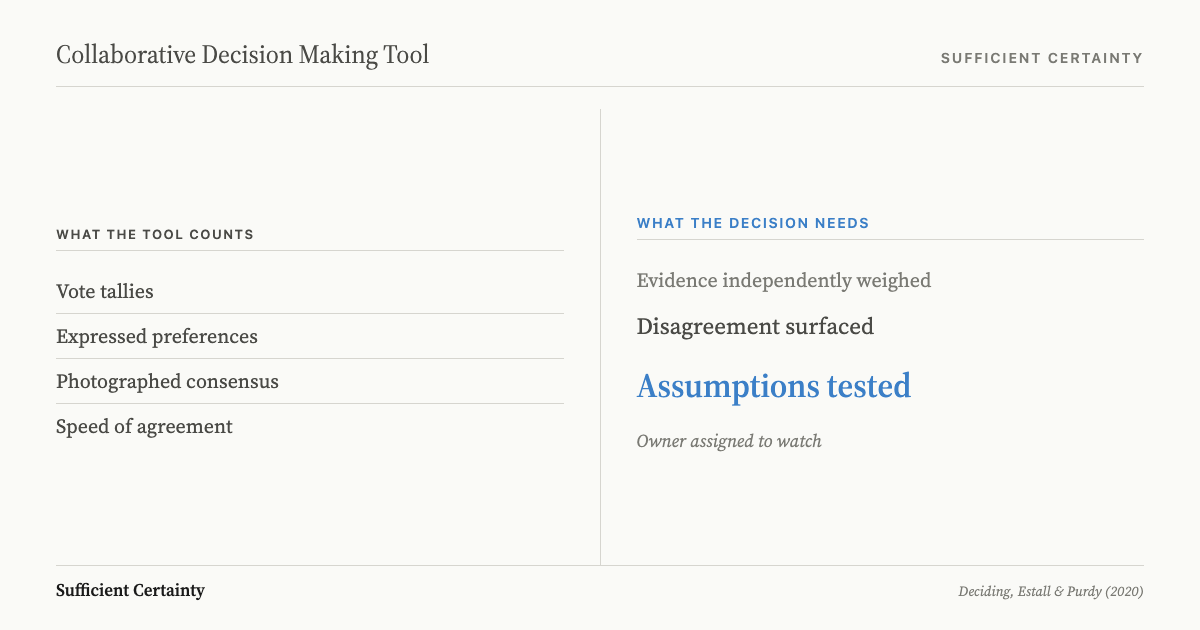
The coloured dots had counted preferences. They did not test whether the group was assuming the same things about supplier capacity or the regulatory timeline that connected the two. A collaborative decision making tool that counts agreement without testing what sits underneath it is solving the wrong problem.
I built the Walk to address that specific failure. It takes a group through five steps that force the room to say what it is assuming before anyone evaluates options. At the end it produces a Decision Document: the assumptions, their significance, and the signal that would bring the group back together if the conditions change.
A collaborative decision making tool is a structured method that enables a group to test the assumptions underneath a shared decision and record them before committing to it.
Why collaborative decision making tools fail teams
Every result on the first page of a search for a collaborative decision making tool offers software: voting features and polling integrations. These products aggregate existing preferences; they do not test whether those preferences rest on the same reading of the facts or the same assumptions about what will hold after the decision is made.
Cass Sunstein and Reid Hastie synthesised decades of group decision-making research for the Harvard Business Review and found that groups amplify individual errors rather than correct them, and that cascade effects cause members to follow early speakers instead of contributing independent judgement.
Federal judges, whose profession depends on impartial analysis, showed far more ideological voting patterns when sitting with appointees from the same political party; that is group polarisation measured in people trained to resist it.
A voting button inside a collaboration product does not counter this dynamic; it entrenches it, because the button aggregates expressed preferences while leaving the underlying assumptions untested. The critical piece of information held by one person goes unmentioned because the software has no mechanism to elicit it.
Robert Cross and Susan Brodt documented the complementary failure in MIT Sloan Management Review. They described how executives routinely assume their teams agree with them when they do not, a pattern they called social projection.
In one case a Fortune 100 company invested heavily to manufacture and distribute a core product in Asia because the project champion was convinced he could replicate his domestic success; senior executives endorsed the decision without testing that assumption, and the project failed.
The tool the organisation needed was not a polling feature; it was the question nobody in the room had asked: what are we assuming here, and does the evidence support it?
When a collaborative decision making tool is enough
A voting tool or a dot exercise is enough when the decision is contained and reversible: choosing a meeting format or selecting a vendor for a bounded contract. These are choices where the downside is absorbable and the group can change course without material cost. I do not pretend the Walk is needed for every decision a team makes.
The threshold sits where the cost of a wrong assumption reaches people, capital, or the organisation's capacity to operate. A product-line commitment that depends on untested demand forecasts, a restructure built on assumptions about staff retention that nobody has verified: these are the decisions where counting votes is not enough and the group needs a method that tests assumptions before it commits.
The cost of more analysis is itself an assumption most teams never test, and I write about where that line sits in making decisions with uncertainty.
The Walk exists because I watched teams use collaborative software for precisely these decisions, reaching nominal agreement without testing anything, and calling the result a decision when it was closer to a collective guess.
Name the assumption your team carried into the last group decision and write who would have owned the watch. Start the Walk →
The assumption your team never surfaced
A 2025 study in Organization Studies tracked what happens when a group of diverse stakeholders has to reach consensus under deadline pressure. They reduced participation to speed up agreement.
It worked at first; within months, the unresolved disagreements escalated.
Deadlines designed to foster efficiency drove groups to commit before the underlying assumptions had been examined, and every shortcut the group took to reach faster consensus created a new source of conflict downstream. The mechanism is predictable once you see it, and I have seen it in corporate teams consistently.
The tool any group adopts makes agreement faster, and faster agreement is not the same as a tested decision. The software removes friction from the voting step while leaving the assumption step absent entirely.
The Walk forces that step back into the conversation: the group names what it is assuming, and each assumption is written into the Decision Document with an owner assigned to watch the condition it depends on.
Rob Cross and Inga Carboni studied 66 organisations using network analysis and found that 88 per cent exhibited at least one pattern of collaborative dysfunction, with 60 per cent of teams failing to meet their strategic objectives.
Employees now serve on twice as many teams as five years earlier, which means the decision load on each participant has grown while the time available for genuine deliberation has shrunk.
The dysfunctions Cross and Carboni identified are structural: wrong people in the room and dominant voices displacing contributors who hold material knowledge. A feature inside a collaboration product cannot address these failures; the conversation itself has to be structured differently, which is what the Universal Decision-Making Method does by separating what the group assumes from what it decides.
What a collaborative decision must actually produce
The real test of any group decision process is what remains after the meeting ends. If the only artefact is a vote tally or a photographed whiteboard, the group has not recorded what it assumed or who will act when those assumptions change.
Roger Estall and I wrote Deciding and designed the Universal Decision-Making Method to address that gap. The Walk produces a Decision Document that records the critical assumptions the group identified and the person who must act when conditions shift.
Collaborative decisions are especially vulnerable to assumption drift: everyone leaves the room believing someone else is tracking the underlying conditions, and nobody is.
In my experience, the reason collaborative decisions drift is that nobody writes down the monitoring arrangement. A demand forecast that was central to the decision sits on a spreadsheet; if it starts to weaken, nobody has a clear mandate to reconvene the group.
The Decision Document makes that arrangement explicit: the assumption and the person who owns the watch. That specificity is what separates a commitment the team can monitor from an agreement that nobody defends.
The five-step method moves a group from framing through assumptions to sufficient certainty in a single session, without a facilitator and without the overhead that benefits the people selling the process rather than the people who must live with the decision. It addresses the blind spot that runs through every conventional decision making tool: evaluation without assumption-testing.
You could photograph the consensus and still leave the assumption underneath it untested.
Work through your decisionNo sign-up. Just pick your decision and start.
Grant Purdy is the co-author, with Roger Estall, of Deciding (2020), and the architect of the Universal Decision-Making Method.