
Critical thinking and judgment are not the same skill. Critical thinking sharpens analysis. Judgment calls the bet. Most training courses teach the first and assume the second follows. It does not, because analysing a problem well does not tell you when to stop analysing and commit.
A board I worked with sent six senior people to a two-day critical-thinking course. They came back with folders on fallacies. They had a sheet of Socratic questions and the pleased look people get after expensive training. Six weeks later the same board approved a systems cutover without once naming the assumption that the test environment matched production. It did not. People talk about critical thinking for better judgment and decision making as though the course closes that gap. In my experience it does not.
No course I have seen teaches that last step, which is unfortunate, because it is the step that decides whether the training money was wasted.
I respect critical thinking, and I keep seeing it stop where the discomfort begins. It teaches people to inspect reasoning in general. Judgment starts when somebody has to put the live assumption into words and carry the consequence if it is wrong.
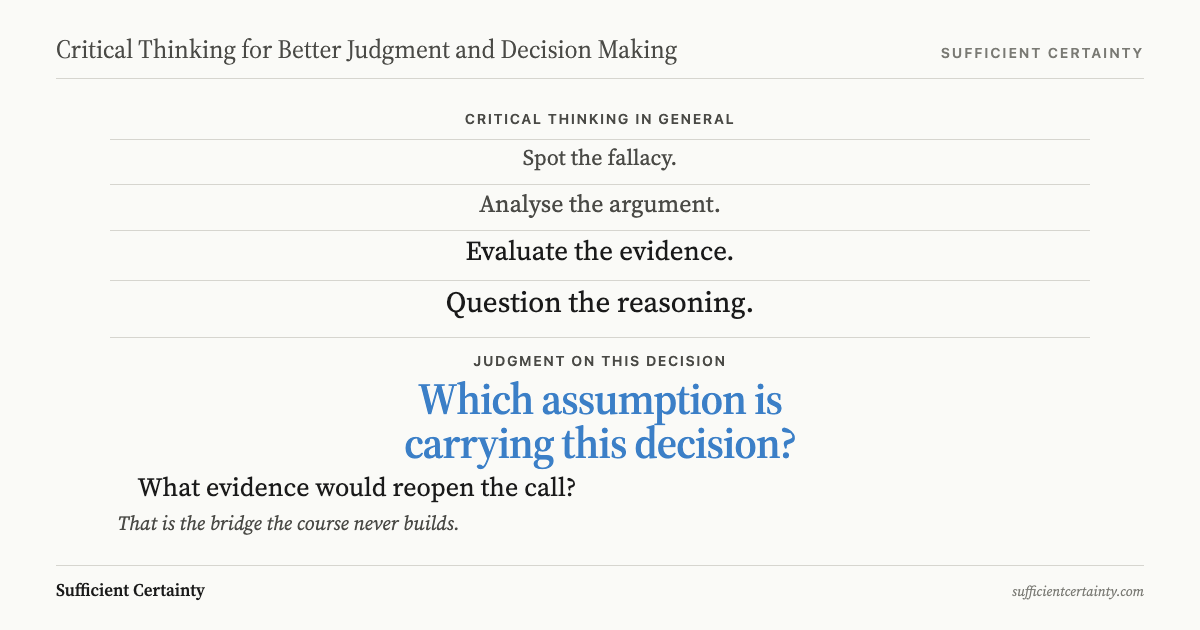
Critical thinking and judgment meet only when general reasoning is pinned to a live decision and the assumption carrying it is named, tested, and owned.
What people teach as critical thinking for better judgment and decision making
Richard Paul and Linda Elder built one of the strongest versions of the subject. In their Elements of Reasoning, all reasoning has parts and all reasoning rests on assumptions. That is why I have more time for their work than I do for most courseware. They at least tell people to look for the assumption. What they do not give a board or plant manager is a way to pin one decision to the table and say: this is the assumption carrying it.
Peter Facione's 1990 Delphi report did the academic version of the same job. Forty-six experts spent two years defining critical thinking and produced six cognitive skills with seven dispositions. Useful work. Then the academics slip the knife in sideways. "Maturity of judgment" appears as a disposition, something the good thinker possesses. That is very convenient for universities and course sellers. It also suits executives shopping for a respectable answer to a messy problem, preferably one that does not disturb next Tuesday's meeting. If judgment is a quality you admire in people, nobody has to teach a room how to expose the assumption hiding inside tomorrow's board paper.
Where critical thinking for better judgment and decision making falls short
Philip Abrami and his colleagues looked across 117 studies covering 20,698 participants. Their result should embarrass every executive who tells staff to use good judgment and leaves it there. When critical thinking was left to immersion inside ordinary subject teaching, the effect size was 0.09. When it was taught explicitly with practice, the effect size was 0.94. That is roughly a tenfold difference between hoping people pick something up and showing them what to do. It improves the quality of analysis, but it still does not turn itself into sound judgment.
Huber and Kuncel, in their meta-analysis of college gains, estimated about 0.46 standard deviations of improvement over four years. I do not dismiss that, but I do question the bargain. Four years is a long apprenticeship for an outcome that still leaves the live assumption politely unnamed. Immersion remains popular because it flatters management. You can fund the program and announce your commitment to better decisions. The next paper still fails in exactly the old way, only with tidier vocabulary.
Put your next production call through the five steps and separate strong analysis from the bet judgment still has to place. Start the Walk →
Why the skill does not travel
Critical thinking for better judgment and decision making usually breaks down at transfer. Daniel Willingham wrote in his 2008 review of the problem that critical thinking is not a skill in the bicycle sense, something you learn once and carry everywhere. It depends on domain knowledge and practice. Susan Barnett and Stephen Ceci reached the same destination from another direction in their work on far transfer: the further the new context sits from the old one, the worse transfer gets. The course can finish on Friday and the certificate can go in the drawer. Monday's supplier decision still arrives with its assumption untouched.
Arum and Roksa made the point more bluntly. On the University of Chicago Press page for Academically Adrift, they report that 45 percent of students in their sample showed no significant improvement in critical thinking during the first two years of college. I do not need the number to believe the problem. I have seen managers who can dismantle an essay for weak evidence still sign off a supplier change without naming the assumption about delivery reliability. This is marvellous for the people selling awareness, because failure can always be blamed on circumstance rather than on the missing bridge.
Critical thinking examines reasoning, judgment exposes the bet
When I send people to the essay on sound judgment, I keep making the same point. Critical thinking can tell you whether an argument is tidy. Judgment asks what bet the organisation is really taking and what evidence would make a sensible room stop pretending. Those are related jobs, but they are not interchangeable.
I have watched organisations spend good money on critical-thinking training, then circulate a board pack with 26 slides and 14 appendices wrapped around a preferred answer nobody wanted to name as a preference. The paper will speak gravely about evidence. The real work will be done by one sentence nobody has written plainly enough to defend: that demand will hold or that the contractor will deliver. Consultants and in-house champions love this sort of apparatus because it gives the room proof of seriousness without forcing the preferred answer into daylight. A director once introduced me to his board as the man who asks the question the pack avoided, and I took it as a compliment.
People also muddle this with judgement and decision making, as though a critical-thinking course had settled the wider job, which it has not. I have seen rooms define judgment perfectly well and still fail to separate the assessment from the decision that contains it. Roger Estall and I wrote Deciding because clever people kept using good language to hide bad ownership.
What critical thinking for better judgment and decision making needs instead
When Roger Estall and I built the Universal Decision-Making Method, we were fixing the gap between general reasoning and commitment. Critical thinking can spot a weak argument. The method makes a room name the assumption carrying the preferred answer and decide whether the evidence really warrants the call.
A room gets better when it names the bet in plain language and stays answerable to evidence that may force a reversal. I come at the same problem from the other end in how to develop sound judgment, but the work starts here. The bridge critical thinking never builds is the one between the argument on the table and the assumption the decision is standing on.
You could leave with sharper jargon and miss the assumption behind tomorrow's production call.
Work through your decisionNo sign-up. Just pick your decision and start.
Grant Purdy is the co-author, with Roger Estall, of Deciding (2020), and the architect of the Universal Decision-Making Method.