
Sound judgment is not a character trait and it is not intuition. It is the demonstrated capacity to surface the assumptions a decision rests on, test them against evidence, and act when you have sufficient certainty. Every organisation says it values judgment. Almost none can define what it contains.
Every organisation says it values sound judgment. It appears in job descriptions for directors, annual reports, and competency frameworks that human resources departments circulate and nobody reads. Ask any of those organisations what sound judgment actually means, how to assess it, or how to improve it, and the silence is total.
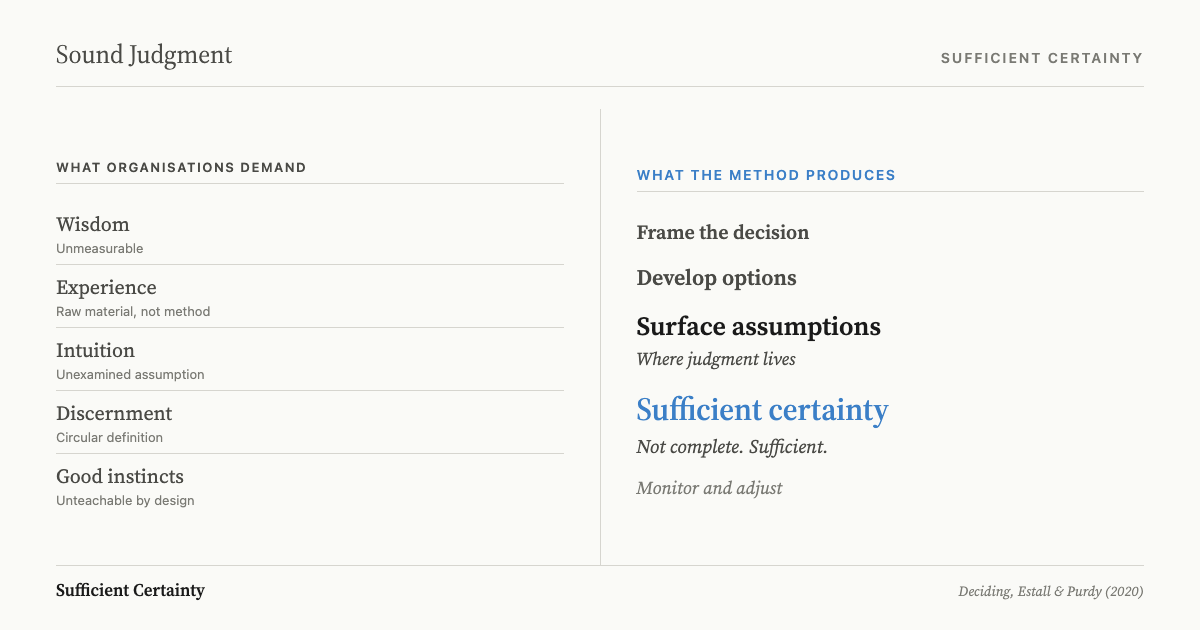
Roger Estall and I built the Universal Decision-Making Method to fill that silence. Sound judgment is the demonstrated capacity to surface the assumptions a decision rests on, test those assumptions against evidence, and act when you have sufficient certainty to proceed. It is a method, not a personality trait. It has nothing to do with intuition or native intelligence. We set it out in Deciding.
Sound judgement is the practice of bringing the assumption a choice rests on into the open and testing it against the evidence before you act.
What sound judgment actually means
The word appears in board charters and competency frameworks, but no governance document defines it operationally. If judgment is a trait, it cannot be taught. If it cannot be taught, organisations must hire for it — which requires assessing what they cannot define.
The method locates judgment in a process, not a person. The quality of your judgment and decision making depends on whether you surfaced the assumptions your decision rested on. That is testable and improvable. For the full operational definition, see what sound judgment actually is.
Why experienced leaders still make poor decisions
Pilots call it got-to-get-there-itis. A pilot with ten thousand hours of flight time decides to press on into deteriorating weather because the destination is close, the fuel is adequate, and the conditions have been worse before, probably. Each of those statements is an assumption. Not one has been tested against the conditions on this flight, on this day.
Got-to-get-there-itis kills experienced pilots, not beginners. The experience itself creates the problem. Ten thousand hours builds a library of situations where pressing on worked. That library becomes the basis for the next call, and the pilot does not recognise that "it worked last time" is an assumption about this time. Experience gives you data. It does not give you a method for questioning whether the data applies.
Boeing's engineers raised concerns about the 737 MAX's reliance on a single angle-of-attack sensor. The competitive frame, getting to market before Airbus, overrode the engineering concern. That was not a failure of data or intelligence. It was a failure of judgment: the assumption that competitive urgency justified the trade-off was never surfaced as an assumption and examined against its consequences. The real examples are always stories about the assumption nobody named.
The same pattern runs through every boardroom where a track record becomes the unexamined assumption on which the next decision rests. The leader who steered a business through three downturns assumes the fourth will respond to the same approach. The assumption is always the same: that the past predicts the future. Sometimes it does. Judgment is the practice of testing that assumption before you bet on it. Judgment in leadership is that capacity to examine what your experience is offering, not the confidence to act on it unexamined.
The assumption at the centre of every judgment
You cross the road every day. You do not think of it as a decision. But you unconsciously frame the decision (I need to get to the other side), develop your options (cross here, walk to the crossing, wait), assess your assumptions (the traffic is moving slowly enough, the driver has seen me), reach a level of certainty sufficient for you to act, and then you monitor (you keep watching as you cross).
That sequence is what Roger Estall and I formalised as the Universal Decision-Making Method in Deciding (Grant Purdy and Roger Estall, 2020). You already use it without naming it. Any decision, from crossing a street to approving a capital expenditure, rests on assumptions. The judgment is always about whether those assumptions are sound enough to act on.
The difficulty is not the method. The difficulty is that most decisions hide their assumptions. When a board approves a growth strategy, the assumptions are buried in the projections: market growth will continue, competitors will not respond for eighteen months, the team can deliver on schedule. Those assumptions are not labelled "assumptions." They are labelled "the base case" or "the plan." Nobody examines them because nobody has been asked to name them.
That is the gap between critical thinking and judgment. Critical thinking tells you to question assumptions in general. The method tells you how to surface the specific assumptions that a specific decision rests on, in a room with specific people, before you commit.
Put a method under the judgment call you are about to make and find out what it actually rests on. Start the Walk →
Five steps that produce sound judgment
The Universal Decision-Making Method, which Roger Estall and I developed, makes five steps explicit so they can be taught, practised, and assessed.
First, Frame the decision: name what you are actually deciding and why. The frame determines what gets considered and what gets excluded. A wrong frame produces a wrong judgment before any analysis begins. Then Develop options, genuine alternatives, not variations on a preferred choice. If you have only one option, you do not have a decision.
The third step is where judgment lives: Recognise assumptions. List what each option takes as given. An assumption that passes unexamined is a potential failure point. The greatest risk to any decision is the assumption you did not know you were making.
Fourth, ask whether you have Sufficient certainty to act given the consequences of being wrong. Not complete certainty, which never arrives. Sufficient certainty to proceed. Finally, Design monitoring: agree what you will watch after you commit. Assumptions do not become facts once the decision is made.
How to develop sound judgment in your team
Most organisations treat judgment as individual — the annual review says "demonstrates sound judgement" or it does not. That framing misses where judgment actually fails: in groups, when the structure of the conversation prevents assumptions from surfacing. Decision making for leaders begins with knowing who the Decider is.
Evidence from forecasting, aviation, and medicine shows that judgment can be learned when treated as practice. The path is structured repetition with a method, not talent identification. For the full development framework, see how to develop sound judgment on purpose.
When risk management replaces sound judgment
Enron Corporation had a risk committee. It had board-level oversight, external auditors, a compliance apparatus, and a chief risk officer. At the time of its collapse in 2001, Enron held $63.4 billion in assets. It was, at the time, the largest bankruptcy in American history.
All of it was in place. All of it was useless. Not because the systems were poorly designed, but because the systems had become a substitute for judgment. The risk committee approved transactions it did not understand. The board relied on assurances from management rather than examining the assumptions those assurances rested on. The auditors checked compliance with process rather than asking whether the process produced sound decisions.
This is what happens when risk management replaces judgment. The apparatus generates reports, matrices, and heat maps. People fill them in, circulate them, file them. I have sat in rooms where a board spent forty minutes discussing the colour coding of a risk matrix and zero minutes discussing the assumptions behind the three largest items on it. The organisational obligation is discharged. Nobody has made a judgment about anything. They have completed a process designed to produce judgments and produced paperwork instead.
I, Grant Purdy, spent twenty years inside that apparatus. I chaired risk committees, wrote standards, reviewed governance structures across four continents. The machinery works when someone in the room is willing to say: "What are we actually assuming here?" It fails the moment everyone treats the process as the judgment itself. Enron's board did not lack process. It lacked a single person who insisted on examining the assumptions the process was supposed to surface.
The method does not replace risk management. It replaces the part of risk management that was supposed to involve thinking. When you sit in a risk committee meeting and ask "what are we assuming here?", you are not undermining the process. You are doing what the process was supposed to do all along.
Sound judgment under pressure
On 27 March 1977, KLM Flight 4805 sat on the runway at Tenerife's Los Rodeos airport in dense fog. The KLM captain, one of the most senior and experienced pilots in the airline, initiated takeoff without clearance from air traffic control. His co-pilot and flight engineer voiced concerns. The captain overrode them. KLM 4805 collided with Pan Am Flight 1736 on the runway. Five hundred and eighty-three people died. It remains the deadliest aviation disaster in history.
The co-pilot and the flight engineer both had the data, and the captain had the authority to override them both. The assumption that went unexamined was his: that the runway ahead was clear. Under pressure, with delays mounting and duty-time limits approaching, the most experienced person in the cockpit acted on an assumption he never named.
Pressure does not remove the need for the method. It increases it. When you are under time pressure, you are more likely to act on the first assumption that feels right. In Tenerife, one step alone, Recognise assumptions, would have surfaced the one assumption that killed five hundred and eighty-three people: that the runway was clear.
Making decisions with uncertainty means maintaining a method when pressure tells you to skip it. The argument that structured methods slow decisions down is wrong. Surfacing assumptions before you commit is always faster than recovering from the consequences of an assumption that was wrong.
Aviation learned. Crew Resource Management training, which followed Tenerife, is a structured method for surfacing assumptions under pressure. It works because it treats judgment as a team practice, not a captain's prerogative. Any organisation can build that same discipline with far less tragedy as the catalyst.
You could say it feels right, and still hesitate when others ask why.
Work through your decisionNo sign-up. Just pick your decision and start.
Grant Purdy is the co-author, with Roger Estall, of Deciding (2020), and the architect of the Universal Decision-Making Method.