
How to develop sound judgment starts with one discipline: name what you are assuming, find out whether it is true, and only then decide. Your team already makes judgment calls. The difference between good and poor judgment is whether the assumption was tested before anyone committed.
A plant manager brief I saw recently asked for 15 years' experience and "sound judgment". The document ran to four pages. The competency table had 11 rows. The line on judgment got six words. If you want to know how to develop sound judgment, start with that omission. That is how organisations turn a skill into a personality test.
Sound judgment is the practice of exposing the assumption a decision rests on and testing it before you commit. That is what the Universal Decision-Making Method exists to do. O*NET can list Judgment and Decision Making across 894 occupations because a labour database does not have to teach anybody how to do it. Organisations borrow the label from places like the U.S. Department of Labor's O*NET database and paste it into role descriptions, while leaving the difficult part blank. It is a lovely arrangement for hiring panels, because they get to praise the word and never say what the job is actually asking for.
People sometimes ask why I sound rude about "sound judgment" as a competency. I sound rude because I have sat through too many board packs where senior people arrived with deep CVs and thick briefing packs, yet still could not say what their preferred answer was assuming. Roger Estall and I put the Pocket Card into Deciding for exactly that reason, and the wider argument sits inside our work on sound judgment.
Developing sound judgment means repeating a simple discipline: name what you are assuming, find out whether it is true, and only then decide.
Why experience does not teach you how to develop sound judgment
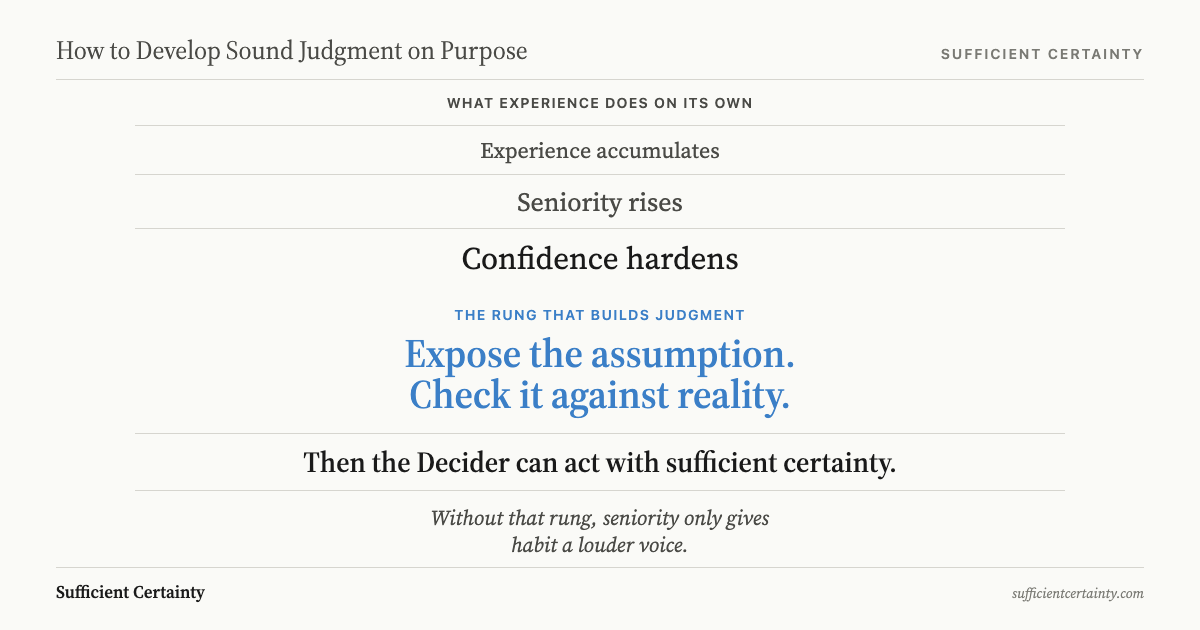
Years in the chair do not teach judgment on their own. They teach habits, and habits harden whether they deserve to or not. K. Anders Ericsson's 1993 work on deliberate practice separated the best performers from the merely good by structured practice with clear goals and feedback. The point applies in surgery, and it applies to Deciders.
I have watched senior people get very quick at turning a live bet into a stack of respectable attachments. Speed does not rescue them. If you want to know how to develop sound judgment, attach experience to a discipline that drags the assumption into daylight and then checks what reality did with it.
Take the call in front of you through the five steps and build judgment around feedback instead of confidence. Start the Walk →
The Pocket Card is how to develop sound judgment in practice
Roger and I built the Pocket Card for live decisions. People do not need another manual when the room is already full of paper. They need a small interruption just before confidence outruns thought. When people wave my name back at me and say the Pocket Card is too blunt for governance, I take it as confirmation.
In practice the card forces a room to do two things most governance systems somehow avoid. It has to put the decision into one sentence, and it has to expose the assumption carrying the preferred answer. Sufficient certainty sits in the middle of that work. You ask whether you know enough to act for this Purpose, which matters most in decisions made under uncertainty, then you write the signal that reopens the call later, before the room disappears into implementation theatre.
When I say practise, I mean one live decision, not an offsite with coloured markers. Classroom confidence usually vanishes when a live consequence walks into the room. Put the real choice through that discipline while the consequences still matter. That is how judgment gets built without pretending a workshop certificate changed anybody. The same logic applies when someone asks how to develop strategic thinking.
How to develop sound judgment in a team
Teams develop judgment when challenge is structured and usable. Tenerife made the price hideous. After 583 people died in 1977, the Federal Aviation Administration's crew resource management guidance turned the lesson into training: contrary information has to survive rank long enough to matter.
I have seen softer versions of the same failure in boardrooms. The senior person speaks early, the room tidies its doubts, and the preferred answer glides out carrying one untested assumption. If you want to know how to develop sound judgment in a team, protect the person who questions the favourite answer. Leaders who worship decisiveness often discover too late that speed and judgment were never the same thing.
I separate the Decider from the rest of the room for a simple reason. Advice is cheap when someone else carries the loss. The room can advise all day; the person exposed when it goes wrong should hold the casting vote.
The proof is in the feedback, not the confidence
Judgment improves when the person making the call gets forced back into contact with the result. That is why the Good Judgment Project matters. In the paper by Mellers and colleagues, training and tracking improved forecasting accuracy because judgments were scored against outcomes and then revised. Confidence teaches very little unless it gets scored against what happened.
Most organisations prefer judgment to stay flattering and vague. HR competency writers and training vendors do well out of that fog, along with the internal reviewers paid to certify it, which is a pleasant little racket because nobody can prove them wrong. The most respectable product in that fog is the critical thinking course. Roger and I put Design monitoring into the Pocket Card to break the spell. If demand is carrying the decision, say what demand number reopens it. If supplier reliability is carrying it, say when delay changes the call.
Medicine offers the same embarrassment. The National Academies' Improving Diagnosis in Health Care report said about 5 percent of U.S. adults seeking outpatient care each year experience a diagnostic error. The report is polite about it. Reality is less polite. Experienced clinicians still stop too early, and follow-up on whether the first judgment deserved confidence remains part of the job, however inconvenient that is for heroic-profession folklore.
The practical answer to how to develop sound judgment is duller than people want and harsher than most systems will tolerate. Use the method on live decisions and write the trigger before the room congratulates itself. Otherwise "sound judgment" stays where most organisations like it, in a job description polished just enough to spare everyone the trouble of explaining it.
You could praise sound judgment and never test the assumption beneath your next decision.
Work through your decisionNo sign-up. Just pick your decision and start.
Grant Purdy is the co-author, with Roger Estall, of Deciding (2020), and the architect of the Universal Decision-Making Method.