
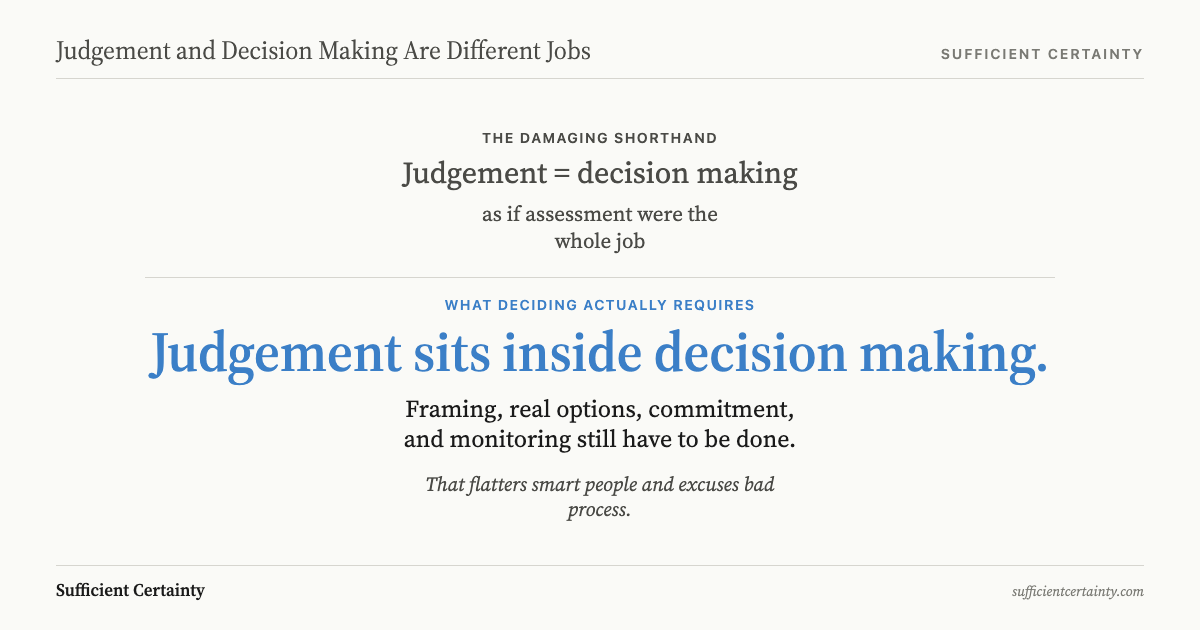
Judgement and decision making are not the same job. Judgement is the quality of the assessments inside a choice. Decision making is the whole process of framing, testing, committing, and watching what follows. Confusing them lets a room call paperwork a decision.
A chairman once handed me a 38-page decision paper and a nine-box risk matrix. He said the board had done the judgement and decision making, and all that remained was approval. That sentence told me the room was in trouble.
Even the field that studies the subject keeps the two separate, from the journal Judgment and Decision Making to the 2020 review by Baruch Fischhoff and Stephen Broomell. In the Universal Decision-Making Method, that distinction is structural.
I care about the distinction because once a room treats judgement as a personal virtue, process gets excused. The cleverest person becomes the substitute for method. Then the paper can stay foggy, the options can stay thin, and the assumption doing the real work never has to show its face. That flatters senior people, which is one reason the confusion survives.
In my experience, the blur survives for another reason as well: it is useful after the event. A project overruns, a merger disappoints, a closure backfires, and the report says management exercised judgment on the information available. Perhaps. The sharper question is why the decision arrived with one decorative option, a page of assumptions nobody believed, and no written condition for reconsidering it. Calling that "judgment" is a dodge.
Judgement and decision making combine when the process sets the steps and judgement sets the standard of evidence each step must meet before the decision moves forward.
Why judgement and decision making get blurred
People blur the terms because the blur pays. "We used our judgment" sounds weighty. "We never framed the decision properly and nobody owned the consequence" sounds like malpractice. I have heard boards use the first sentence as a shield after the fact. Once judgment becomes a badge, the meeting stops asking whether the job was done properly.
Fischhoff and Broomell are helpful precisely because they are so dry. They distinguish judgment from preference and choice, which is the academic way of saying decision making is larger than your forecast about what happens next. That ought to have finished the argument, but tidy distinctions do not earn much once a process industry has a template to protect.
The same split runs through Hastie and Dawes and through Jonathan Baron. They separate the search for options from the inferences made about them, and both from the eventual choice. Executives keep the language vague because vague language lets a weak paper arrive dressed as prudence.
I have read more board evaluations than I care to remember. Many praise "judgment" several times and never say what decision the paper was supposed to serve. When that happens, the room is complimenting its own posture while the actual choice slips out the side door. Nobody defines sound judgment in leadership as anything a paper could fail.
Trace your current approval through the five steps and separate the judgment call from the process wrapping around it. Start the Walk →
Where judgment actually sits
Judgement sits in the middle of the work, not above it like holy water flicked by the most senior person in the room. It helps you estimate what each option rests on and which assumption is quietly carrying the answer people already want. In my experience, that is the point where a serious room becomes useful and a vain room becomes theatrical.
Judgment does useful work only when it has something concrete to bite on. Give it two real options and an exposed assumption, and it can tell you where the strain is. Give it one pre-cooked recommendation wrapped in board prose, and it becomes a ceremonial nod from senior people who were never offered a real choice.
The distinction between analysis and commitment matters here. In problem solving and decision making, I make the same point more directly: explanation can be solid and the decision can still be unmanaged.
This is why the risk matrix has had such a long and undeserved career. It lets people score a view before anyone has named the decision or the Decider. I have sat through sessions where adults argued over amber versus red for twenty minutes and no one asked who would carry the consequence. The gap between decision science and data science starts right there. That is clerical theatre, and it has been a nice little earner for the people selling the theatre tickets.
Why good judgment still produces bad decisions
Herbert Simon punctured the executive fantasy back in 1955. In "A Behavioral Model of Rational Choice" he showed that people do not inspect every possible option and optimise neatly. They search under limits, stop when something seems satisfactory, and move on. Real decisions arrive late, incomplete, and under pressure. So when a senior executive claims to have "used judgment," I want to know how wide the search was before the room fell in love with the first respectable answer.
Search is the part most organisations skimp on because search is awkward. A second serious option delays approval. A named assumption invites challenge. A written trigger for review makes the original authors accountable later. Much easier to call the paper balanced and move on, especially when the room is hungry and the chairman wants the item cleared before lunch.
I have seen executives make a sensible forecast about one option because nobody forced a second serious option onto the table. I have seen others accept a reasonable forecast because nobody wrote the condition that would force the decision back onto the table when reality changed. That is the practical difference between judgement and decision making: the judgment may have been decent, but the decision making was poor.
This is where a great deal of advice on rational decision making goes soft. It treats failure as if people mainly need to think harder. In my experience, they usually need a better search and a plainer statement of what the preferred answer depends on, followed by a written way of checking whether reality has humiliated the paper.
Putting judgement and decision making back in the right order
The fix is never smarter people. It is a discipline that does what the room will not do on its own: say what the decision actually is before anyone starts analysing, and say what would have to change before anyone walks away satisfied. This is why Roger Estall and I wrote Deciding: forty years of watching organisations skip that discipline wore through our patience. Judgement and decision making are not the same job. Judgment tests what a choice rests on. Deciding, the wider work behind sound judgment, owns everything either side of that test.
You could approve the paper and never notice judgment disappeared behind the process.
Work through your decisionNo sign-up. Just pick your decision and start.
Grant Purdy is the co-author, with Roger Estall, of Deciding (2020), and the architect of the Universal Decision-Making Method.