
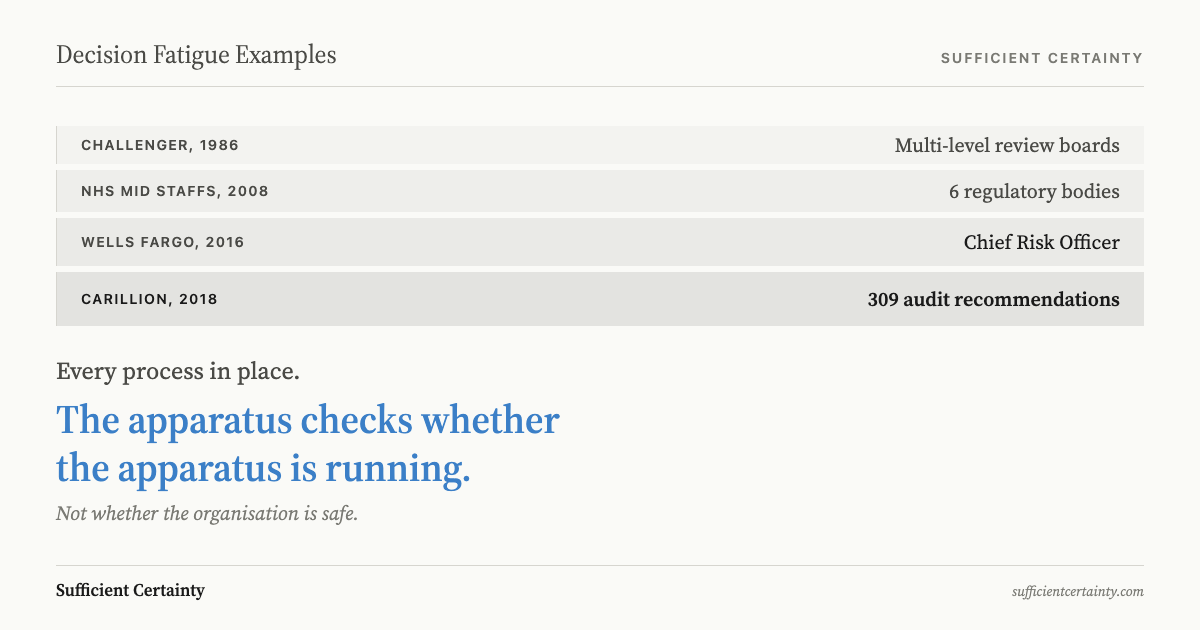
Decision fatigue examples that matter are not about choosing lunch after a long meeting. They are organisations where governance was fully in place and still could not produce a decision. NASA, NHS Mid Staffs, Carillion, and Wells Fargo all had working oversight systems. The oversight itself was the source of delay.
The most instructive decision fatigue examples I know do not involve tired judges or presidential wardrobes. They involve NASA, the National Health Service, a FTSE 250 construction company, and the third-largest bank in the United States. Each had more governance than most organisations dream of. Each failed catastrophically. Not despite the apparatus. Because the apparatus replaced the actual decision with the appearance of having made one.
Decision fatigue examples at organisational scale share one cause. The fatigue is not produced by too many choices. It is produced by an apparatus that generates sign-offs, ratings, and compliance records in place of the one thing the Decider actually needs: a statement of what the decision rests on. The Universal Decision-Making Method starts there: name what you are assuming, test your confidence, decide.
Decision fatigue examples are cases in which review burdens or repeated approval demands visibly erode judgment and commitment.
Challenger: the reviews that filtered out the question
NASA operated a multi-level Flight Readiness Review process. Engineering data moved upward through panels, each level certifying readiness before passing to the next. On the night of 27 January 1986, engineers at Morton Thiokol presented data showing O-ring seals degraded in cold temperatures and recommended against launching Challenger the following morning. NASA's shuttle program manager responded: "My God, Thiokol, when do you want me to launch, next April?" A Thiokol senior vice president told the vice president of engineering to "take off your engineering hat and put on your management hat." The engineering VP reversed his position.
The launch proceeded at 36°F. Seventy-three seconds later, seven crew members died.
The governance apparatus had not been absent. It had been running for every prior flight. O-ring anomalies had been documented on previous missions and progressively normalised. Diane Vaughan, who studied the disaster for a decade, coined the term "normalisation of deviance": each successful flight with a known defect shifted the baseline until the defect became accepted procedure. I have seen this compression work the same way in boardrooms. The engineer raises the inconvenient question; the senior manager reframes it as a scheduling problem. The apparatus does not resolve disagreements. It ranks them by seniority. The process exhausted everyone who needed to decide, and the one question that mattered, will these seals hold at this temperature, was never asked in the review that approved the launch.
Mid Staffordshire: the apparatus that celebrated itself
Of the decision fatigue examples in public-sector governance, Mid Staffordshire is the most damning. Between 2005 and 2008, between 400 and 1,200 more patients died at Stafford Hospital than expected mortality models predicted. Patients were left in their own urine. Basic nutrition was not provided. Systematic failures of the most elementary care persisted for years.
Throughout this period, the Trust was subject to oversight by Monitor, the Healthcare Commission, the NHS Litigation Authority, local strategic health authorities, and local scrutiny committees. On 1 February 2008, in the middle of the worst care period, Monitor assessed the Trust as meeting its criteria and awarded it Foundation Trust status. The regulator gave the hospital a gold star while patients starved. I have seen this pattern across every sector I have worked in: the apparatus does not check whether the organisation is safe; it checks whether the apparatus is running. Six regulatory bodies had all been inspecting their own outputs. None had checked the thing that mattered: whether patients were receiving adequate care.
The Francis Report, published in 2013, issued 290 recommendations. The chief executive resigned with over £400,000 in severance and a £1 million pension. The Health Secretary acknowledged that protecting the reputation of the NHS "had become more important" than patient safety.
Put your over-governed decision through the five steps and see which approval chain is filtering out the real question. Start the Walk →
Carillion: 309 recommendations, one question never asked
Carillion had 40,000 employees, more than 450 public contracts, and every edifice prescribed by modern governance codes. A board with non-executive directors. An audit committee. A risk committee. Deloitte as internal auditor, averaging £775,000 per year since 2010. KPMG as external auditor for nineteen years. When the company went into compulsory liquidation on 15 January 2018, it had £29 million in cash against debts exceeding £1 billion.
Between 2012 and 2016, Deloitte issued 309 internal audit recommendations. Fifteen were rated high priority. Across 61 internal audit reports in 2015 and 2016, exactly one found inadequate controls. The parliamentary inquiry that followed described a "rotten corporate culture." It found Deloitte "unable or unwilling" to identify terminal failings. KPMG's audit tenure was described as "long and complacent" and the audits themselves as "cursory." The people paid to ask questions had every reason not to find the answers: Deloitte's engagement ran to seven figures across the decade, and an auditor who discovers a terminal problem ends its own contract. Not a virtuous circle, but certainly a lucrative one. In Deciding, Roger Estall and I argued that the practical task of filling out a risk register distracts Deciders from achieving sufficient certainty. Carillion is the corporate proof: hundreds of board papers, compliance checklists, none stating whether the company's contracts would deliver the revenue they claimed.
Wells Fargo: the risk officer who suppressed the risk
Between 2011 and 2016, Wells Fargo employees opened over 3.5 million fake deposit accounts and applied for more than 565,000 credit cards without customer authorisation. The bank had a Chief Risk Officer, a dedicated group risk officer for its community banking division, compliance departments, enterprise risk management frameworks, and board-level risk oversight. All required by federal regulators.
The group risk officer, specifically tasked with managing sales-practice risk, "repeatedly downplayed" the misconduct and "provided false, incomplete or misleading information" to regulators during 2015 examinations. She was later banned from the banking industry for life and fined $10 million. This is not an irony. It is a structural outcome: the apparatus creates positions whose occupants advance by keeping things quiet. A risk officer who surfaces a systemic fraud problem is, in career terms, firing herself. Wells Fargo paid $3 billion to settle civil and criminal probes. Over 5,300 employees were fired. The Federal Reserve imposed an asset cap that remained in force years later. Roger Estall and I built the method starting from Purpose: state what the organisation exists to achieve. Wells Fargo's stated purpose and its incentive structure pointed in opposite directions. No amount of apparatus reconciled them because the apparatus never asked.
What these decision fatigue examples reveal
These cases span aerospace, healthcare, construction, and banking, across four decades. The common element is not incompetence. It is an apparatus that generates activity which substitutes for deciding: reviews, sign-offs, ratings, audit recommendations, compliance reports. Each item looks like governance. Collectively, they produce everything except the one thing that would have reduced the fatigue: a clear question and a basis for answering it.
That is decision fatigue at organisational scale: a surplus of process that never reaches the decision.
You could call it tiredness and miss the approvals breaking your next call.
Work through your decisionNo sign-up. Just pick your decision and start.
Grant Purdy is the co-author, with Roger Estall, of Deciding (2020), and the architect of the Universal Decision-Making Method.