
Executive decision fatigue is not caused by too many decisions. It is caused by too many processes that never reach a decision. When every meeting produces a report and none produces a recorded commitment, the executive drowns in preparation and starves for closure.
A director I worked with some years ago described his preparation for a quarterly board meeting. He had received a 34-page enterprise risk report, a compliance summary with 19 action items, and minutes from two sub-committee meetings he had not attended. He had read all of it. He could not tell me what decision the board was being asked to make. That is executive decision fatigue, and it has nothing to do with too many choices.
That director was not incompetent. He was diligent. Executive decision fatigue is what happens when the governance apparatus around senior decisions consumes every hour available and leaves nothing for the actual work of deciding. That was his problem. It was not a lack of energy or too few hours in the day, but too much apparatus between him and the decision.
Executive decision fatigue is the strain that accumulates when senior judgment is buried under repeated review, reporting, and unresolved escalation.
What causes executive decision fatigue
The popular account of decision fatigue says executives are worn down by the sheer volume of choices they face. Eliminate trivial decisions, the advice goes, and you will have more energy for the important ones. This is wrong. When a board spends six months unable to close on a restructure, the delay has nothing to do with what anyone ate for breakfast. It has everything to do with a process that produces reports and committee papers without ever naming the assumptions that actually matter.
I have spent nearly fifty years watching this pattern across mining, finance, aviation, and public health. The organisations whose executives complained most about being overwhelmed were not the ones making the most decisions. They were the ones with the most elaborate governance machinery. Risk committees, quarterly risk reports, compliance frameworks layered on top of compliance frameworks. Collectively, it buries the executive under process that was never designed to help anyone decide anything.
The risk register is a case in point. These documents have taken on a life of their own. Organisations generate far too many columns of information, most of which nobody uses. I have watched directors wade through fifty-row registers trying to work out what any of it means for the decision in front of them. The register was created at a point in time. Few if any registers record the context in which entries were made, context that will change and invalidate the original reasoning. The practical task of filling out those columns compounds the fatigue, distracting the people who actually need to decide from the question that matters: do I have enough confidence to proceed?
Cut one overloaded executive call down to the real decision in the five steps and drop the apparatus around it. Start the Walk →
How the apparatus sustains itself
The apparatus persists not because it works but because the executive is the only person in the chain who bears the cost of it failing. People on the board who believe governance is the product assume, without compelling evidence, that more process means better outcomes. Consultants and in-house specialists sell their particular scheme as the key to organisational success. Standards bodies codify beliefs into published codes, so it looks rigorous. Regulators impose compliance obligations that send organisations back to the first three groups for guidance.
Not one of these actors sits beside the executive who needs to commit to a course of action by Friday. The executive receives the output of all that activity and is expected to turn it into a decision. The output was never written to help anyone decide. It was designed to demonstrate that uncertainty had been “considered.” Consideration and decision-making are different activities.
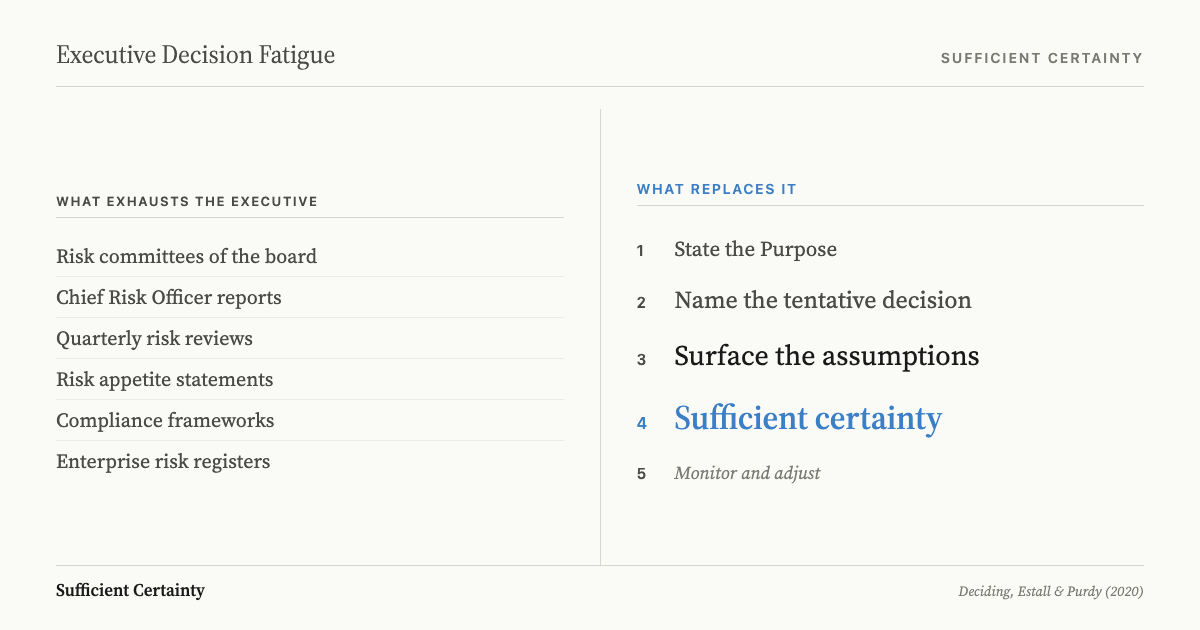
Executive decision fatigue in practice
Take Fairfax. A respected family company publishing two of Australia’s most prestigious broadsheets, sustained for decades by classified advertising revenue so reliable the industry called it the “rivers of gold.” The executives who inherited this business model operated on an assumption that nobody had ever written down: that classified revenue would remain stable. No board paper surfaced it. No risk register named it. No governance committee tested it. When online advertising platforms invalidated that assumption entirely, nobody left in the building could explain why they had believed it. Last-minute diversification and ultimately sale of the company prevented outright failure, but at vastly degraded value. The ‘risk management’ apparatus was present throughout. It produced reports on dozens of lesser concerns while the one assumption that determined the company’s survival sat unnamed and unmonitored.
A statutory public safety organisation that I chaired showed the same thing in reverse. The governing legislation specified that one function was to be the agency’s “prime consideration.” The organisation was spending 0.03% of its budget on it. The paperwork arrived on schedule. None of it connected the budget allocation to the organisation’s legislated purpose. When we named the assumptions behind that allocation, the critical one, that existing controls were effective, turned out to be completely unsupported. We raised the allocation to 0.5%. Loss of life fell 60% within two years. The apparatus had been fully assembled for years. It had not asked the one question that mattered: are we spending our money on the thing we exist to do?
What replaces the apparatus
Roger Estall and I built the Universal Decision-Making Method because we kept seeing this failure. It does not add another layer of governance. It replaces the layers with five steps: state the purpose, name the tentative decision, name the assumptions, test for sufficient certainty, and build monitoring in before the decision leaves the desk.
Sufficient certainty is the target. Not maximum certainty. Maximum certainty is what the apparatus pursues, and the pursuit is what exhausts executives. One more committee review, one more round of consultation. Each feels responsible. Each delays the decision and wastes time that should go to the decision itself. Sufficient certainty asks a different question: for each assumption that matters, do I have enough confidence to proceed, given what is at stake? When the answer is yes, the executive decides. When it is no, the executive adjusts the decision or investigates the specific assumption that is lacking, not everything that might go wrong.
In Sydney in 2017, newly built apartment buildings developed alarming structural cracks despite having been signed off by independent certifiers. The governance apparatus was fully assembled: regulation and certification. It rested on two assumptions nobody had tested: that the regulation covered functional usability, and that outsourced certifiers possessed the technical competence to validate what they were certifying. Neither assumption held. Occupants were evacuated. Owners faced massive remediation costs. An executive who had spent ten minutes naming the two assumptions the certification rested on would have done more useful work than the entire compliance apparatus produced. That is not an exaggeration. Roger Estall and I have seen it consistently across nearly fifty years.
The executive who decides well
The executives who make the best decisions are not the ones with the thinnest committee packs. They are the ones who walk into the room knowing what assumption they are resting on and how confident they are that it will hold. They have stated the purpose. Named a tentative course of action. Named the five or six assumptions that drive the outcome. Decided which ones they are confident about and which ones they are not. That work takes less time than reading a single consultant report. It gives the board something concrete to question and test.
The decision fatigue those executives avoid is not the fatigue of deciding. It is the fatigue of processing governance theatre before getting to the decision. Strip the theatre away and the decision is what it always was: state what you are trying to achieve, name what you are resting on, determine whether it is enough, and act. That executive spends less time on apparatus and more on the one thing it was supposed to serve.
You could read every pack tonight and still miss the actual decision tomorrow.
Work through your decisionNo sign-up. Just pick your decision and start.
Grant Purdy is the co-author, with Roger Estall, of Deciding (2020).