
Decision making models are not one thing, and using the wrong type is how teams run a perfectly good model and still let the decision drift. A comparison tool cannot govern. A governance chart cannot forecast. Matching the model to the job is the step most frameworks skip.
A chief executive I worked with had a housing forecast on one screen and a governance chart on the other. The strategy team had dropped a decision tree into the board pack the night before. The paper was 28 pages long, the capital request had to be settled by Friday, and she asked me which of these decision making models was supposed to make the call. The honest answer was awkward: none of them could.
I am not anti-model. Roger Estall and I wrote about them in Deciding because we had seen this trick before. I am anti-idolatry. Give a model a diagram and a respectable sponsor, and half the room starts behaving as if the human judgement has been safely handed to machinery, which feels marvellous right up to the invoice from reality.
Decision making models are structured tools that organise different kinds of choices, such as comparison, prediction, sequencing, or governance.
What people mean by decision making models
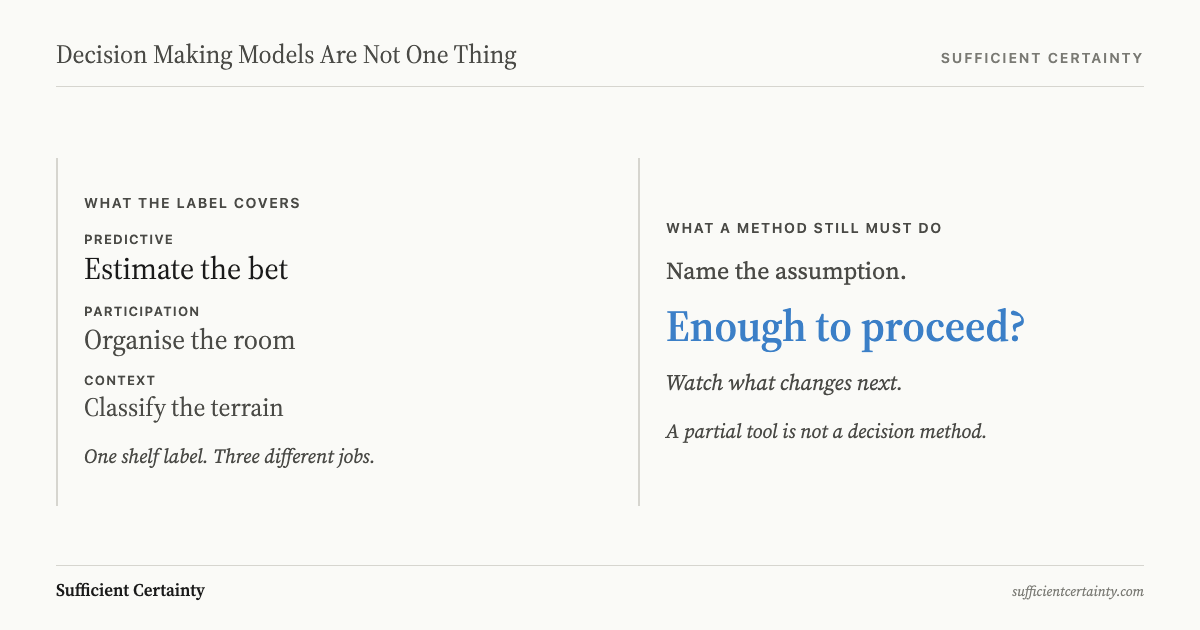
When a live decision goes upstairs, people ask for decision making models because they want the uncertainty shaved down before somebody owns the call. The mistake comes a minute later. One model prices, a five forces model maps competitive pressure, and another sorts who belongs in the room. No model in that shelf tells you when the context has turned strange. Call the whole shelf a method and you have already lied to yourself. If you want the narrower case against letting arithmetic pose as judgement, I set that out in decision model.
Predictive models fail when scale hides the bet
Zillow Offers is useful because the numbers were big enough to kill the romance. In its 2021 results, Zillow reported about $6.0 billion in Homes revenue and a Homes segment loss before income taxes of about $881.5 million. The pricing system kept producing answers, which was convenient for executives and board members who preferred a neat printout to the uglier judgement about when to stop buying houses, especially with a board pack to hide behind.
What failed was not mathematics in the abstract. It was the unspoken bet underneath the output: demand would stay strong and resale prices would keep rescuing the buying pace. Renovation speed sat behind that too. A predictive model can rank houses or estimate margins. It cannot tell a Decider how much of the business should lean on that bet. If nobody writes down what must stay true for the output to remain worth trusting, scale just helps the mistake eat faster.
Choose the model guiding your live decision, then check whether it fits the bet, the context, and revision. Start the Walk →
Recognition-primed models depend on earned experience
Fireground commanders do not hold a little options workshop in the smoke. They recognise a pattern. They imagine the first workable move failing, then act. Gary Klein's study of fireground commanders mattered because it described people with scar tissue, not seminar notes.
I trust that logic in the street more than I trust it in a board pack. Experience earned in a hundred fires is not the same as confidence borrowed from last quarter's offsite. In companies, people mimic the posture of rapid judgement long before they have earned the right to it. In my experience, the missing beliefs do not disappear; they just sink below the table while everyone applauds the speed.
Participation and context models answer earlier questions
Managers are desperate for a rule about consultation, which is why Victor Vroom and Arthur Jago could report that well over 100,000 managers had been trained on their participation model. I understand the demand. I have seen rooms wrecked because nobody knew who should speak. I have also seen them wrecked because the boss spoke first and everyone else began decorating the answer.
Cynefin, set out in Harvard Business Review, helps when the real problem is that the room is misreading the terrain. Sometimes the old playbook is safe. Sometimes it is the danger. Cynefin helps with that call. It still cannot tell me what belief this option is resting on, or what would make me reopen it. A room can have neat authority and the right Decider, and still march into a bad decision with excellent manners.
The best decision making models expect revision
I trust the New Zealand coastal hazards strategy for Clifton to Tangoio because it expects to be wrong later and plans for that fact up front. The case study spans a century, three councils, and an estimated bill of roughly NZ$130 million to NZ$285 million. What interests me is not the size. It is the refusal to pretend today's answer can stay right for the next hundred years.
That humility is rarer than it should be. The same case study says the current system was not built to respond dynamically to changing information in the way the approach requires. Of course it was not. Agencies, committees, and consultants usually prefer a fixed story to a live trigger that might humiliate last quarter's answer. Somebody still has to decide what signal matters next and who is watching for it, which is the work I treat separately in monitoring. Without that, even an adaptive model hardens into a respectable tale told over moving ground.
Roger Estall and I built the Universal Decision-Making Method because we were tired of watching outputs finish arguments. I use it to keep the model in its place. That means I Frame the decision and Recognise assumptions before the output gets treated as fact; Sufficient certainty and Design monitoring are settled in the same judgement, not bolted on after the model has impressed everyone.
The wider decision-making frameworks map matters only if it keeps that hierarchy clear. My own rule is simpler: let the model sharpen one part of the decision, never let it become the alibi. A model is a hired hand. The moment it starts running the household, the Decider has abdicated and the bureaucracy has found a new pet.
You could open your next board pack and still treat every decision model as interchangeable.
Work through your decisionNo sign-up. Just pick your decision and start.
Grant Purdy is the co-author, with Roger Estall, of Deciding (2020), and the architect of the Universal Decision-Making Method.